CONSERVATION INTERNATIONAL FOUNDATION
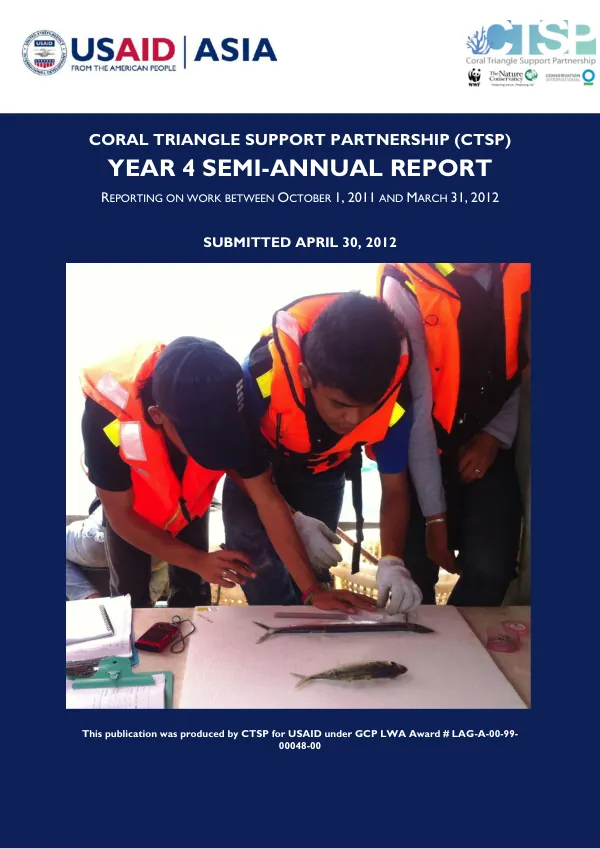
Coral Triangle Support Partnership (CTSP) Year 3 Semi-Annual Report
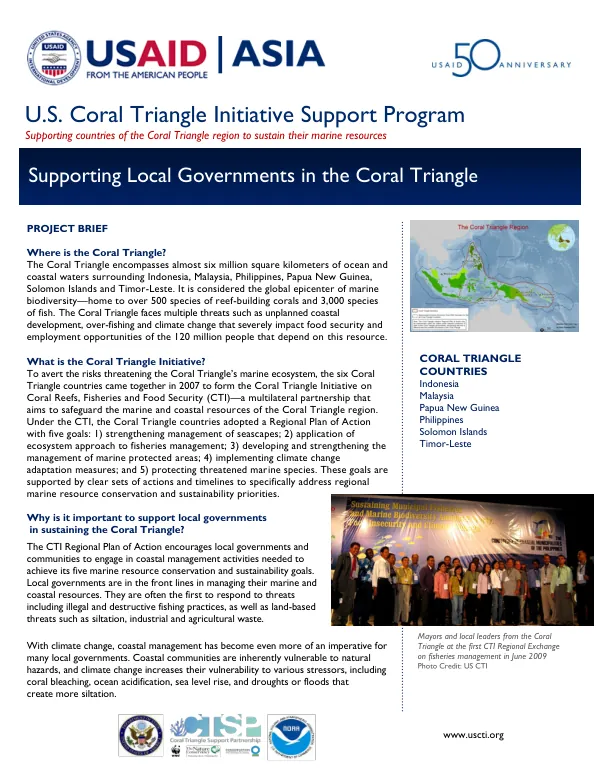
The Coral Triangle Support Partnership (CTSP) is a USAID-funded project aimed at conserving and sustainably managing the marine resources of the Coral Triangle region.
2011 · 108 pages
Sign in to readA free account is required to download.
Abstract
The region comprises six countries: Indonesia, Malaysia, Papua New Guinea, the Philippines, Solomon Islands, and Timor-Leste. The CTSP project is a collaborative effort between World Wildlife Fund, Conservation International, and The Nature Conservancy. The project's goal is to improve the health and resilience of the Coral Triangle's marine ecosystems, while also enhancing the livelihoods of local communities. To achieve this goal, the CTSP project focuses on several key areas, including the development of effective marine protected areas, the promotion of sustainable fishing practices, and the enhancement of community-based resource management. In the third year of the project, significant progress was made in the region. At the regional level, the CTSP project supported the development of a regional marine protected area network, which aims to protect 20% of the Coral Triangle's marine habitats by 2020. The project also facilitated the establishment of a regional fisheries management plan, which aims to reduce overfishing and promote sustainable fishing practices. At the national level, the CTSP project made significant progress in several countries. In Indonesia, the project supported the development of a national marine protected area plan, which aims to protect 10% of the country's marine habitats by 2020. The project also facilitated the establishment of a national fisheries management plan, which aims to reduce overfishing and promote sustainable fishing practices. In Malaysia, the CTSP project supported the development of a national marine protected area plan, which aims to protect 5% of the country's marine habitats by 2020. The project also facilitated the establishment of a national fisheries management plan, which aims to reduce overfishing and promote sustainable fishing practices. The CTSP project also made significant progress in the area of community-based resource management. In several countries, the project supported the development of community-based marine protected areas, which aim to protect marine habitats and promote sustainable fishing practices. Overall, the CTSP project has made significant progress in the Coral Triangle region, and has helped to improve the health and resilience of the region's marine ecosystems. The project has also enhanced the livelihoods of local communities, and has promoted sustainable fishing practices and community-based resource management. The project's success can be attributed to the collaborative efforts of the CTSP partners, as well as the support of the regional governments and local communities. The project's progress has been monitored and evaluated through a performance monitoring plan, which aims to track the project's progress and identify areas for improvement. Despite the progress made, the CTSP project still faces several challenges, including the need to strengthen the capacity of local governments and communities to manage marine resources sustainably. The project also faces challenges related to the enforcement of marine protected areas and the promotion of sustainable fishing practices. To address these challenges, the CTSP project has developed a plan to strengthen the capacity of local governments and communities to manage marine resources sustainably. The project also plans to continue to support the development of marine protected areas and the promotion of sustainable fishing practices. Overall, the CTSP project has made significant progress in the Coral Triangle region, and has helped to improve the health and resilience of the region's marine ecosystems. The project's success has been attributed to the collaborative efforts of the CTSP partners, as well as the support of the regional governments and local communities.
Related documents