USAID DEC
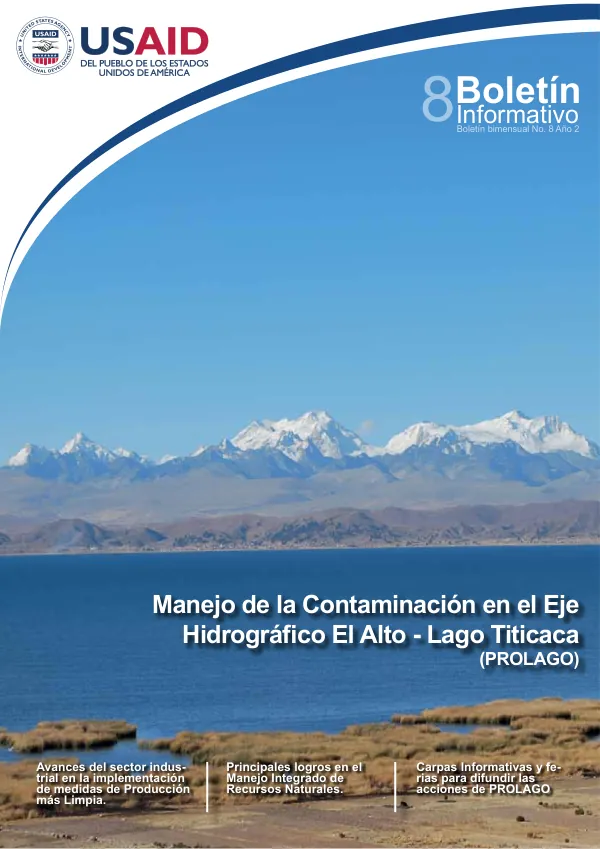
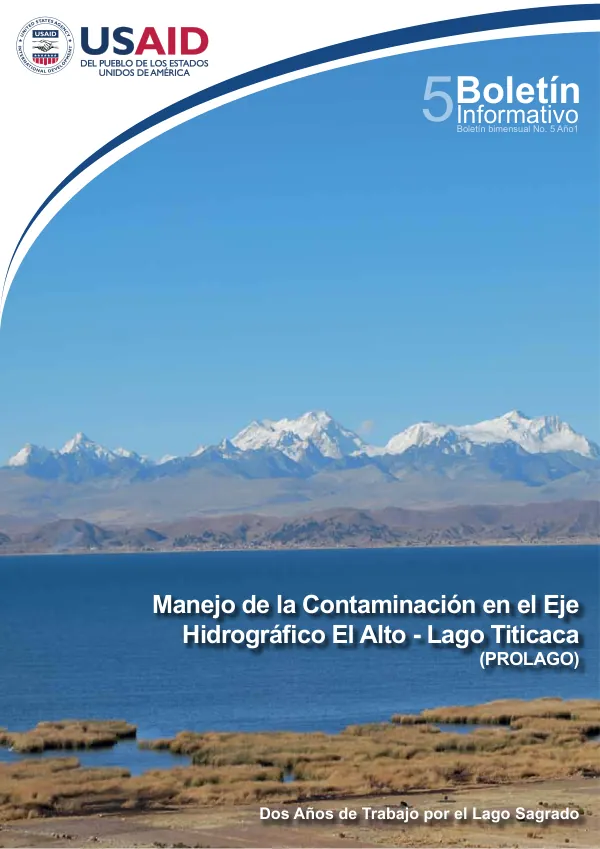
Boletín Informativo del Proyecto Manejo de la Contaminación en el Eje Hidrográfico El Alto - Lago Titicaca (PROLAGO)
Sign inUSAID DEC
Boletín Informativo del Proyecto Manejo de la Contaminación en el Eje Hidrográfico El Alto - Lago Titicaca (PROLAGO)
The PROLAGO project, a joint initiative between the governments of the United States and Bolivia, was established in September 2008 to address the issue of contamination in the El Alto - Lago Titicaca watershed.
2011 · 13 pages
Sign in to readA free account is required to download.
Abstract
The project's primary objective is to contribute to the improvement of environmental health and, consequently, the health of the population and biodiversity living in the area. The project began by analyzing the challenges associated with addressing this issue. Interestingly, the urban population of the Bolivian altiplano is well aware of the problem, but often seeks to shift the blame to others rather than finding a solution. In contrast, rural residents blame the urban population and industries for the problem, without considering their own role in contributing to the issue. Both sectors agree that authorities are responsible for the solution, but they are not very collaborative in understanding the need to contribute to the costs of the service. In response to this situation, the PROLAGO project, with the support of municipal governments, has implemented joint interventions that contribute to demonstrating the need and viability of cleaning activities. This activity is carried out with the support of citizen participation from all sectors in urban areas. In a collaborative effort, work is being done to clean neighborhoods, close dumping sites, establish sanitary landfills that meet technical specifications, and define systems that ensure that the cleanliness and environmental quality of municipalities depend on a joint effort between governments, industry, and citizens. In the rural area, PROLAGO demonstrates to producers that what they consider waste or a useless item, such as animal dung, actually has energetic value and can also be transformed into organic fertilizer (humus) of great commercial value and can be applied to their own crops. Additionally, if they have an appropriate conduct and a suitable waste collection system, they can dispose of waste properly without great effort and beautify their community without more effort than not polluting. The PROLAGO project, with the resources provided by USAID, aims to contribute to the improvement of environmental quality by reducing the risks to environmental health and biodiversity in the 19 communities of the two municipalities where it operates. Carlos Rivas, Director of the PROLAGO project, emphasizes the importance of addressing the issue of contamination in the El Alto - Lago Titicaca watershed. The PROLAGO project has made significant progress in addressing the issue of contamination in the El Alto - Lago Titicaca watershed. One of the key achievements of the project is the closure and restoration of the Santa Bárbara dumping site, which was a major source of pollution in the area. The project has also implemented a campaign to raise awareness about the importance of proper waste disposal and has established a sanitary landfill in the municipality of Viacha. The project has also implemented strategies to reduce industrial pollution, including the provision of technical assistance to industries to implement best practices for waste management and the development of a plan to reduce pollution in the Bahía de Cohana. The project has also conducted a third campaign of water quality monitoring in the El Alto - Lago Titicaca watershed, which has provided valuable information on the current state of the environment and the effectiveness of the project's interventions. Overall, the PROLAGO project has made significant progress in addressing the issue of contamination in the El Alto - Lago Titicaca watershed and has contributed to the improvement of environmental health and biodiversity in the area.