USAID DEC
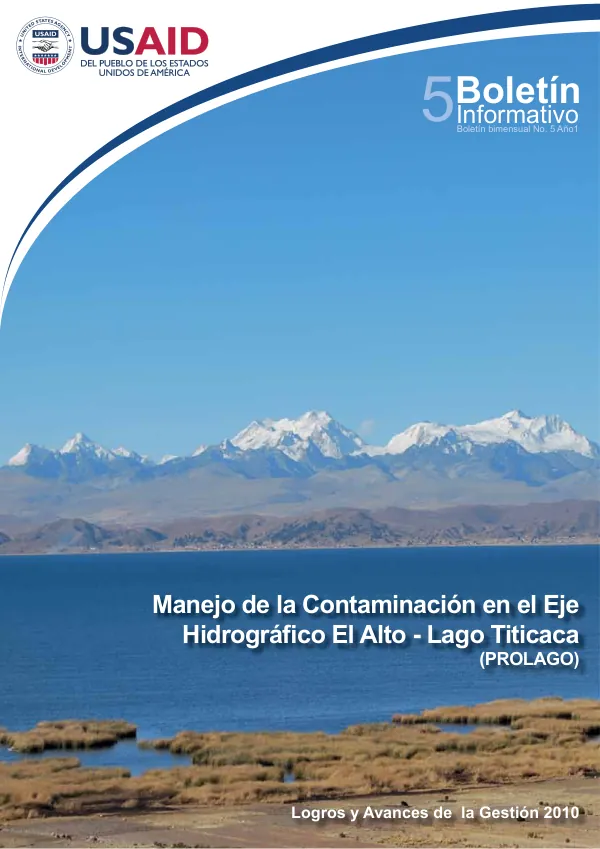
Boletín Informativo No. 8 Año 2: Manejo de la Contaminación en el Eje Hidrográfico El Alto - Lago Titicaca
Sign inUSAID DEC
Boletín Informativo No. 8 Año 2: Manejo de la Contaminación en el Eje Hidrográfico El Alto - Lago Titicaca
In the context of reducing water pollution from local industrial activities, PROLAGO prioritized industries that contribute the most to pollution in the sectors of tanneries, dairy products, meat products, and non-alcoholic beverages.
2011 · 6 pages
Sign in to readA free account is required to download.
Abstract
The Plan of Integral Management of Solid Residues (PMIRS) was developed for the city of Viacha, aiming to implement activities that reduce the environmental impact generated by the inadequate management of solid residues. The PMIRS is a tool aimed at achieving the implementation of activities that reduce the environmental impact generated by the inadequate management of solid residues, in order to maximize their reuse. During its development, a technical and social diagnosis was carried out, which allowed knowing operational municipal aspects, as well as the perceptions and practices of the population regarding the current management of solid residues. The principal characteristic of the PMIRS developed in this municipality was the participation of municipal authorities and key actors involved in the theme. It is expected that in the coming days it will be presented and officially delivered to the municipal authorities of this municipality for their approval and implementation. The activity consisted of the implementation of "pilot" projects in which measures of Cleaner Production (PML) were implemented, which promote a better environmental performance through a greater competitiveness/efficiency of the companies. As a second stage, training sessions will be carried out for interested companies on the measures implemented to disseminate this proposal. In this experience, a demonstrative project was initiated in the Tusequis industry, in which bacteria were used to allow the rapid biodegradation of organic residues. As a result of this activity, a product was obtained that can be used to improve agricultural soils. PROLAGO has achieved significant progress in the implementation of biodigesters, with 73 units implemented, of which 24 are in the maturation phase and 48 are being used to produce biogas and biol. This activity was carried out thanks to the collaboration of GIZ (GTZ). More than 220 families participate in the implementation of worm composting, located between the cantons of Chojasivi and Cohana. Of this group, more than 120 are in the production phase of humus and reproduction of worms, 37 are in the phase of preparing beds, and more than 60 are under construction. The PROLAGO project has also implemented 160 stables, of which more than 100 are in operation, while around 60 stables are not yet active due to rotational grazing. The PROLAGO project has also initiated the process of promoting practices related to the management of solid residues in six Educational Units of the municipality of Viacha, reaching more than 350 people between secondary students, alternative education, and teachers. The theme addressed was the proper management of solid residues, emphasizing the impacts generated by the poor management of solid residues on public and environmental health in the Katari River basin. The PROLAGO project has also participated in the Prospective and Environmental Fairs of Pucarani and Viacha, organized to showcase the agro-pastoral potential of the area and promote its products. In both fairs, producers who participate in the implementation of worm composting, stables, and biodigesters and receive technical assistance from the project presented their innovative products (biol and worm humus) and provided institutional information. Through these instances of socialization, the interest of the population in the activities of the project was awakened, particularly that of the agro-pastoral producers in the biol and worm humus, with a significant demand for these products. The PROLAGO project has also carried out the systematization of experiences generated in these three years of implementation, resulting in seven Success Stories and three Case Studies. The Success Stories systematized are: 1. Closure of the Santa Bárbara-Viacha dump. 2. Project for cleaning the main channel and margins of the Pallina River-Viacha. 3. Community implementation of Biodigesters-Aygachi. 4. Commercialization of worm humus-Cohana Grande. 5. Implementation of Family Worm Composting-Quiripujo. 6. Sanitary campaigns-Kenacahua Alta. 7. Implementation of educational projects (U.E. Norah Gutierrez)-Viacha. The