ENGENDERHEALTH
Boresha Afya Brief: DE Findings from Boresha Afya, Lake and Western Zone
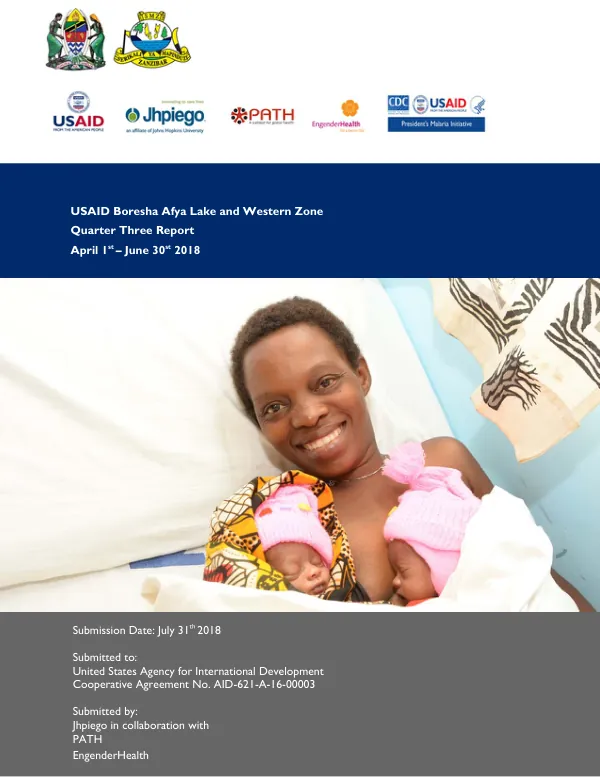
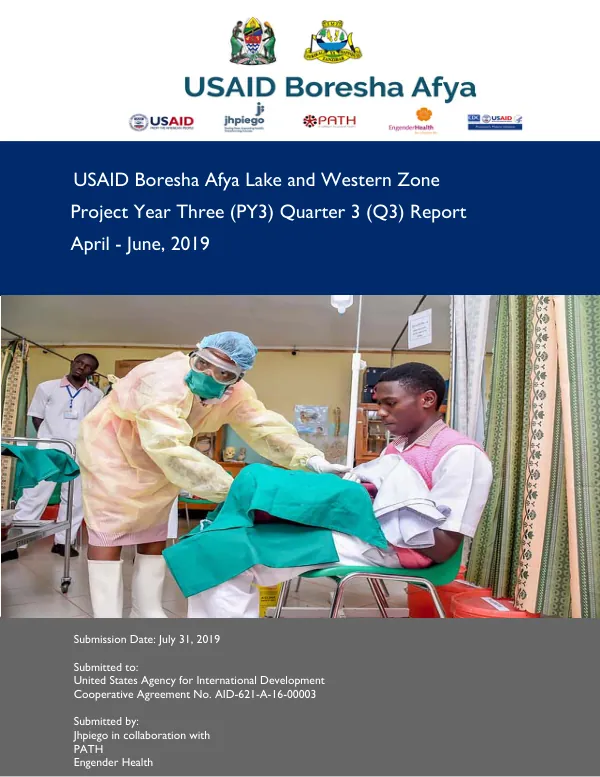
The Boresha Afya project in Tanzania aims to improve access to high-quality, comprehensive, and integrated health services, particularly for women and youth.
2019 · 4 pages
Sign in to readA free account is required to download.
Abstract
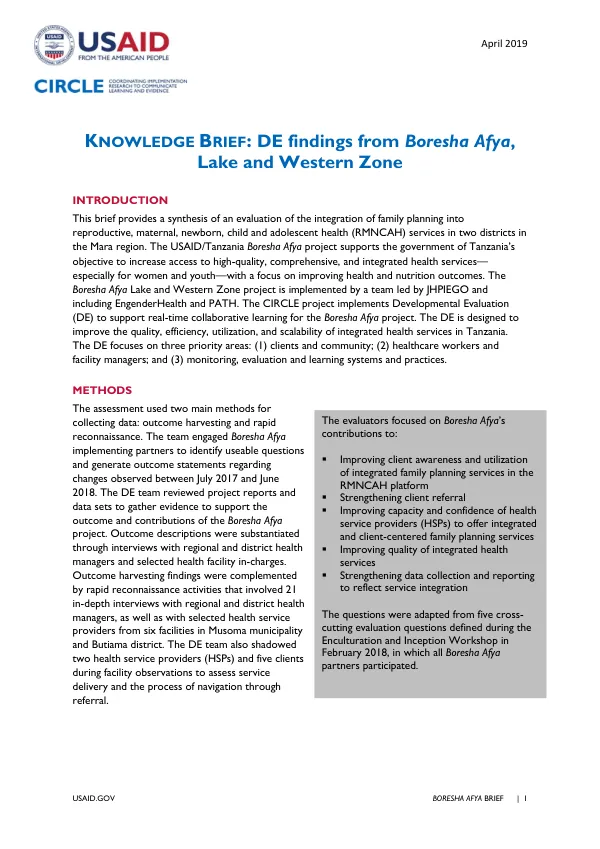
The project is implemented by a team led by JHPIEGO and EngenderHealth, with PATH as a key partner. The project focuses on three priority areas: clients and community, healthcare workers and facility managers, and monitoring, evaluation, and learning systems and practices. The project has made significant progress in improving the quality of integrated family planning services in expanded health facilities. Boresha Afya has actively worked to improve the quality of integrated family planning services in Mara, and stakeholders have confirmed the support and observed change. Regional and community health management teams, as well as health providers, have attested to the availability of equipment, service utilization, client satisfaction, and data quality as positive indicators of improvement. The project has also seen an increase in the proportion of women receiving health services, especially first ANC visits, with their partners. However, men mostly accompany women mostly during the first ANC visit, and there is a need to explore the issue of quality from the client's perspective to understand how they define it and what matters to them when it comes to service accessibility and utilization. In addition, the project has seen an increase in community-to-facility referrals for long-term family planning methods. The program has identified a model district, Butiama, where community health workers are active and community-to-facility referrals are functioning well. However, there is a need to track referrals for long-term methods and ensure that they are properly documented. The project has also improved the capacity of health service providers for the provision of post-partum family planning services. Boresha Afya has provided consistent capacity-building through mentorship, coaching, and supportive supervision to improve health provider capacity. The project has trained 96 health providers across the seven regions they are supporting in postpartum family planning, long-acting reversible contraceptives, and short-term methods. However, most health facility providers still do not meet the minimum level of training set by the Ministry of Health, Community Development, Gender, Elderly and Children. This issue requires discussion and advocacy with the Ministry to review minimum training requirements for health service providers and the potential for task shifting. The joint learning session in January 2019 agreed on priority steps to address the issues noted. These include conducting a client flow study to identify opportunities for time and efficiency gains, using client feedback cards to ensure a first-come-first-served approach, and conducting community sensitization on male involvement in family planning and other integrated services.