USAID DEC
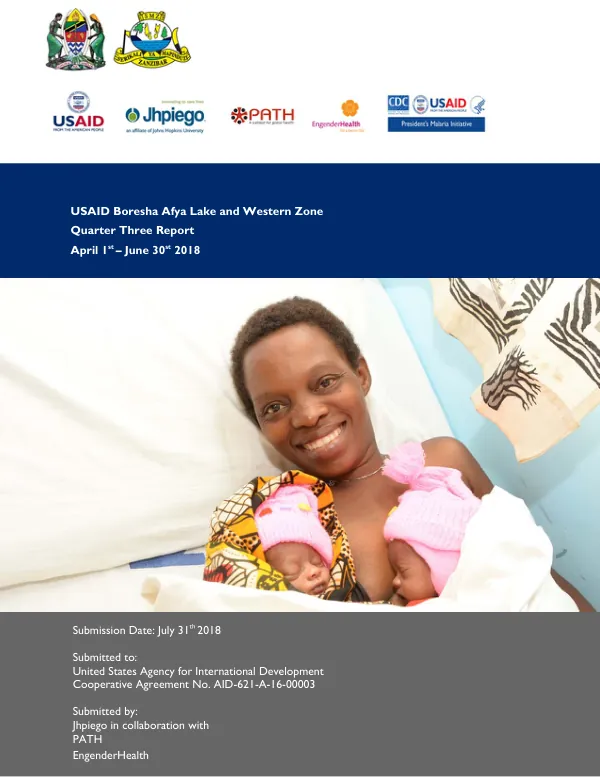
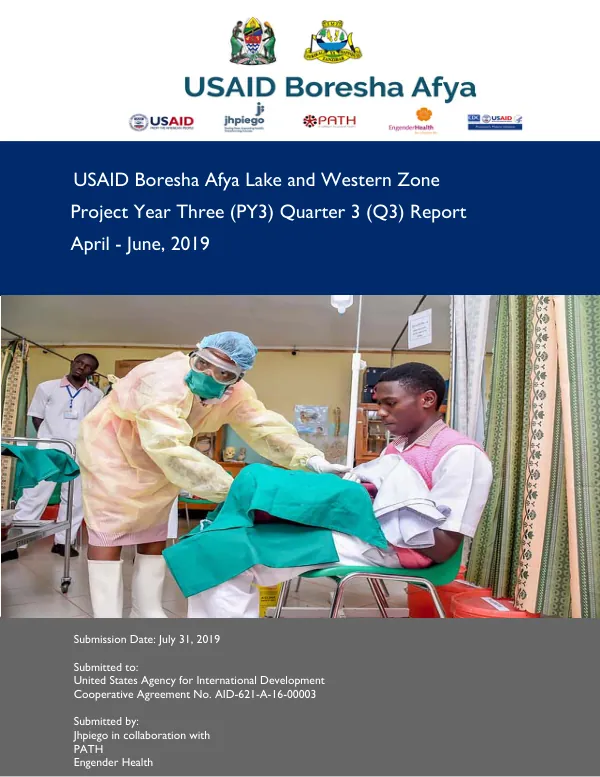
USAID Boresha Afya Lake and Western Zone Project Year Three (PY3) Quarter 3 (Q3) Report
Sign inENGENDERHEALTH
USAID Boresha Afya Lake and Western Zone Project Year Three (PY3) Quarter 3 (Q3) Report
The USAID Boresha Afya Lake and Western Zone Project is a five-year initiative focused on improving Reproductive, Maternal, Newborn, Child and Adolescent Health (RMNCAH) in seven regions of Tanzania Mainland and Zanzibar.
2019 · 73 pages
Sign in to readA free account is required to download.
Abstract
The project is implemented by Jhpiego in collaboration with PATH and Engender Health, with the Ministry of Health, Community Development, Gender, Elderly and Children (MOHCDGEC) as the in-country partner. The project's geographic coverage includes seven regions of Tanzania Mainland and Zanzibar, with a focus on improving health outcomes in areas with high maternal and newborn mortality rates. The project's objectives are to improve maternal and newborn health, reduce malaria-related illnesses and deaths, and strengthen the health system. In the third quarter of Project Year 3 (April-June 2019), the project provided mentorship to 402 healthcare workers from 125 health facilities in Kagera and Mara regions. The mentorship focused on addressing the drivers of maternal and newborn mortality, including neonatal resuscitation, prevention and management of postpartum hemorrhage (PPH), pre-eclampsia/eclampsia (PE/E), anemia in pregnancy, maternal sepsis, and care of the small newborn through kangaroo mother care (KMC). The project also conducted emergency obstetric and newborn care (EmONC) training for 30 healthcare workers in Kagera and Mara regions. Additionally, the project supported the implementation of the Integrated Reproductive and Child Health (IRCH) program, which aims to improve access to reproductive health services, including family planning, maternal and newborn health, and child health. In terms of malaria control, the project supported the distribution of insecticide-treated bed nets (ITNs) to 10,000 households in Kagera and Mara regions. The project also conducted malaria case management training for 20 healthcare workers in Kagera and Mara regions. The project's progress towards its targets in each supported program area is highlighted in the report. The report also describes the activities implemented, key achievements, and challenges faced by the project during the third quarter of Project Year 3. The project's financial summary for the third quarter of Project Year 3 shows that the total budget for the project is $42,354,097, with $44,440,719 in funds obligated to date. The project has also received additional funds of $0, bringing the total funds available to $44,440,719. The project's implementation is led by Jhpiego, with PATH and Engender Health as technical partners. The project's in-country partners include the Ministry of Health, Community Development, Gender, Elderly and Children (MOHCDGEC), the National Malaria Control Program (NMCP), and the Tanzania Food Nutrition Centre (TFNC). The project's monitoring and evaluation (M&E) framework is designed to track progress towards its targets and identify areas for improvement. The project's M&E system includes data collection, analysis, and reporting, as well as regular review and feedback mechanisms. The project's digital health component includes the use of electronic data systems (EDS) and electronic logistics information systems (eLMIS) to improve data management and supply chain management. The project also supports the implementation of the Open Smart Register Platform (OpenSRP) to improve health facility management and patient care. The project's environmental mitigation and monitoring plan aims to minimize the project's environmental impact and ensure that the project's activities do not harm the environment. The plan includes measures to reduce energy consumption, minimize waste, and protect biodiversity. The project's strategic priorities for the fourth quarter of Project Year 3 include continuing to provide mentorship to healthcare workers, supporting the implementation of the IRCH program, and conducting malaria case management training for healthcare workers. The project also plans to continue its digital health initiatives and implement its environmental mitigation and monitoring plan. The project's progress towards its annual targets is highlighted in the annex to the report. The report also includes a success story from the project, which highlights the impact of the project's activities on improving health outcomes in the project areas.