USAID DEC
Brazil’s Mandatory Ecological Compensation System for Industrial Development Projects
Sign inUSAID
Brazil’s Mandatory Ecological Compensation System for Industrial Development Projects
Brazil's mandatory ecological compensation system for industrial development projects was established by the National Protected Areas Systems Law in 2000.
2019 · 2 pages
Sign in to readA free account is required to download.
Abstract
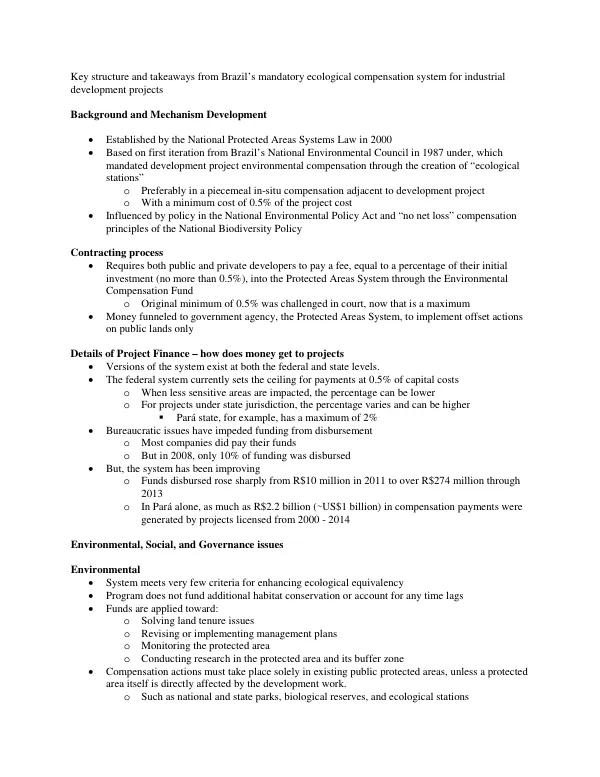
This legislation built upon the first iteration of the system, developed by Brazil's National Environmental Council in 1987, which mandated environmental compensation through the creation of "ecological stations." These stations were to be created in a piecemeal, in-situ manner adjacent to development projects, with a minimum cost of 0.5% of the project cost. The contracting process requires both public and private developers to pay a fee, equal to a percentage of their initial investment, into the Protected Areas System through the Environmental Compensation Fund. The original minimum of 0.5% was challenged in court and is now a maximum. The money is funneled to the government agency, the Protected Areas System, to implement offset actions on public lands only. Versions of the system exist at both the federal and state levels, with the federal system currently setting the ceiling for payments at 0.5% of capital costs. Implementation details reveal that bureaucratic issues have impeded funding disbursement, with only 10% of funding disbursed in 2008. However, the system has been improving, with funds disbursed rising sharply from R$10 million in 2011 to over R$274 million through 2013. In Pará alone, as much as R$2.2 billion (∼US$1 billion) in compensation payments were generated by projects licensed from 2000 to 2014. The system has been criticized for meeting few criteria for enhancing ecological equivalency. Funds are applied toward solving land tenure issues, revising or implementing management plans, monitoring the protected area, and conducting research in the protected area and its buffer zone. Compensation actions must take place solely in existing public protected areas, unless a protected area itself is directly affected by the development work. The system has been criticized for not funding additional habitat conservation or accounting for time lags. The system has several strengths, including regulatory simplicity and straightforward rules that reduce transaction costs and resistance to compliance. The policy ensures that developers always have a supply of offsets available for purchase, and the program minimizes uncertainty regarding compensation costs by capping payments at 0.5% of investment. Offset actions are implemented by a government agency that specializes in conservation, and protected areas on formally-protected public lands have a better chance of surviving than those on unprotected lands. However, the system has several weaknesses, including simplicity resulting in a lack of ecologically equivalent outcomes, administrative inefficiency decreasing the amount of funding delivered for conservation, and not accounting for indirect impacts. The regulation does not clearly define "significant environmental impact" or assessment methodologies, and depending on compensation as a regular source of funding for national PAs is problematic as it is based on the very environmental degradation that should be avoided.
Related documents