COLORADO STATE UNIVERSITY
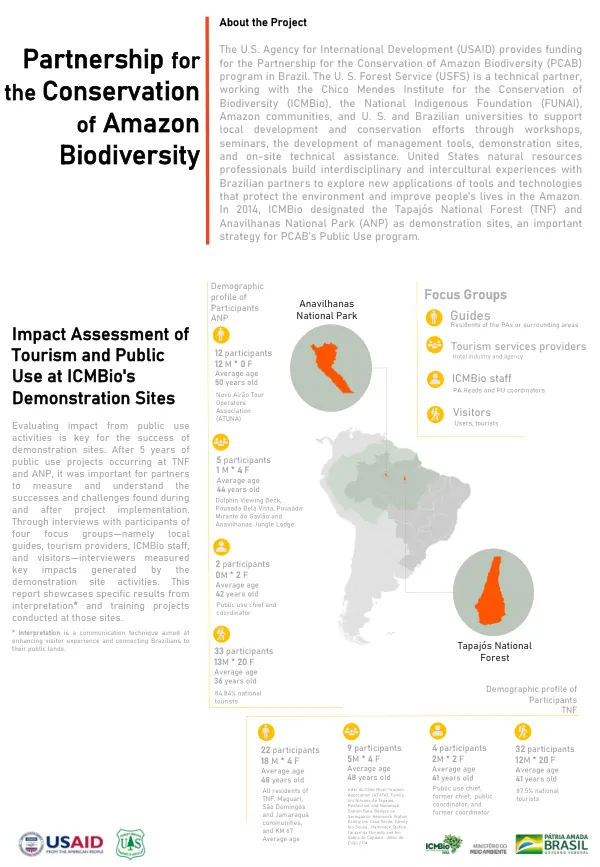
Impact Assessment of Tourism and Public Use at ICMBio's Demonstration Sites
The Partnership for the Conservation of Amazon Biodiversity (PCAB) program in Brazil is a collaborative effort between the U.S.
2020 · 6 pages
Sign in to readA free account is required to download.
Abstract
Agency for International Development (USAID), the U.S. Forest Service (USFS), and various Brazilian institutions, including the Chico Mendes Institute for the Conservation of Biodiversity (ICMBio) and the National Indigenous Foundation (FUNAI). The program aims to support local development and conservation efforts in the Amazon region through workshops, seminars, and the development of management tools. The PCAB program focuses on the Tapajós National Forest (TNF) and Anavilhanas National Park (ANP), which were designated as demonstration sites in 2014. The demonstration sites serve as platforms for exchanging knowledge and experiences, where projects, processes, and infrastructure are planned, implemented, and documented to improve learning and inform decision-making. The TNF, located in Pará State, is a 1,309,100-acre tropical forest in the Amazon biome, with an established and growing regional, national, and international visitation. The ANP, located in Amazonas State, is a 518,700-acre protected area that hosts the second-largest freshwater archipelago in the world. Both sites were selected as demonstration sites due to their potential for public use and tourism. The PCAB program implemented various actions at the TNF and ANP demonstration sites between 2014 and 2018. At the TNF, these actions included monitoring visitation, designing and installing interpretive signs, developing an interpretive plan, and training community members and tourism operators. At the ANP, actions included reviewing and revising the public use plan, conducting an initial assessment of potential for an aquatic trail, and developing interpretive products. The outcomes of these actions were evaluated in 2019, with significant improvements observed in various areas, including income, quality of service, and visitor acknowledgement of the importance of the protected areas. The demonstration sites also contributed to the development of management agency relationships with tourism operators and communities, as well as ICMBio's competences and skills in managing protected areas. The PCAB program's focus on public use and tourism at the TNF and ANP demonstration sites has led to improved outcomes and increased capacity-building in these areas. The program's collaborative approach and emphasis on knowledge exchange and experience sharing have contributed to the success of the demonstration sites and the conservation of the Amazon region's biodiversity.