USAID DEC
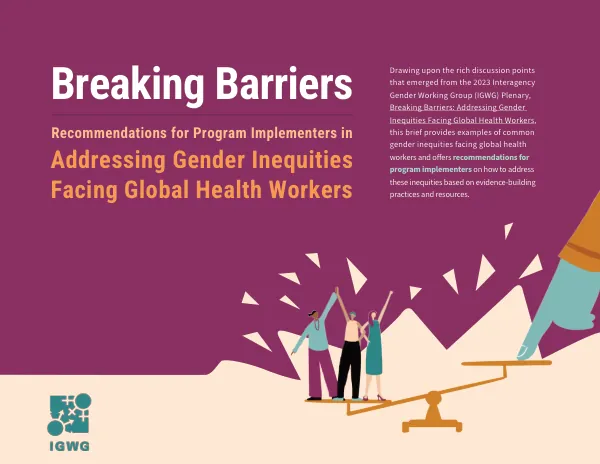
Breaking Barriers: Recommendations for Program Implementers in Addressing Gender Inequities Facing Global Health Workers
Sign inUSAID DEC
Breaking Barriers: Recommendations for Program Implementers in Addressing Gender Inequities Facing Global Health Workers
The global health and care sector is a major source of employment, with one in 30 paid jobs worldwide in health.
2023 · 11 pages
Sign in to readA free account is required to download.
Abstract
Women make up two in every three health workers globally, yet they face numerous barriers to paid employment and career advancement. Gender inequities are a systemwide problem for health workers, entrenched in policies, practices, institutional culture, and behaviors of national health systems. These inequities are rooted in societal expectations, gender norms, and intersectional factors that perpetuate discrimination and disadvantages for women and other groups of health workers. Examples of inequities faced by health workers include unfair labor laws and practices, discriminatory human resources practices, gender-based workplace harassment and violence, lack of leadership commitment and accountability practices, and systematic lack of data about gender inequities facing health workers. Women tend to be clustered into lower status, low paid, and unpaid roles and occupy only a quarter of senior roles in the health sector. They earn about 67% less per hour than male health workers with similar jobs. Two-thirds of health workers across all genders have experienced sexual harassment and violence in the workplace. To address these inequities, program implementers should focus on improving the successful completion of pre-service academic education for female students, establishing mechanisms for health workers to promote nondiscrimination and equal opportunity, and offering gender sensitization and skills-building trainings for human resources staff. They should also support improved contract quality and benefits packages, provide mentoring and leadership training, and facilitate women's recruitment and advancement into positions traditionally filled by men. Health system leaders must ensure implementation of and accountability for human resources policies that promote equitable and fair contracts, pay, leave, benefits, recruitment, and promotion practices. Program implementers should work with health system leaders to establish workplace norms of safety, fairness, respect, and equity and ensure a culture of accountability. They should also support development of formal policies and practices to prevent and respond to sexual harassment, including a clear code of conduct. Program implementers should engage health system leaders in efforts to create a workplace culture that prioritizes accountability for diversity, equity, and inclusion among health workers. This includes developing a multi-stakeholder, multi-year action plan, supporting leaders in building trust and establishing a regular communication plan, and facilitating reporting of progress on key performance indicators. Fostering leadership commitment and accountability to promote intersectional gender equity for health workers requires a comprehensive approach. Program implementers should promote gender transformative supervision and leadership skills and processes among health workforce leaders and educators to help participants overcome unconscious bias and promote safe discussions about gender bias and discrimination.