USAID DEC
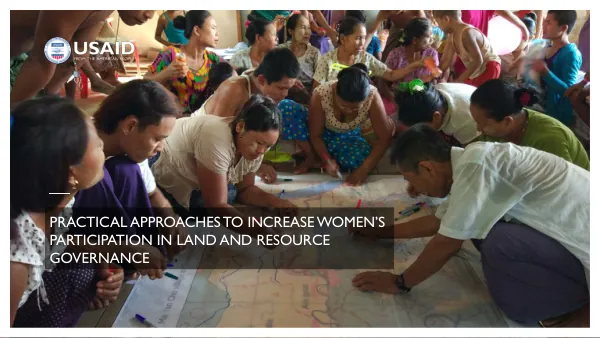
PRACTICAL APPROACHES TO INCREASE WOMEN'S PARTICIPATION IN LAND AND RESOURCE GOVERNANCE
Sign inUSAID
PRACTICAL APPROACHES TO INCREASE WOMEN'S PARTICIPATION IN LAND AND RESOURCE GOVERNANCE
Women's participation in land and resource governance is crucial for sustainable development and equitable resource management.
2018 · 24 pages
Sign in to readA free account is required to download.
Abstract
The agricultural sector, in particular, is heavily influenced by women's involvement, as they often play a significant role in farming and food production. However, women's participation in decision-making processes and leadership roles is often limited due to various barriers. Community forest management groups are one key entry point for women's participation. These groups are responsible for managing and maintaining forests, which are essential for rural livelihoods and ecosystem services. Women's involvement in these groups can help ensure that their needs and perspectives are taken into account in forest management decisions. Small- and medium-scale enterprises (SMEs) and non-governmental organizations (NGOs) also provide opportunities for women's participation in land and resource governance. Best practice actions for increasing women's participation include determining the challenges women face when participating in various activities, planning activities and meetings at a time of day and in a location conducive to their schedules, and allowing children to be present whenever possible. Maintaining an open dialogue between women's advocacy groups and government is also essential for promoting women's participation. Reserving leadership and decision-making roles for women capable of taking on such roles can help address the lack of representation in these areas. Capacity development is a critical component of increasing women's participation in land and resource governance. Targets for capacity development include raising women's and men's skills at the community level, ensuring that all project participants have the same knowledge to work together, and bolstering women's skills to level the playing field. The capacity development process involves convening stakeholders, particularly men, to explain and discuss the concept of gender equality and what they see as women's contributions. Consulting women to determine whether capacity development activities will be useful at the household and community levels is also essential. Institutional strengthening is another critical component of increasing women's participation in land and resource governance. Challenges to institutional strengthening include deep-rooted gender biases, lack of sex-disaggregated data, poor technical capacity on gender matters, and limited budget allocations for gender issues. Common institutional challenges include support to review and re-organize existing management structures to create more balanced institutions with female representation in leadership roles. Corrective measures include organizing consultation meetings, engaging stakeholders to ensure inclusive approaches to gender-responsive policies, and organizing gender-awareness workshops for officials, including decision-makers. Data collection is also essential for increasing women's participation in land and resource governance. Gaps in data collection include the lack of sex-disaggregated and socioeconomic data, women's activities concentrated in the informal sector, and the challenge this poses to policy planning. Providing data and analysis focused on gender issues can facilitate the development of targeted gender-responsive policies, strategies, and frameworks. Information systems should include sex-disaggregated data and ensure wide dissemination, and gender-sensitive monitoring and evaluation systems should be developed to track progress and identify areas for improvement.