MEASURE EVALUATION PRH
The Importance of Gender in HIV Health Information Systems
Addressing gender while strengthening HIV health information systems (HIS) ensures equity in access and benefits for women, men, girls, boys, and transgender people.
2019 · 4 pages
Sign in to readA free account is required to download.
Abstract
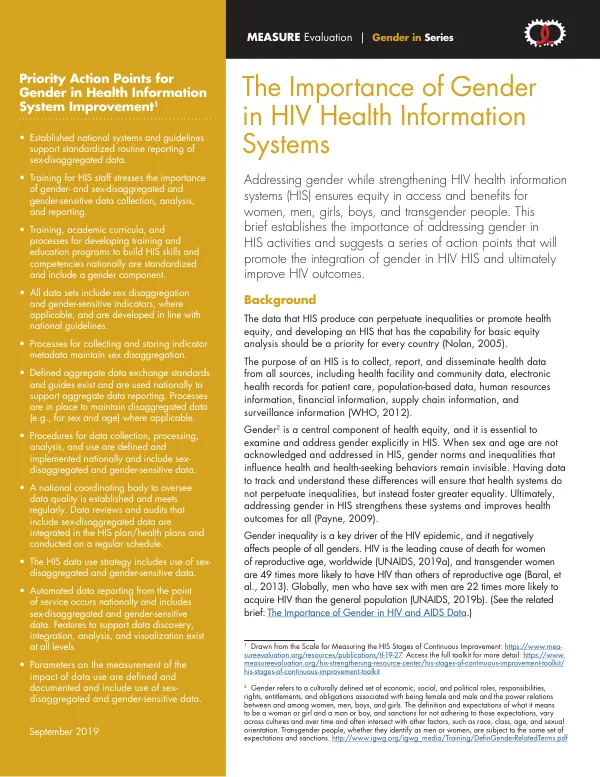
This brief establishes the importance of addressing gender in HIS activities and suggests a series of action points that will promote the integration of gender in HIV HIS and ultimately improve HIV outcomes. The data that HIS produce can perpetuate inequalities or promote health equity, and developing an HIS that has the capability for basic equity analysis should be a priority for every country. The purpose of an HIS is to collect, report, and disseminate health data from all sources, including health facility and community data, electronic health records for patient care, population-based data, human resources information, financial information, supply chain information, and surveillance information. Gender is a central component of health equity, and it is essential to examine and address gender explicitly in HIS. When sex and age are not acknowledged and addressed in HIS, gender norms and inequalities that influence health and health-seeking behaviors remain invisible. Having data to track and understand these differences will ensure that health systems do not perpetuate inequalities, but instead foster greater equality. Ultimately, addressing gender in HIS strengthens these systems and improves health outcomes for all. Gender inequality is a key driver of the HIV epidemic, and it negatively affects people of all genders. HIV is the leading cause of death for women of reproductive age, worldwide, and transgender women are 49 times more likely to have HIV than others of reproductive age. Globally, men who have sex with men are 22 times more likely to acquire HIV than the general population. To address gender in HIS, priority action points include establishing national systems and guidelines that support standardized routine reporting of sex-disaggregated data. Training for HIS staff should stress the importance of gender- and sex-disaggregated and gender-sensitive data collection, analysis, and reporting. All data sets should include sex disaggregation and gender-sensitive indicators, where applicable, and be developed in line with national guidelines. The HIS data use strategy should include the use of sex-disaggregated and gender-sensitive data. Automated data reporting from the point of service should occur nationally and include sex-disaggregated and gender-sensitive data. Features to support data discovery, integration, analysis, and visualization should exist at all levels. Parameters on the measurement of the impact of data use should be defined and documented and include the use of sex-disaggregated and gender-sensitive data. Integrating gender into HIV HIS involves considering gender in each area of the Health Information System Strengthening Model (HISSM): the enabling environment, information generation, and HIS performance. The enabling environment lays the foundation for planning, implementing, and maintaining an HIS. HIS governance and leadership should be aware of and champions for the importance of gender in HIV and HIS. Including gender in HIS policies, standards, financing, human resources, and capacity strengthening efforts will create a gender-sensitive enabling environment. Disaggregated data and gender-sensitive indicators allow program managers and decision makers to examine service-delivery, treatment, and health-outcome data in-depth so that they can detect differences between genders, age groups, and key populations. Data collection for HIS draws on a variety of sources, including census, vital registration, household survey, and facility-based data. HIS HIV data are frequently collected by sex, but in some instances, the sex variable is dropped when data are aggregated from facility registers to regional and national levels, preventing analysis of gender differences. In addition to sex disaggregation, gender-sensitive indicators can further illuminate gender inequities. Gender-sensitive indicators are often collected in surveys or special studies, but select indicators should also be included in routine HIS, such as experience of gender-based violence (GBV). Studies have demonstrated a strong association between GBV and HIV, with GBV both a risk factor for infection and a consequence of infection. Data use is a key output of a strong HIS, making gender integration at this stage critically important. Maintaining an awareness of gender inequity while analyzing, synthesizing, and interpreting data will highlight gaps and lay the foundation for gender-sensitive decision making for HIV programming. Researchers have also noted the importance of building a culture of equity-oriented decision making in HIS. HIS should include components that raise awareness among and build capacity of system users, preparing and encouraging them to use health data to examine and address gender inequities, demand rich gender data, and influence policy change to support gender equality.
Related documents
Documents in this collection
 2017
2017USAID DEC
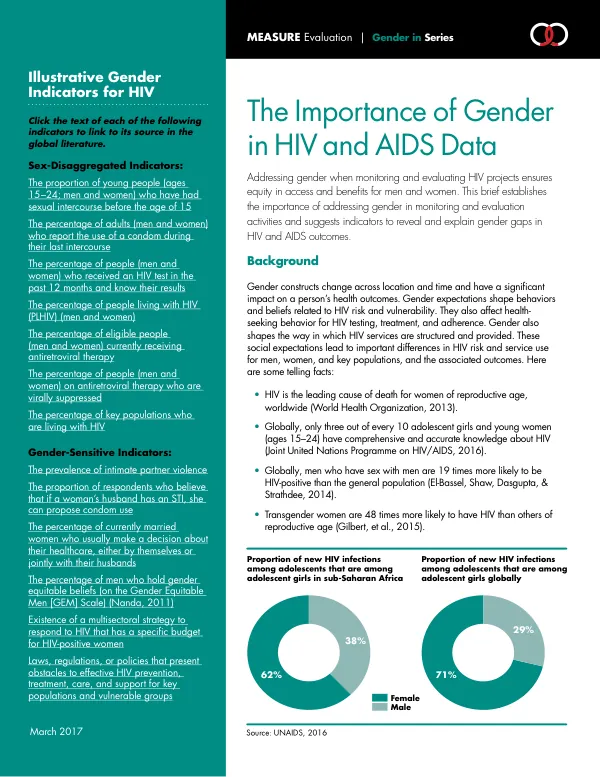
The Importance of Gender in HIV and AIDS Data
Open record 2012
2012USAID DEC