USAID DEC
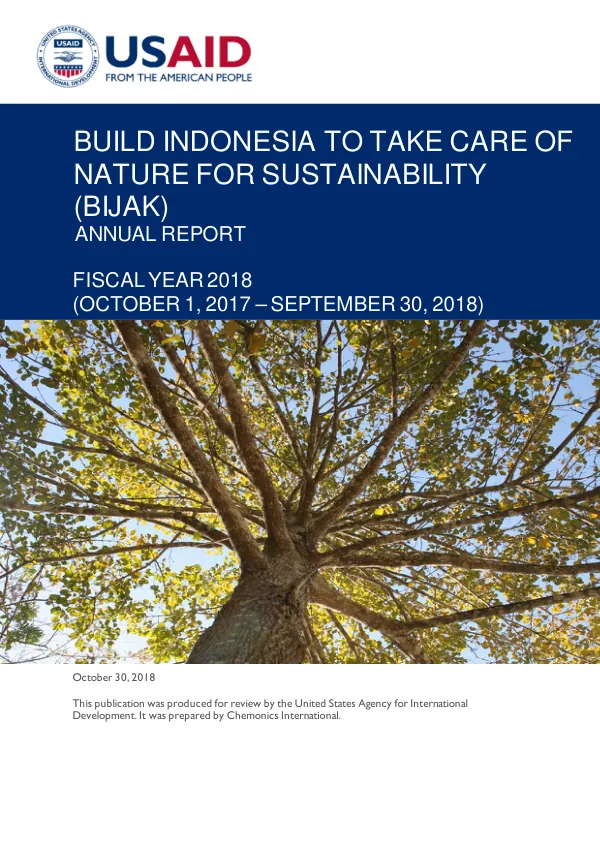
BUILD INDONESIA TO TAKE CARE OF NATURE FOR SUSTAINABILITY (BIJAK) ANNUAL REPORT FY 2018
Sign inCHEMONICS
BUILD INDONESIA TO TAKE CARE OF NATURE FOR SUSTAINABILITY (BIJAK) ANNUAL REPORT FY 2018
The agricultural development initiative in Indonesia began in 2018 with a focus on improving forest and conservation area management and combating wildlife trafficking.
2018 · 72 pages
Sign in to readA free account is required to download.
Abstract
The project, known as BIJAK, aimed to strengthen the capacity of national and local staff in developing and scaling up approaches to address deforestation risks from palm oil plantations. BIJAK's technical approach was refocused in Year 2, consolidating the project's four components into two overarching technical themes: Technical Theme 1 (TT1) and Technical Theme 2 (TT2). TT1 focused on improving forest and conservation area management, while TT2 aimed to combat wildlife trafficking. Within TT1, BIJAK provided technical assistance to strengthen conservation management frameworks and systems, including improving the regulatory framework for conservation forest management units and developing a national-level information system for adaptive and data-driven decision making. BIJAK advanced its work on wildlife trafficking by building capacity in key line agencies to operationalize, enforce, and update the legal and policy framework for species protection. The project continued its work with the Ministry of Environment and Forestry, the Indonesian Institute of Science, and other partners on species protection under the Convention on International Trade in Endangered Species of Wild Fauna and Flora. In 2018, BIJAK achieved several significant milestones, including the approval of zoning maps for 50 national parks and the drafting of zoning and blocking maps for 248 conservation areas. The project also contributed to the establishment of collaborative partnerships for conservation objectives, which were officially enacted into the KSDAE policy. BIJAK's work on reducing deforestation risks from palm oil plantations involved strengthening the capacity of national and local staff in developing and scaling up approaches to address these risks. The project also promoted the protection of high conservation value and high carbon stock lands in non-forest areas and essential ecosystem areas outside conservation areas. The project's focus on improving forest and conservation area management and combating wildlife trafficking was reflected in its work with the Ministry of Environment and Forestry, the Indonesian Institute of Science, and other partners. BIJAK's efforts aimed to strengthen the capacity of national and local staff in developing and scaling up approaches to address deforestation risks and promote the protection of high conservation value and high carbon stock lands. BIJAK's work on species protection under the Convention on International Trade in Endangered Species of Wild Fauna and Flora involved continued support for the Government of Indonesia's participation in the CITES intersessional meeting. The project's focus on building capacity in key line agencies to operationalize, enforce, and update the legal and policy framework for species protection was a key aspect of its work in 2018.