USAID DEC
Indonesia Ensures Sustainable Shark Trade Lessons from Six Parks Strengthen Conservation Partnerships
Sign inCHEMONICS
Indonesia Ensures Sustainable Shark Trade Lessons from Six Parks Strengthen Conservation Partnerships
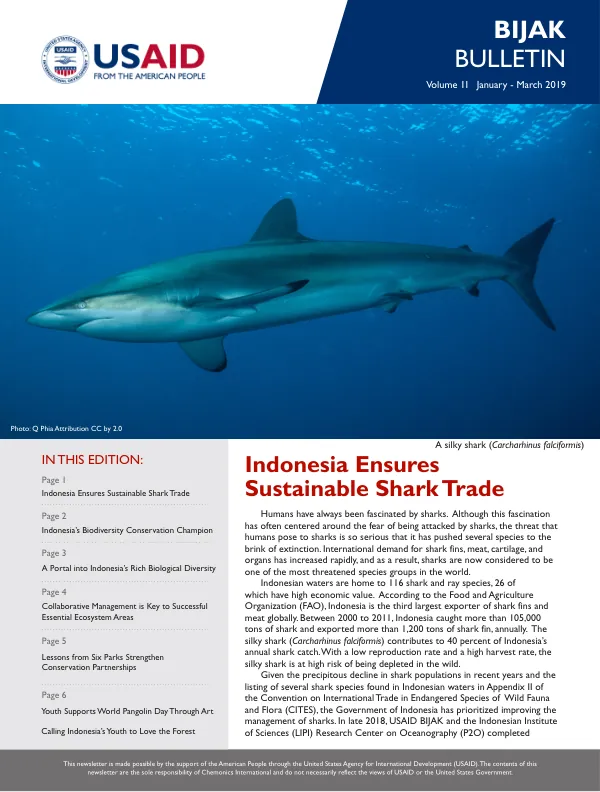
The silky shark (Carcharhinus falciformis) is a species of shark found in Indonesian waters, contributing to 40 percent of the country's annual shark catch.
2019 · 6 pages
Sign in to readA free account is required to download.
Abstract
The silky shark has a low reproduction rate and a high harvest rate, making it at high risk of being depleted in the wild. Indonesia is the third largest exporter of shark fins and meat globally, with the silky shark being a significant contributor to this trade. The Government of Indonesia has prioritized improving the management of sharks, particularly the silky shark, due to its listing in Appendix II of the Convention on International Trade in Endangered Species of Wild Fauna and Flora (CITES). In late 2018, USAID BIJAK and the Indonesian Institute of Sciences (LIPI) Research Center on Oceanography (P2O) completed a science-based risk assessment, known as a non-detriment finding (NDF), to determine the vulnerability of the silky shark in relation to its management. The NDF is a critical step toward defining management practices and sustainable trade levels for the species. The NDF assessment proposed an export and catch quota of 80,000 individuals for the silky shark, which would significantly reduce the annual legal catch of the species in Indonesia. The standard protocols for conducting the silky shark NDF assessment and quota setting will be used to improve the management of other threatened shark species, demonstrating Indonesia's commitment to marine species conservation and sustainable trade of sharks. Indonesia's biodiversity is facing significant pressure from human activities, including poaching, illegal trade, and habitat destruction. The country has the highest terrestrial and marine species biological diversity on earth, with thousands of flora and fauna species, many of which are endemic. To address this challenge, Indonesia joined the Convention on Biological Diversity (CBD) in 2004 and developed a national-level biodiversity information system, known as a Clearing-House Mechanism (CHM). The CHM is a valuable tool for centralizing conservation data, allowing government institutions, experts, and the general public to access information on wildlife, plants, ecosystems, and threats to biodiversity. Since 2016, USAID BIJAK has supported the development of an integrated online platform for the CHM, which was launched in July 2018 and won a gold award at the 2018 UN Biodiversity Conference of the Parties (COP14). The CHM will be included in Indonesia's RPJMN, ensuring funding for its maintenance for the next five years. The Director of the Directorate General Ecosystem and Natural Resources Conservation (DG KSDAE), Ministry of Environment and Forestry (KLHK), Ibu Indra Exploitasia Semiawan, emphasized the importance of mainstreaming biodiversity into national development and integrating wildlife habitat protection through ecosystem-based spatial planning development. She also highlighted the need to balance development with providing living space for wildlife, as there is only one Earth and it is the responsibility of humans to share this space with other forms of life. The Government of Indonesia, through the Directorate of Biodiversity Conservation (KKH), has had a long and productive partnership with USAID BIJAK, working together to develop and implement conservation initiatives, including the Helmeted Hornbill SRAK and protected species identification guidelines. The partnership aims to develop innovations towards Conservation 4.0, adapting concepts like digital economy, artificial intelligence, big data, and robotics to support biodiversity conservation efforts in Indonesia.