USAID DEC
Building and Sustaining Civil Society Organizational Capacity Development in Tanzania
Sign inJOHN SNOW INTERNATIONAL
Building and Sustaining Civil Society Organizational Capacity Development in Tanzania
The USAID Kizazi Kipya project was a five-year initiative funded by the U.S.
2021 · 12 pages
Sign in to readA free account is required to download.
Abstract
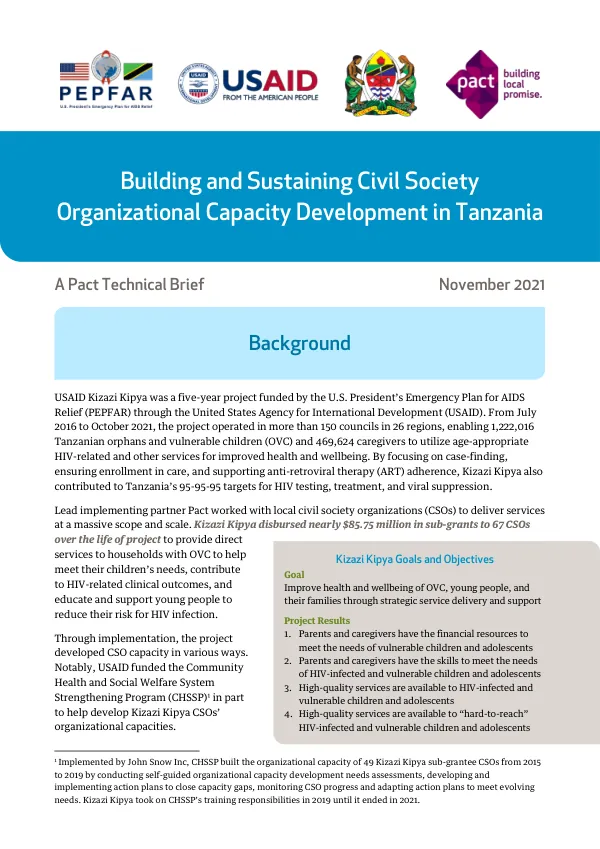
President's Emergency Plan for AIDS Relief (PEPFAR) through the United States Agency for International Development (USAID). The project operated in more than 150 councils in 26 regions of Tanzania from July 2016 to October 2021, providing services to 1,222,016 orphans and vulnerable children (OVC) and 469,624 caregivers. The project's primary goal was to improve the health and wellbeing of OVC, young people, and their families through strategic service delivery and support. Kizazi Kipya's implementation structure involved working with local civil society organizations (CSOs) to deliver services at a massive scope and scale. The project disbursed nearly $85.75 million in sub-grants to 67 CSOs over the life of the project to provide direct services to households with OVC. The project also developed CSO capacity in various ways, including organizational capacity development, through the Community Health and Social Welfare System Strengthening Program (CHSSP). The project's approach to capacity development focused on building CSO technical competencies and operational capacities to ensure they delivered quality services at scale to targeted households and optimally managed their sub-grants. Kizazi Kipya developed an array of tools, including standard operating procedures (SOPs), curricula, and implementation guides, to support CSO staff in overseeing project activities and delivering services. The project also trained staff and volunteers to conduct household case management, educate youth to prevent HIV, promote positive gender norms, and support village savings and lending groups. To reach its goal of providing services to more than 1 million vulnerable children, Kizazi Kipya required vast scale and scope. The project's decentralized implementation model of working through local CSOs helped it reach the necessary scale of services, but posed several challenges, including shifting to direct service delivery, ensuring quality case management, and contributing to HIV outcomes. The project addressed these challenges by developing the technical capacities of CSOs, including training staff and volunteers in case management approaches and providing oversight to the volunteer workforce. Kizazi Kipya's efforts to build CSO capacities were successful, with the project achieving significant results, including a 27% increase in household income among program participants compared to the control group. The project's approach to capacity development, which focused on building CSO technical competencies and operational capacities, was a key factor in its success.
Related documents