USAID DEC
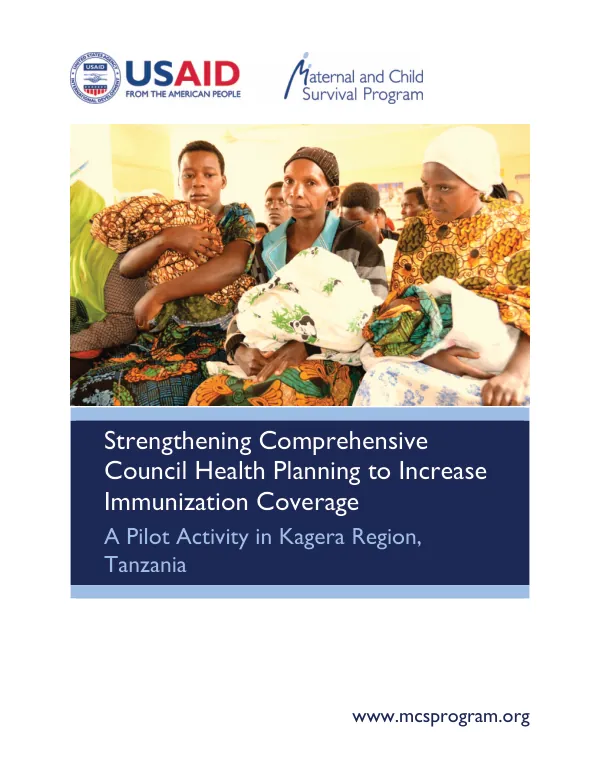
Strengthening Comprehensive Council Health Planning to Increase Immunization Coverage, A Pilot Activity in Kagera Region, Tanzania
Sign inJOHN SNOW INTERNATIONAL
Strengthening Comprehensive Council Health Planning to Increase Immunization Coverage, A Pilot Activity in Kagera Region, Tanzania
The Maternal and Child Survival Program (MCSP) provides technical support to the Ministry of Health, Community Development, Gender, Elderly, and Children (MOHCDGEC) in Tanzania to ensure equitable access to quality health care services for women, newborns, and children.
2019 · 31 pages
Sign in to readA free account is required to download.
Abstract
In 2014, MCSP conducted an assessment of the Comprehensive Council Health Plan (CCHP) development process in Kagera Region to explore ways councils could develop more accurate CCHPs to support improved council-level vaccination program delivery. CCHPs are developed through an annual process where councils plan and budget for the coming year's essential health and social welfare programs. However, challenges have been identified in effectively applying comprehensive development guidelines for CCHPs at the operational level. For example, in 2013, a regular appraisal of program implementation in district (RAPID) assessment found that some councils did not budget properly for the recurring costs of annual immunization program delivery. Inaccurate budgeting in CCHPs compromised Immunization and Vaccine Development (IVD) Program performance at council level throughout the year. From 2014 to 2017, MCSP and MOHCDGEC undertook a series of activities focused on strengthening the CCHP planning process in two select councils (Muleba and Ngara) of Kagera Region. Activities included developing an immunization microplanning tool and piloting its use within the CCHP planning process with the Muleba council, analyzing the effects of microplanning tool use in Muleba on CCHP and immunization program performance, and expanding microplanning tool use to additional councils in Kagera Region and in Shinyanga, Tabora, and Simiyu regions. Results of the microplanning tool use pilot activity with the Muleba council were impressive. Post-intervention, budgeting in Muleba for the 2016/2017 financial year improved greatly, with annual CCHP budgets matching the required funds needed for outreach, vaccine distribution, purchase of liquefied petroleum gas, electricity, and immunization costs overall. In Ngara, the control site, budget improvements were not as significant in 2016/2017, as allocations fell short of requirements in each category except electricity. Importantly, accurate CCHP budgeting may have played a role in increasing immunization coverage on the Muleba council. The use of the microplanning tool in Muleba resulted in improved budgeting and potentially increased immunization coverage. Penta 3 coverage in Muleba increased during the intervention period, whereas the number of children receiving the Penta 3 vaccination remained unchanged for the same time period in Ngara. This suggests that strengthening CCHP planning and budgeting may be an important and effective way to increase coverage of critical immunization services. The MCSP would like to acknowledge the financial support, guidance, and close collaboration of USAID Tanzania, USAID Washington, the Tanzania MOHCDGEC, the President's Office for Regional and Local Government Authority, the Kagera Regional Health Management Team, and the Council Health Management Team in the implementation of this report. The hard work and dedication of the authors of this report, including Dorosella Njunwa, are also acknowledged.