USAID DEC
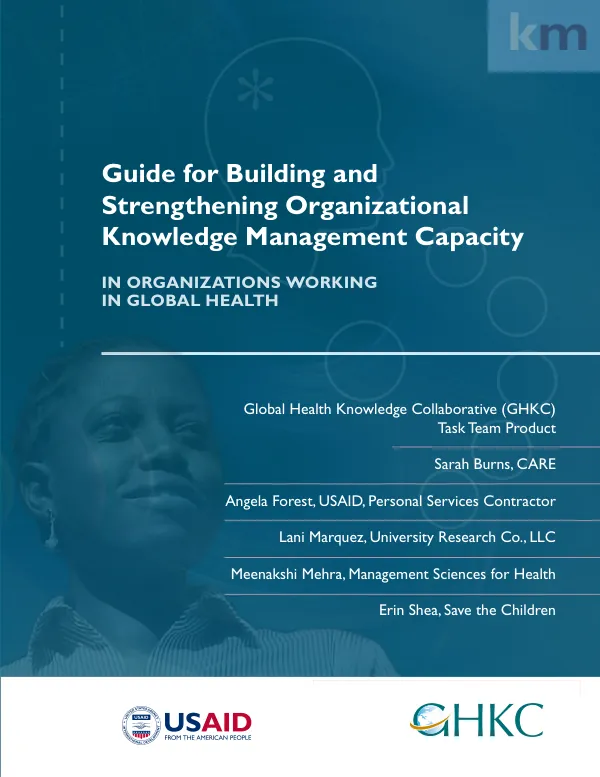
Building Better Programs: A Step-by-Step Guide to Using Knowledge Management in Global Health
Sign inFHI 360
Building Better Programs: A Step-by-Step Guide to Using Knowledge Management in Global Health
The Knowledge Management Road Map is a five-step systematic process for generating, collecting, analyzing, synthesizing, and sharing knowledge.
2017 · 80 pages
Sign in to readA free account is required to download.
Abstract
This process guides global health workers and professionals in applying knowledge management systematically and strategically in their programs. The Knowledge Management Road Map is an adapted version of the widely used P Process, developed by the Johns Hopkins Center for Communication Programs (CCP) to provide step-by-step guidance for strategic health communication. The Knowledge Management Road Map consists of five steps: Assess Needs, Design Strategy, Create and Iterate, Implement, and Monitor and Evaluate. Each step is designed to help global health professionals develop and implement a systematic knowledge management strategy to improve program efficiency and effectiveness. The Assess Needs step involves identifying the health problem that knowledge management can help solve, defining the audience of the needs assessment, deciding what key questions to answer, selecting and implementing the appropriate methods to answer the key questions, analyzing and synthesizing the needs assessment findings, and learning before, during, and after implementation. The Design Strategy step involves deciding on knowledge management objectives, defining the audience, grounding the knowledge management intervention in a relevant theoretical framework, deciding on knowledge management tools and techniques and appropriate information and communication technologies (ICTs), developing a budget and an implementation plan, developing a monitoring and evaluation plan, and bringing together relevant stakeholders to launch the knowledge management intervention. The Create and Iterate step involves identifying the knowledge management team, drafting the knowledge management tools and techniques, testing or gathering feedback about the knowledge management tools and techniques, revising and retesting, finalizing the knowledge management tools and techniques, and creating knowledge management tools and techniques to share tacit knowledge. The Implement step involves launching the knowledge management intervention, implementing the knowledge management tools and techniques, and monitoring and evaluating the knowledge management intervention. The Monitor and Evaluate step involves monitoring and evaluating the knowledge management intervention, identifying lessons learned, and making recommendations for future improvements. The Knowledge Management Road Map is a comprehensive framework for applying knowledge management in global health programs. It provides a step-by-step guide for developing and implementing a systematic knowledge management strategy to improve program efficiency and effectiveness. The Knowledge Management Road Map is an essential tool for global health professionals who want to improve their knowledge management skills and apply knowledge management systematically and strategically in their programs. The Knowledge Management Road Map is supported by a family of resources, including the Knowledge Management Pocket Guide for Global Health Programs, the Knowledge Management Training Package for Global Health Programs, and the Knowledge Management Tools & Techniques to Share Tacit Knowledge. These resources provide additional guidance and support for applying knowledge management in global health programs. The Knowledge Management Road Map has been used in various global health programs, including the ICMM's knowledge management strategy. The ICMM creates knowledge management tools and techniques to share tacit knowledge, including net-map, peer assist, and after-action review. These tools and techniques are designed to help global health professionals share knowledge and improve their knowledge management skills.
Related documents