JSI RESEARCH & TRAINING INSTITUTE, INC
Building Capacity within the Sierra Leone Association of Ebola Survivors
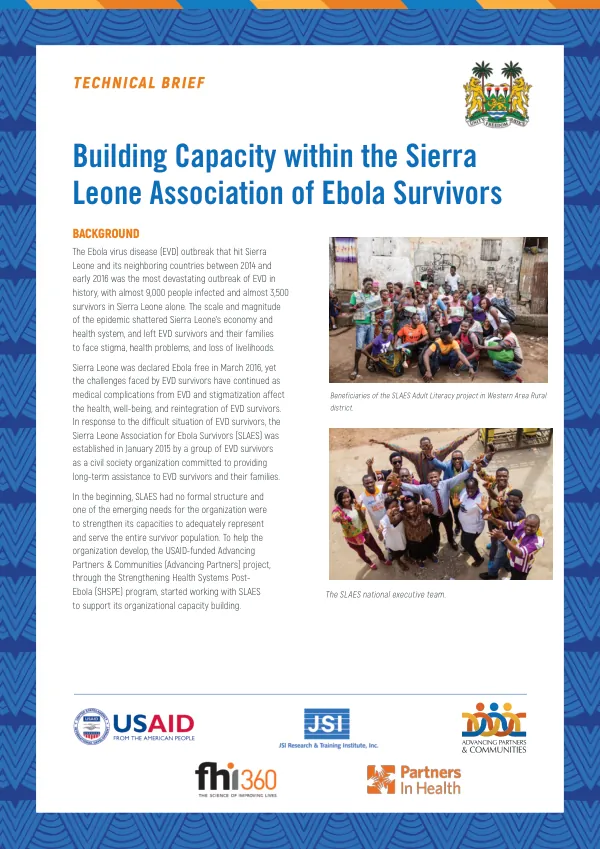
The Sierra Leone Association for Ebola Survivors (SLAES) was established in January 2015 by a group of Ebola virus disease (EVD) survivors as a civil society organization committed to providing long-term assistance to EVD survivors and their families.
2019 · 4 pages
Sign in to readA free account is required to download.
Abstract
The organization's primary goal is to advocate for and protect the rights of EVD survivors, who face stigma, health problems, and loss of livelihoods due to the devastating EVD outbreak in Sierra Leone between 2014 and 2016. To help SLAES develop its capacity to serve EVD survivors, the USAID-funded Advancing Partners & Communities (Advancing Partners) project, through the Strengthening Health Systems Post-Ebola (SHSPE) program, started working with SLAES in 2017. The program's objective was to help SLAES become an effective, autonomous institution that can serve EVD survivors and advocate for their needs. This was achieved by supporting SLAES to build its capacity, systems, and knowledge needed to be a functional grassroots organization. Three key components were identified as essential to helping SLAES accomplish its objective: organizational capacity building, support for key advocacy priorities and activities, and technical support to implement SLAES-led projects. Advancing Partners focused on building capacity within the SLAES national executive team, based in Freetown, with additional support to their district leadership teams in Kailahun, Kenema, Bo, Moyamba, Bombali, Kono, and Port Loko districts. Organizational capacity building was a priority area for SLAES, and Advancing Partners provided training and technical assistance to advance this area. The program supported the development of SLAES' mission and vision, strategic plan, board of directors, resource mobilization plan, operational policies and procedures, and financial systems. These areas were essential to enabling successful growth and sustainability of SLAES as a grassroots organization beyond the close of the project. Advocacy for survivor rights and responsibilities was also a key goal for SLAES, and Advancing Partners supported the development of the association's advocacy capacity. The program provided advocacy training to the SLAES executive leadership and tools to develop a strategic and evidence-based advocacy and communication strategy. These interventions were identified as paramount to enable SLAES to continue to develop as an organization and implement advocacy activities as part of their overall mission to support EVD survivors. Technical project implementation was also a critical component of the program, and Advancing Partners provided support to SLAES for the implementation of two priority technical projects: an Adult Literacy project in the Western Area Urban and Western Area Rural districts, and a Survivor to Survivor (S2S) project to provide community-based support that focuses on resilience and reintegration. The S2S project also guided EVD survivors' groups that want to start up income-generating activities in their communities. The results of the program were significant, with SLAES developing key documents valuable for the organization's operations, such as the constitution and finance and operational manual. The association's executive team members demonstrated an average improvement of 10 percent in skills related to administrative management, project management, financial management, and computer literacy. The Adult Literacy program in WAR and WAU completed, with 189 EVD survivors participating in the project, and 169 of them completing the course. The S2S groups project targeted a total of 150 participants, including EVD survivors, EVD-affected people, and widows, for a total of 14 weeks, with four groups engaging in soap making, two in rice selling, two in palm oil selling, one in groundnut planting, and another one in Gari production. The development of both the Adult Literacy and the S2S projects was accomplished through a collaborative effort between Advancing Partners and SLAES in order to mentor SLAES in the project design process, budgeting, work-planning, implementation, and monitoring of the activities. This mentorship approach has enabled SLAES leaders to carry on the work autonomously, and the organization has already started applying these skills to the development of future projects, which will contribute to making the organization sustainable.