DFID
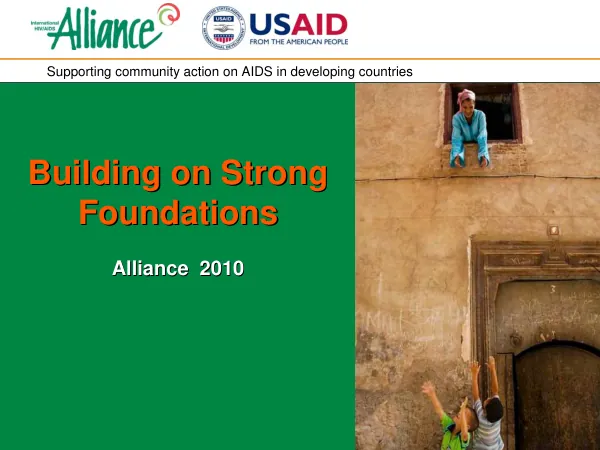
Building on Strong Foundations: Alliance 2010
The Alliance for Supporting Community Action on AIDS in Developing Countries was established in 2010 with support from the US Government.
15 pages
Sign in to readA free account is required to download.
Abstract
The organization has expanded geographically, creating partnerships and providing small and medium-sized grants to support community-led responses to the AIDS epidemic. Through its efforts, the Alliance has strengthened community-led responses, attracted other donors to enable scale and sustainability, and developed technical support capacity. US Government leadership has played a crucial role in the Alliance's success, bringing a new dimension to the response through the President's Emergency Plan for AIDS Relief (PEPFAR). PEPFAR has strengthened and scaled up indigenous responses, had a positive impact beyond HIV/AIDS, and has committed to bringing the voice of communities to the fore. The Alliance has also worked to strengthen health systems and has attracted funding from other sources, including the Global Fund, the World Bank, and the European Union. The Alliance has identified several areas of work and partnership opportunities to build on, including AIDS financing, civil society capacity, AIDS policy, and AIDS programming. In the area of AIDS financing, the Alliance has seen a significant increase in funding, with contributions from the US Government, the Global Fund, and other donors. The organization has also emphasized the importance of transparency and accountability to communities, particularly in reaching marginalized and vulnerable populations. In terms of civil society capacity, the Alliance has recommended that PEPFAR continue to transition from emergency relief to long-term strategic planning and capacity building. The organization has also highlighted the importance of HIV/SRH linkages, emergency relief/long-term responses, and high-quality toolkits for civil society organizations. Additionally, the Alliance has emphasized the need for good international policy frameworks, pricing of second-line drugs, and civil society and health systems strengthening. The Alliance has also identified several challenges in the area of AIDS policy, including scaled-up responses with service gaps, particularly for marginalized and vulnerable populations. The organization has also noted that treatment, testing, and prevention efforts have not shown expected synergies, and that PMTCT coverage remains low. Furthermore, the Alliance has highlighted the need for comprehensive OVC support, new technologies, and microbicides and vaccines to address the AIDS epidemic.