USAID DEC
Africa Supply Chain Roundtable: Accelerating Commitment to Patient-Centered Supply Chains
Sign inPEPFAR
Africa Supply Chain Roundtable: Accelerating Commitment to Patient-Centered Supply Chains
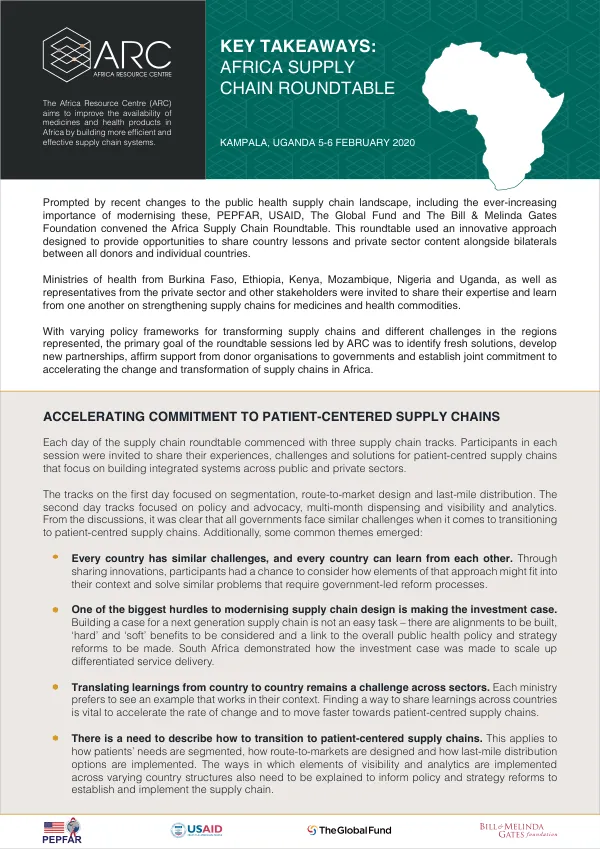
The Africa Supply Chain Roundtable was convened in 2020 by PEPFAR, USAID, The Global Fund, and The Bill & Melinda Gates Foundation to address the modernization of public health supply chains in Africa.
2020 · 3 pages
Sign in to readA free account is required to download.
Abstract
The roundtable brought together ministries of health from Burkina Faso, Ethiopia, Kenya, Mozambique, Nigeria, and Uganda, as well as private sector representatives and other stakeholders. The primary goal of the roundtable was to identify fresh solutions, develop new partnerships, and establish joint commitment to accelerating the transformation of supply chains in Africa. The roundtable sessions, led by the Africa Resource Centre (ARC), focused on sharing country lessons and private sector content alongside bilaterals between donors and individual countries. The discussions highlighted the need for patient-centered supply chains that focus on building integrated systems across public and private sectors. Every country faces similar challenges in transitioning to patient-centered supply chains, and sharing innovations can help countries learn from each other and solve similar problems. One of the biggest hurdles to modernizing supply chain design is making the investment case. Building a case for a next-generation supply chain requires aligning benefits, considering both "hard" and "soft" benefits, and linking to overall public health policy and strategy reforms. South Africa demonstrated how the investment case was made to scale up differentiated service delivery. Translating learnings from country to country remains a challenge across sectors, and finding a way to share learnings across countries is vital to accelerate the rate of change and move faster towards patient-centered supply chains. The roundtable discussions emphasized the need to describe how to transition to patient-centered supply chains. This includes segmenting patients' needs, designing route-to-markets, and implementing last-mile distribution options. The ways in which elements of visibility and analytics are implemented across varying country structures also need to be explained to inform policy and strategy reforms. The Africa Resource Centre aims to improve the availability of medicines and health products in Africa by building more efficient and effective supply chain systems. Key takeaways from the roundtable included the need for supply chain innovations that are tailored to each country's specific needs, context, and desired outcomes. Modernized supply chains must be patient-centric and oriented around impact, considering the needs of patients throughout the supply chain. Supply chain design affects all medicines delivered by ministries of health, not just antiretrovirals, and requires a sector-wide approach involving government, non-government organizations, faith-based bodies, and the private sector. Increased country-based knowledge sharing between government and private sector is needed to inform considerations related to developing supply chain-related policies and strategies.
Related documents