USAID DEC
Reaching the Global Target to Reduce Stunting: How Much Will it Cost and How We Pay for it?
Sign inTHE BILL AND MELINDA GATES FOUNDATION
Reaching the Global Target to Reduce Stunting: How Much Will it Cost and How We Pay for it?
The global target to reduce stunting in children under 5 by 40% by 2025 is unlikely to be met due to inadequate investment levels.
2015 · 5 pages
Sign in to readA free account is required to download.
Abstract
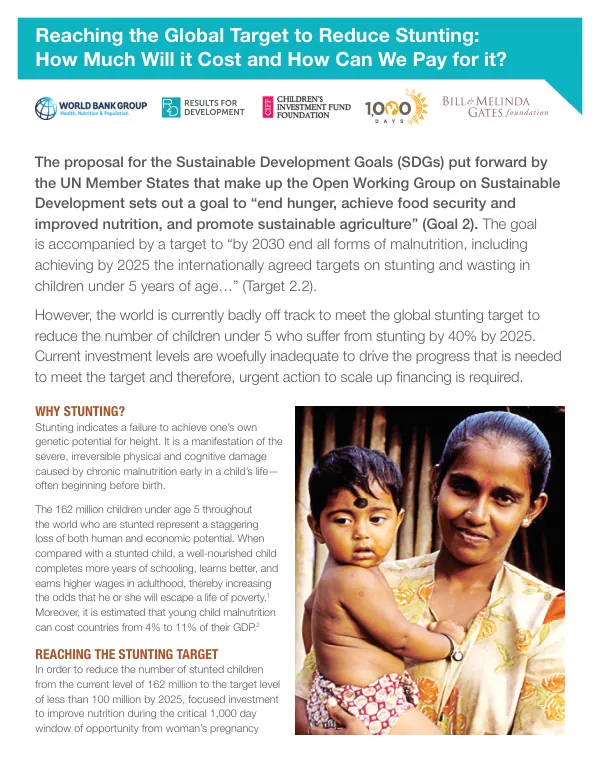
Current investment levels are insufficient to drive the progress needed to meet the target, and urgent action to scale up financing is required. Stunting indicates a failure to achieve one's own genetic potential for height, resulting from severe, irreversible physical and irreversible physical and cognitive damage caused by malnutrition early in a child's life. The 162 million children under 5 who are stunted represent a staggering loss of human and economic potential. Well-nourished children complete more years of schooling, learn better, and earn higher wages in adulthood, increasing the odds that they will escape a life of poverty. To reduce the number of stunted children from 162 million to less than 100 million by 2025, focused investment is required to improve nutrition during the 1,000-day window of opportunity from a woman's pregnancy to a child's 2nd birthday. Efforts to improve nutrition during this critical window must be intensified in countries where the burden of stunting is greatest. While globally, 1 in 4 children under 5 is stunted, the vast majority of them reside in Sub-Saharan Africa and South Asia. The estimated cost to meet the global stunting target is $8.50 per child per year, covering the scale-up of high-impact interventions focused on improving maternal nutrition, infant and young child feeding practices, and child nutrition through micronutrient supplementation and provision of nutritious complementary foods. The total additional investment required to scale up this package of interventions is $49.6 billion over the next 10 years, with smaller annual investments in the first 5 years and increasing gradually as progress is made. Improving young child nutrition is one of the best investments a country can make in its future prosperity. According to recent estimates, $1 invested in stunting reduction generates about $18 in economic returns. The modest additional investment of $8.50 per child under 5, if sustained over 10 years, would enable significant reductions in stunting. By 2025, about 74 million children would escape the impacts of stunting, and be able to fully contribute to growing their families' income and their national economies. Despite the overwhelming evidence of the economic impact of reducing young child malnutrition, domestic and donor investments in improving nutrition have been inadequate and slow. The estimated $2.9 billion currently being spent annually by country governments, donors, and households on the identified package of interventions targeted toward stunting reduction is insufficient to meet the target. The majority of this amount is invested by country governments, with donors contributing only $0.2 billion, and households adding $1.1 billion per year. A significant gap exists between the estimated costs of scaling up targeted interventions and the domestic, household, and donor resource flows over the next 10 years. The global target to reduce the number of stunted children by 40% will not be met if business as usual continues. To close the funding gap, a coordinated effort is required to mobilize additional resources from countries, donors, and new innovative financing mechanisms such as the Power of Nutrition Fund and the Global Financing Facility. In the Global Solidarity scenario, high-burden country governments would take on an additional $18 billion, while traditional donor aid would contribute $15.8 billion, and innovative sources such as the Power of Nutrition and the GFF would account for another $3.6 billion. On average, countries would increase their share of government health spending for nutrition from less than 1% to 4%, while donor funding for stunting reduction would peak at 4% of estimated Official Development Assistance in 2021 and decline after that. Past experience shows that it is possible to dramatically accelerate and sustain funding to lower stunting by 40% over a decade. Between 2001 and 2011, the global AIDS movement saw funding for prevention and treatment grow from less than $0.5 billion to over $15 billion—a rate of growth greater than what is needed to scale up programs to reduce stunting. With a combination of cost-effective interventions, political will, widespread support, and smart investments, ending child malnutrition within a generation is possible if the global community truly comes together to accelerate and sustain funding and action.
Related documents