CHEMONICS
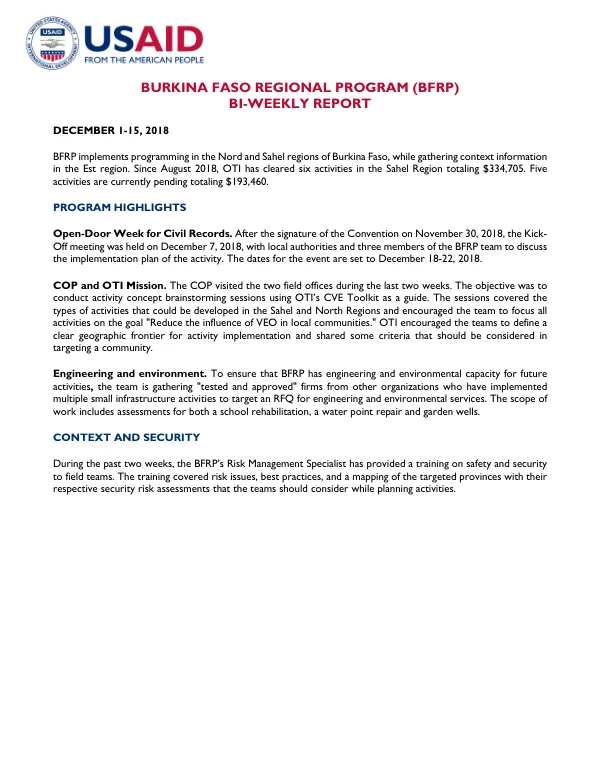
Burkina Faso Regional Program (BFRP) Bi-Weekly Report
The Burkina Faso Regional Program (BFRP) implements programming in the Nord and Sahel regions of Burkina Faso, while gathering context information in the Est region.
2018 · 1 pages
Sign in to readA free account is required to download.
Abstract
Since August 2018, the Office of Transition Initiatives (OTI) has cleared six activities in the Sahel Region totaling $334,705. Five activities are currently pending, totaling $193,460. Open-Door Week for Civil Records is a key activity, which was initiated after the signature of the Convention on November 30, 2018. A Kick-Off meeting was held on December 7, 2018, with local authorities and three members of the BFRP team to discuss the implementation plan. The event is scheduled to take place from December 18-22, 2018. The objective of this activity is to promote transparency and access to civil records in the targeted communities. A COP and OTI Mission was conducted during the last two weeks, with the objective of conducting activity concept brainstorming sessions using OTI's CVE Toolkit as a guide. The sessions focused on developing activities that could be implemented in the Sahel and North Regions, with the goal of reducing the influence of Violent Extremist Organizations (VEO) in local communities. The teams were encouraged to define a clear geographic frontier for activity implementation and to consider specific criteria when targeting a community. To ensure that BFRP has the necessary engineering and environmental capacity for future activities, the team is gathering information on "tested and approved" firms from other organizations that have implemented multiple small infrastructure activities. The scope of work includes assessments for a school rehabilitation, a water point repair, and garden wells. This will enable BFRP to target a Request for Quotation (RFQ) for engineering and environmental services. During the past two weeks, the BFRP's Risk Management Specialist provided a training on safety and security to field teams. The training covered risk issues, best practices, and a mapping of the targeted provinces with their respective security risk assessments. This training is essential to ensure that field teams are equipped with the necessary knowledge and skills to plan and implement activities safely and effectively.