CHEMONICS
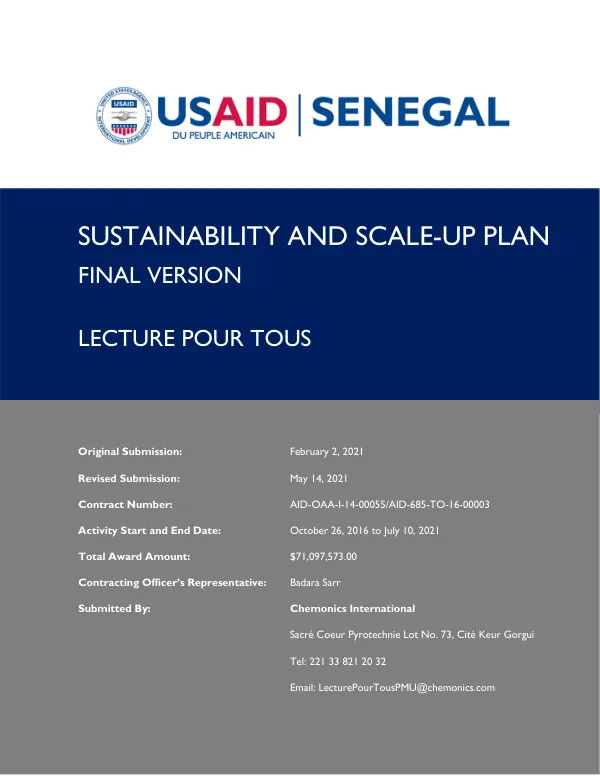
Sustainability and Scale-up Plan for Lecture Pour Tous
The Lecture Pour Tous program in Senegal aims to promote the durability and sustainability of early grade reading reforms.
2021 · 35 pages
Sign in to readA free account is required to download.
Abstract
The program was initiated in 2016 with funding from the United States Agency for International Development (USAID) and has been implemented in partnership with the Ministère de l'Education nationale (MEN). The program's primary objective is to improve the teaching of early grade reading in national languages and to prepare for the scale-up of these reforms at the national level. The program's context is rooted in the Lettre de Politique Générale pour le Secteur de l'Education et de la Formation (LPGS-EF) 2018-2030, which emphasizes the development of bilingual strategies centered on the use of national languages as languages of instruction. The Government of Senegal is implementing its ten-year education sector development program, PAQUET-EF 2018-2030, which aims to improve learning by using national languages. The program's strategic priorities include improving the learning environment, strengthening primary and secondary school curricula, and developing the quality assurance system. The PAQUET-EF 2018-2030 is an updated version of the initial PAQUET (2013-2025), which was aligned with the Government of Senegal's commitments at the national and international level. The updated version focuses on improving school performance in reading and mathematics, gives a greater role to national languages as a language of instruction, and takes into account the main reforms in the management of the education sector and the national decentralization policy. The Lecture Pour Tous program has made significant achievements in terms of sustainability since its inception. These achievements include the development of evidence-based methodologies that have been introduced into the policies and practices of the education system. The program has also supported the Ministère de l'Education nationale in implementing and institutionalizing key elements of reform in the teaching of early grade reading. The program's main assets and opportunities in terms of sustainability include the strong partnerships established with the MEN and other stakeholders, the development of a robust monitoring and evaluation system, and the creation of a sustainable financing mechanism. The program's remaining challenges and risks include the need to ensure the sustainability of the results and their eventual scale-up to all regions of the country, as well as the need to address the challenges of decentralization and the management of the education sector. The Lecture Pour Tous program aims to leave a lasting legacy in the education system by ensuring the sustainability of the results and their eventual scale-up to all regions of the country. The program's legacy will be characterized by the institutionalization of evidence-based methodologies, the strengthening of partnerships with the MEN and other stakeholders, and the creation of a sustainable financing mechanism. The program's final version of the Sustainability and Scale-Up Plan (SSP) describes the context and conceptual framework of the program, the main achievements in terms of sustainability, the main assets and opportunities in terms of sustainability, the remaining challenges and risks, and the legacy that the program wants to leave in the education system. The program's SSP is a critical component of the USAID contract, which mandates that a plan be developed one year after signing the contract for the activity that supports the program. The plan was updated three years after program inception and is now required to be finalized at the end of the fourth year. The final version of the SSP constitutes the culmination of the program's efforts to ensure the sustainability and scale-up of the EGR reforms initiated by Lecture Pour Tous.
Related documents