USAID DEC
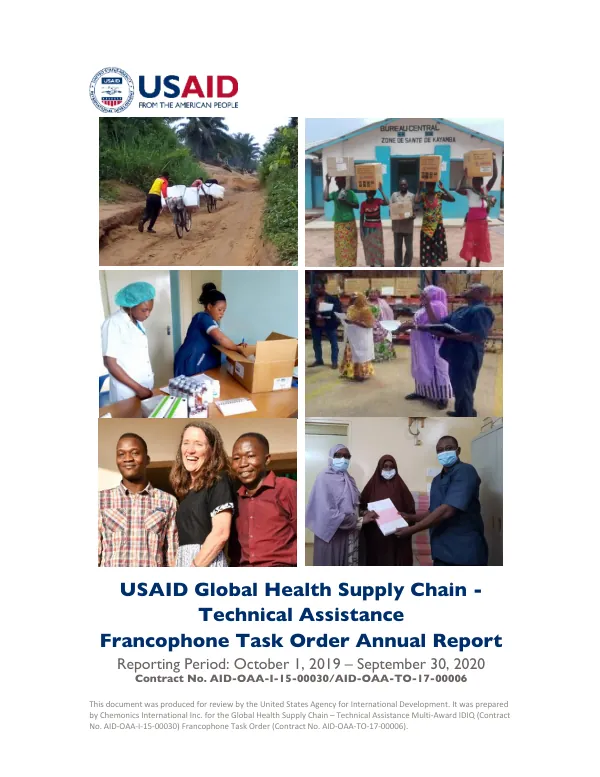
USAID Global Health Supply Chain Technical Assistance Francophone Task Order, Annual Report FY20
Sign inCHEMONICS
USAID Global Health Supply Chain Technical Assistance Francophone Task Order, Annual Report FY20
The Global Health Supply Chain Technical Assistance Francophone Task Order, a project funded by the United States Agency for International Development, aimed to strengthen supply chains in six countries: Benin, Burkina Faso, the Democratic Republic of the Congo, Niger, Senegal, and Togo.
2020 · 61 pages
Sign in to readA free account is required to download.
Abstract
The project focused on four key areas: supply chain workforce, enabling environment, digital supply chain, and last mile distribution. Efficient and sustainable supply chains depend on professional, well-trained supply chain workforces. The project developed workforce capacity through supportive supervision, resulting in improved Logistics Management Information System reporting and reduced stockouts. In Burkina Faso, for example, the Logistics Management Information System Reporting Completeness Rate improved by 22 percent, reaching 90 percent completeness, and Good Storage Rates improved by 10 percent in just three months. A high-functioning supply chain of the future depends on a new cohort of supply chain leaders. The project supported youth logistician professionals in Benin, who contributed to a resilient health system during the pandemic. These young professionals played a crucial role in supporting their communities and ensuring the continuity of essential health services. Sustainable progress in supply chain functions depends on a strong enabling environment. The project tackled challenges to create a coordinated and efficient system. In Senegal, the project strengthened public-private partnerships for resilience during the pandemic and long-term coordination and efficiency. In the Democratic Republic of the Congo, the project streamlined donor collaboration to harmonize support with a first-time nationalized end-use verification survey and applied performance-based incentives from the private sector to improve the performance of regional distribution centers. The project also coordinated support for innovations in supply chain, ensuring sustainability of successful programs. Globally, the Emergency Supply Chain Playbook, developed by the project in previous years, was introduced to 25 countries. Originally designed to help governments prepare for resurgences of pandemics such as COVID-19, the playbook provides a framework for emergency preparedness and response. In addition to these achievements, the project made significant progress in digital supply chain and last mile distribution. The project implemented electronic logistics management information systems, which improved the accuracy and speed of supply chain data. In the Democratic Republic of the Congo, for example, the project implemented an electronic logistics management information system, which reduced stockouts by 30 percent and improved delivery times by 25 percent. The project also focused on last mile distribution, ensuring that essential health products reached remote and hard-to-reach communities. In Benin, the project implemented a last mile distribution system, which improved delivery times by 50 percent and reduced stockouts by 40 percent. Overall, the Global Health Supply Chain Technical Assistance Francophone Task Order made significant progress in strengthening supply chains in six countries. The project's achievements demonstrate the importance of a well-functioning supply chain in protecting health and ensuring the continuity of essential health services.