USAID DEC
Burkina Faso Regional Program (BFRP) Success Story: Revitalizing Public High School to Provide Education
Sign inUSAID/SRI LANKA - OFFICE OF TRANSITION INITIATIVES
Burkina Faso Regional Program (BFRP) Success Story: Revitalizing Public High School to Provide Education
The Public High School in Burkina Faso has been a hub for displaced students fleeing violent extremist organization attacks since the security crisis began in 2015.
2020 · 1 pages
Sign in to readA free account is required to download.
Abstract
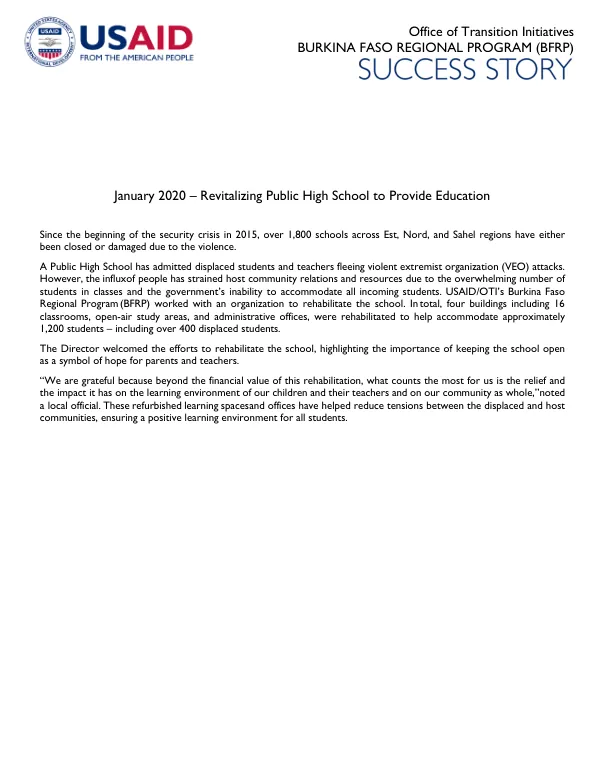
Over 1,800 schools in the Est, Nord, and Sahel regions have been damaged or closed due to the conflict. The influx of displaced students has strained host community relations, with classes overcrowded and the government unable to accommodate the influx of students. The Burkina Faso Regional Program (BFRP) of the Office of Transition Initiatives (OTI) worked with a local organization to rehabilitate the Public High School. The project aimed to provide a safe and conducive learning environment for approximately 1,200 students, including over 400 displaced students. The rehabilitation included the rehabilitation of four buildings, including 16 classrooms, open-air study areas, and administrative offices. The Director of the Public High School welcomed the rehabilitation efforts, highlighting the importance of keeping the school remaining open as a symbol of hope for parents and students. The Director noted that the rehabilitation has provided relief and improved the learning environment for students and teachers. The local official stated, "We are grateful for the financial value of this rehabilitation, but what counts the most for us is the relief and the impact it has on the learning environment of our children and their teachers and on our community as a whole." The rehabilitation of the learning spaces and offices has helped reduce tensions between the displaced and host communities, creating a positive learning environment for all students. The project has also provided a safe space for students to learn and grow, despite the ongoing security crisis in the region. The Public High School has become a beacon of hope for the community, providing a sense of normalcy and normalcy in the face of adversity. The success of the project has been attributed to the collaboration between the BFRP and the local organization. The partnership has enabled the rehabilitation of the school to be completed, providing a safe and conducive learning environment for students. The project has also helped to reduce tensions between the displaced and host communities, creating a more positive and inclusive learning environment for all students.
Related documents