J.D.G. COMMUNICATIONS, INC.
USAID Snapshot Template - Success Story
The Burkina Faso Regional Program (BFRP) was implemented by USAID/OTI from February 2020 to support alternative employment options for youth in Northern Burkina Faso.
2020 · 1 pages
Sign in to readA free account is required to download.
Abstract
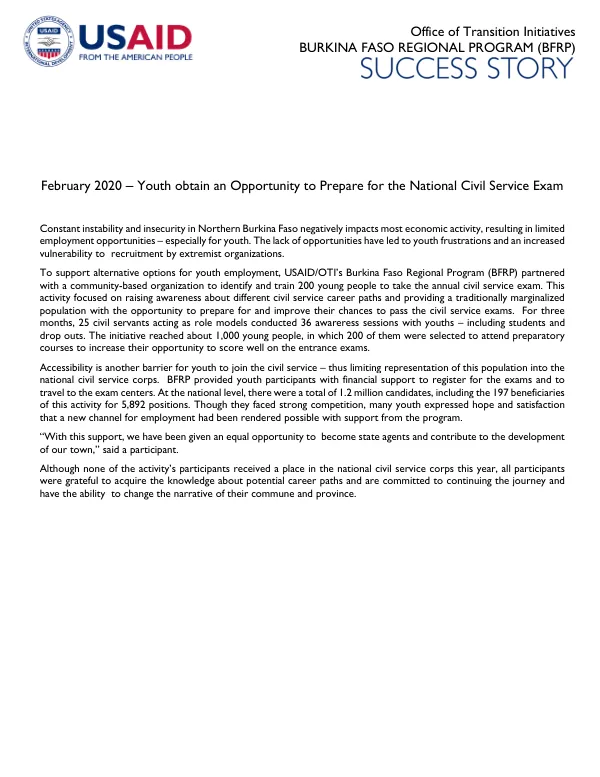
The region has experienced constant instability and insecurity, resulting in limited economic opportunities and increased vulnerability to extremist organization recruitment. To address this issue, BFRP partnered with a community-based organization to identify and train 200 young people to take the annual civil service exam. The initiative focused on raising awareness about different civil service career paths and providing a traditionally marginalized population with the opportunity to prepare for and improve their chances of passing the civil service exams. Twenty-five civil servants acting as role models conducted 36 awareness sessions with approximately 1,000 young people, including students and dropouts. From this group, 200 participants were selected to attend preparatory courses to increase their opportunity to score well on the entrance exams. BFRP provided financial support to the selected participants to register for the exams and travel to the exam centers. The program aimed to increase representation of youth from the region in the national civil service corps. Although the participants faced strong competition, many expressed hope and satisfaction that a new channel for employment had been rendered possible with support from the program. The initiative also aimed to address accessibility barriers for youth to join the civil service. BFRP provided financial assistance to the participants, enabling them to register for the exams and travel to the exam centers. At the national level, there were a total of 1.2 million candidates, including the 197 beneficiaries of this activity, competing for 5,892 positions. Despite not receiving a place in the national civil service corps, the participants were grateful for the knowledge acquired about potential career paths and expressed commitment to continuing their journey. The program's support provided an equal opportunity for the participants to become state agents and contribute to the development of their town, as expressed by one participant.
Related documents