CHEMONICS
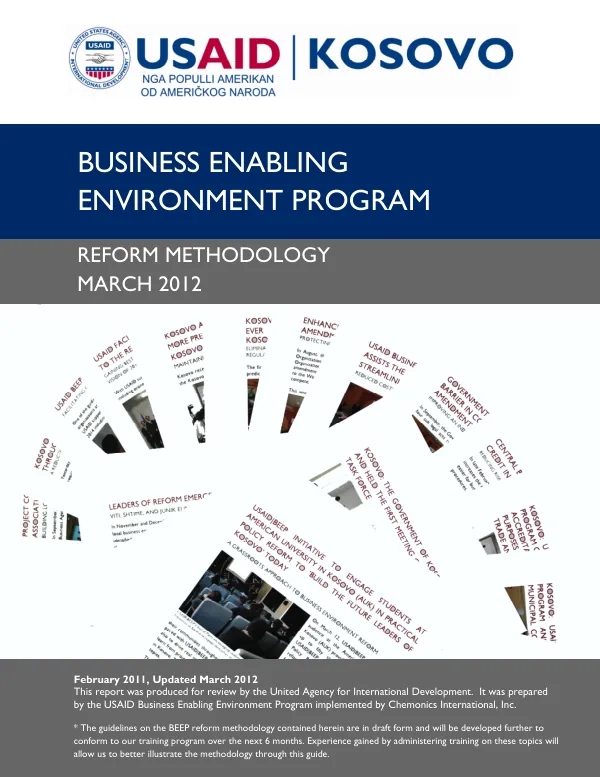
Business Enabling Environment Program Reform Methodology
Business Enabling Environment Program Reform Methodology The purpose of business environment reform is to enable entrepreneurs to engage in free economic activity with the end goal of promoting wealth creation.
2012 · 49 pages
Sign in to readA free account is required to download.
Abstract
Economies are presented with unique opportunities for transformational and institutional change, whether demand-driven by domestic private or public entities or supply-driven through international support. Reform efforts focus not only on changing the legal environment but also on the implementation of existing laws and norms that promote free economic activity. The reform strategy presented in this guide describes the five main phases of the reform process, from constraint identification to monitoring proper implementation of reforms. The methodology can be used by both the private and public sector, with domestic institutions driving reforms and continuously engaging in business environment monitoring and improvement. The typical reform process is composed of the following phases: information gathering, analysis, recommendations, implementation, and monitoring. Information gathering is conducted to assess the existing business legal and regulatory environment and identify unjustified constraints on economic freedom. This phase involves collecting information from various sources, including individual businesses, business community representatives, the legal and regulatory framework, policy documents and strategies, and third-party analysis. Several tools can be utilized to gather information, including focus groups, interviews, surveys, and roundtables. Focus groups are a data collection procedure in the form of a carefully planned group discussion, designed to obtain diverse ideas and perceptions on a topic of interest in a relaxed, permissive environment. They are effective mechanisms for providing qualitative information and are useful when discussing sensitive issues. The reform process involves a series of questions to identify business requirements and determine whether the market can satisfy the objectively justified compelling public interest. If the compelling public interest is not already addressed by another law, regulation, or step, and if it is not met through the least intrusive, burdensome, or restrictive way possible for citizens, then the law, regulation, or operation should be revised to eliminate unnecessary private sector burdens or government costs. The law or regulation should be implemented in the most efficient, least costly way for government, and its implementation should be monitored for continued compliance with the analytical framework. The reform methodology presented in this guide is designed to be used by both the private and public sector, with domestic institutions driving reforms and continuously engaging in business environment monitoring and improvement. The guide provides a framework for identifying business requirements, gathering information, analyzing data, making recommendations, implementing reforms, and monitoring their impact. By following this methodology, economies can leverage opportunities for transformational and institutional change, promoting wealth creation and economic freedom.