USAID DEC
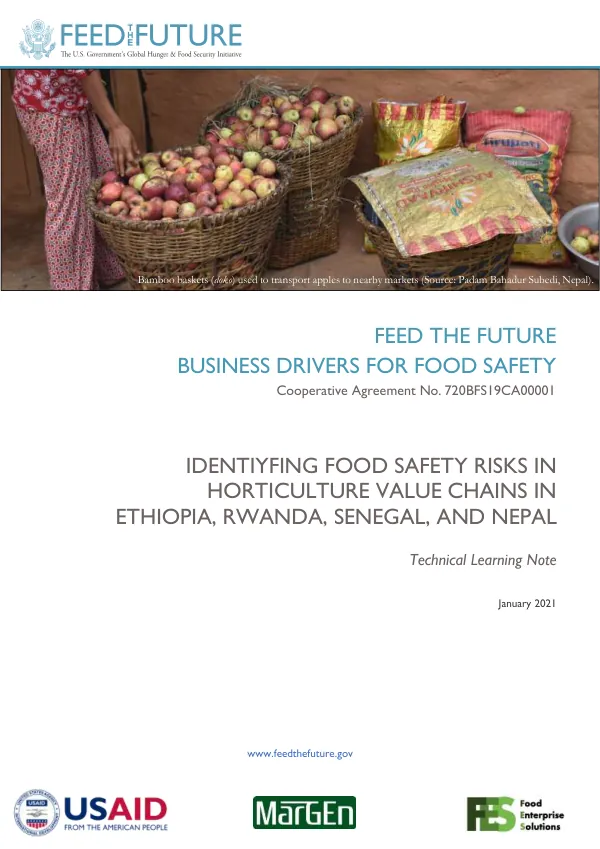
Business Opportunities for Horticultural Crops in Ethiopia, Rwanda, Senegal, and Nepal
Sign inUSAID DEC
Business Opportunities for Horticultural Crops in Ethiopia, Rwanda, Senegal, and Nepal
Horticulture crops such as fruit and vegetables play a significant role in income generation and help to ensure nutritional security via small business activities for many countries in Africa and Asia.
2021 · 6 pages
Sign in to readA free account is required to download.
Abstract
In the case of Ethiopia, Rwanda, Senegal, and Nepal, the majority of the population is directly or indirectly involved in agriculture. A Commodity System Assessment Methodology (CSAM) was undertaken in these countries, initiated by Feed the Future Business Drivers for Food Safety (BD4FS) and conducted by MarGEn, in recognition of the immediate necessity for interventions to reduce food losses and ensure food safety. For each country, two important horticulture crops were selected considering consumption status, nutritional aspects, degree of postharvest loss, food safety issues, and scope for business opportunities. The selected crops included tomato and mango in Ethiopia and Senegal, tomato and banana in Rwanda, and tomato and apple in Nepal. A series of key informant interviews and field studies were conducted from October to December 2020 to complete the assessment of these crops. This report focuses on the portion of the study that identified potential business opportunities for micro, small, and medium enterprises (MSMEs). The detailed commodity assessment identified several important business opportunities in the areas of production, cold chain management, packing, and processing to create value-added products. Additionally, there is a need for training services in all of these areas to provide businesses the technical knowledge and skills to utilize new tools and technologies. Improved tomato seed production and commercialization are not yet developed into a structured system, resulting in shortcomings in seed availability and timeliness of delivery. If the hybrid seeds can be produced at the local level by trained MSMEs, it would not only encourage quality production in the nation but would also contribute to sustainability of tomato production. The ill-effects of various soil-borne diseases on the tomato crop can be avoided by vegetable grafting. Though this technology is not yet accessible to farmers, grafting could be a good business opportunity for vegetable nurseries if they are provided sufficient training. In Nepal, there is good demand for high-yielding apple varieties and quality grafts tolerant to different biotic and abiotic stress conditions. There is a scope for the development of high-quality hybrid varieties, cultivars suitable for processing, as well as the development of nurseries to produce good quality grafts. In Rwanda, there is a huge demand for virus-free banana planting materials, and only a few organizations are commercially producing tissue culture plantlets. There is scope to train and involve the medium scale entrepreneurs in the production of disease-free planting material using tissue culture methods. In Ethiopia and Senegal, the majority of the mango orchards are of local varieties. Due to lack of proper pruning practices, the trees are very tall, making it difficult for crop management practices and harvesting. The unavailability of sufficient cold chain infrastructure renders farmers, wholesalers, and retailers unable to safely handle and store their produce. This situation is responsible for both qualitative and quantitative postharvest losses in all four countries. The cold chain is still in the nascent stage and is being practiced mostly by the processing and export industries. There is a good scope for development of community-based cold storage as well as other low-cost cold infrastructures. A temperature-managed packhouse including machines for weighing, grading, sorting, washing, air drying, and packing can be developed by the local small and medium scale entrepreneurs and pay-per-use services can be offered to different supply chain stakeholders. The appropriate packaging material plays a major role in protecting the produce from damage, thereby protecting quality and reducing postharvest losses throughout the supply chain. There are different materials available for packaging to suit specific needs of the produce handled. Some reports elucidate that covering the banana bunches and mango fruits with plastic bags at the early maturing stage on the plant would decrease the pest and disease incidence and thereby reduce the need for chemical sprays. Many containers and packaging materials are well known and utilized for fruits and vegetables. In the countries studied, reusable plastic crates (RPCs) as a packaging material are in high demand as this simple technology has potential to reduce the losses from 30% to less than 10% and increase the earnings of the farmer or trader. Encouraging local manufacturing of packaging materials is a niche to consider, and it would reduce the cost of the materials and make them more available to stakeholders. These units can be designed not only to manufacture packaging materials but also to produce a range of products such as harvesting implements, storage bags and containers of different sizes and thickness, containers for processed products, covers, tarps and more. Using recycled plastic to manufacture would provide a win-win situation where plastic pollution is also reduced. Processing fruits and vegetables into value-added products is a potential strategy for reducing postharvest losses while also increasing the availability of the products and promoting their consumption. When processed properly, following all the food safety standards, the value-added products earn good prices at both regional and international markets. Therefore, it has gained the attention of several planners and policymakers as value-added products can contribute to the economic development of rural populations. Tomato