USAID
Cold Chain Management and Food Safety in Ethiopia, Rwanda, Senegal, and Nepal
Cold Chain Management and Food Safety in Ethiopia, Rwanda, Senegal, and Nepal is a critical issue that affects the quantity and quality of food, as well as food safety and quality standards.
2021 · 4 pages
Sign in to readA free account is required to download.
Abstract
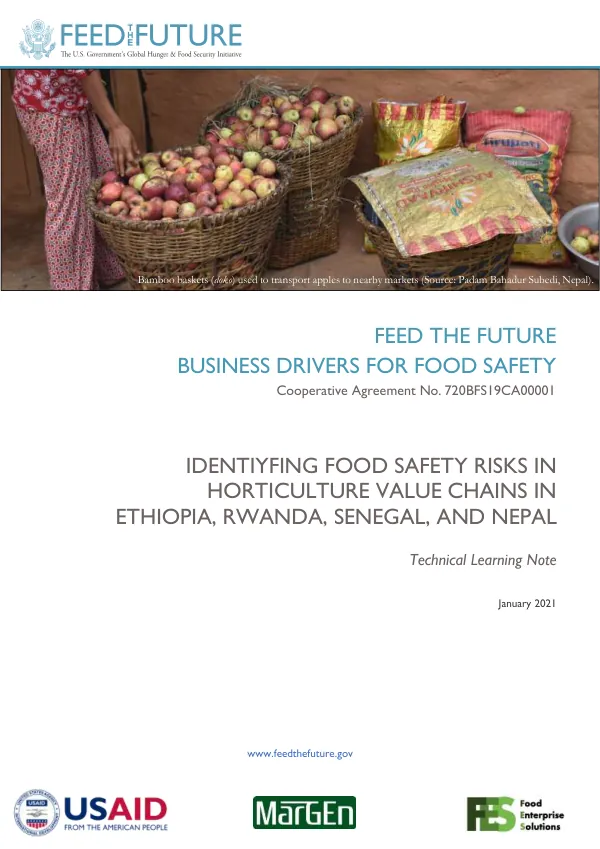
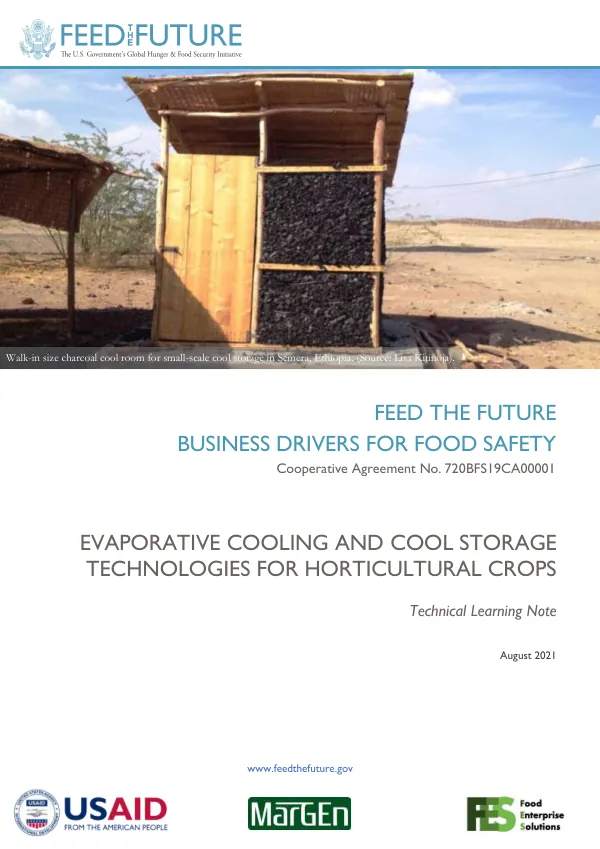
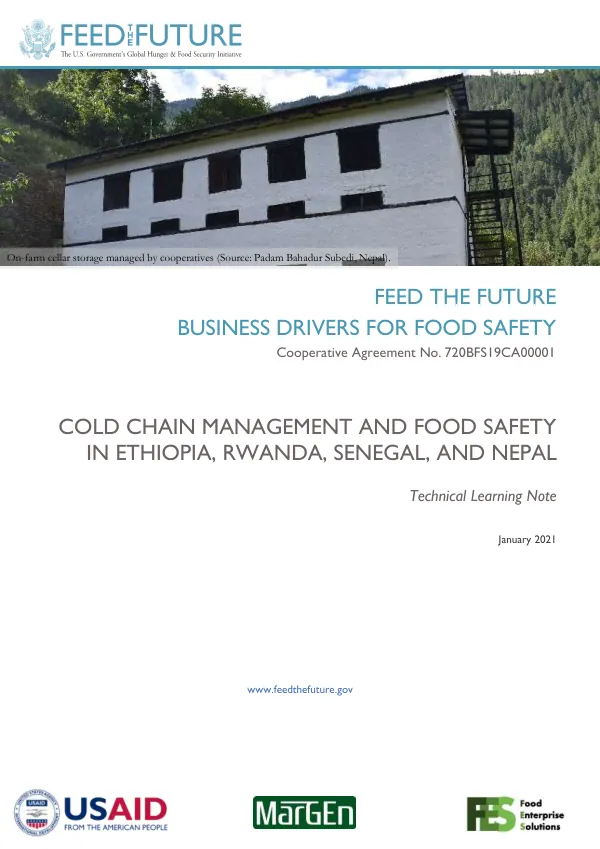
The cold chain is the series of actions and equipment applied to maintain the product or commodity within a specified range of low temperature during the steps of supply chain. A reliable, integrated, and efficient cold chain can reduce losses and waste in the quantity and quality of food, improve the efficiency of food supply chains, and ensure compliance with food safety and quality standards. The four countries studied, Ethiopia, Rwanda, Senegal, and Nepal, lack essential infrastructure such as proper roads and reliable electricity grids, which present significant challenges for investment in the cold chain, especially in rural areas. In Rwanda, the majority of handlers and marketers are not using cold chain infrastructure, while precooling and cooling processes are rarely performed for fresh tomatoes. Harvested tomatoes are typically exposed to direct sun, with little or no shading. Only a few local processors have refrigeration units to handle small quantities of tomato. Similarly, for bananas, which come from all corners of the country to Kigali, Rwanda markets, there is no proper cold chain. Refrigerated trucks are very limited in number, and the transport of horticultural crops in these open trucks is still a challenge. In Senegal, the horticultural crops are mostly produced in rural areas or outside cities, while the cold chain infrastructure is more often concentrated in or around urban areas. The handling, storage, transport, sale, and consumption of perishable food commodities in rural areas often take place entirely outside of temperature-controlled environments. The stakeholders are unaware of the importance of temperature control or report that they cannot afford it. Handlers have pointed out the lack of cold storage equipment as the reason why mangoes are being handled by wholesalers and retailers in ambient atmospheric conditions, which causes significant losses due to exposure to heat. In Ethiopia, there are no cooling or storage facilities for mango fruit for small-scale producers. However, large-scale producers (exporters) have refrigerated transport and storage facilities. The precooling is done at wholesalers' level, but they pre-cool by using ambient temperature water and can remove only about 50% of field heat. This is still too warm compared to the standard of removing 7/8th of field heat before the product packaging or storage, to increase shelf life, reduce losses, ensure quality, and food safety. In Nepal, apple is a high-value crop, and the fruit losses can be minimized by proper precooling and cold storage with temperatures below 0°C. In general, the ripe fruits are picked and stored in the on-farm cellar storage and then packed. The precooling and cold chain systems are not well developed in Nepal for apple storage. The cold storage facilities are far away from popular apple-growing regions and do not have sufficient electricity supply. In the case of tomato, precooling chambers and cold chain systems are not common. Community precooling collection centers and grading systems are seen as big opportunities for investment and business ventures. The effective cold chain management from farm to retail is essential to reduce postharvest losses and ensure food safety. There are several techniques available for temperature management, and the method used depends on the crop requirements and the local costs. Strategies for cold chain development should be adapted to specific commodity groups, and to geographic and socioeconomic conditions. Good management of the integrated steps, including maintenance, is needed. Collaboration among multiple stakeholders involved in the unbroken cold chain of a particular commodity is vital for success. Governments can provide key services, such as roads, electricity, public infrastructure, and legislation, which can facilitate cold chain development. Education, awareness, and capacity building are also critical services that governments can provide. The cold chain begins on the farm. Fresh produce is best harvested during the cooler times of the day, and bins of produce should be placed in the shade. Keeping produce in the shade can help to reduce pulp temperature by 10 to 15°C. For small-scale farmers, a shade structure is a simple and affordable technology that can return its cost after only a few uses. Wrapping a bin or covering it with a tarpaulin and leaving it in the sun is not nearly as effective as putting the bin in the shade. Pre-cooling can be done by different methods, including hydro-cooling, room cooling, top icing, forced air-cooling, or vacuum cooling. Hydro-cooling suits crops such as fruits, melons, and leafy vegetables but only when microbiologically safe water is available to minimize cross-contamination. Mangoes and tomatoes can be pre-cooled using hydro-cooling, but the water should not be too cold. The lowest safe temperature for tropical and sub-tropical crops is generally 13 to 15°C. Considering the sustainable and economic aspects, community-based precooling facilities are a good option for the four countries. Transport is an important link in the cold chain as temperature maintenance is critical in this link to preserve the quality, safety, and shelf