USAID
Evaporative Cooling and Cool Storage Technologies for Horticultural Crops
Horticulture crops are a vital source of nutritional security and income generation for small business activities.
2021 · 8 pages
Sign in to readA free account is required to download.
Abstract
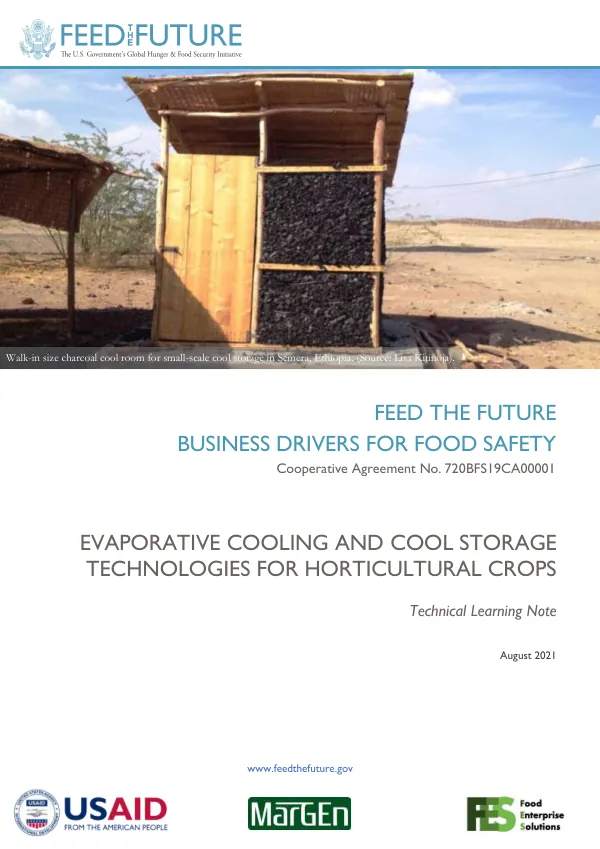
However, the high water content of fresh fruits and vegetables leads to deterioration and decay once harvested. The optimal storage conditions vary for different produce, but many fruits and vegetables are best stored in a cool and humid environment to prevent rot and dehydration. The storage conditions and temperature management along the supply chain play a crucial role in preventing postharvest losses. The cold chain management should start from the time the produce is harvested. In developing nations, most techniques for cooling and storing fruits and vegetables rely on electricity, which is unavailable or unaffordable in rural areas. Evaporative cooling devices, which function without electricity, are well-suited for regions without electricity access or where electricity-dependent cooling and storage technologies are not affordable. Evaporative cooling occurs by the removal of heat through evaporation of water from the surface of the storage device. The evaporative cooling effect causes a decrease in temperature and an increase in the relative humidity inside the storage device, creating conditions that increase the shelf life of many fruits and vegetables. Water has to be added at regular intervals to maintain the cooling effect, and the watering frequency required can vary from several times a day to only a few times a week, depending on the storage device's material and design as well as the weather conditions. Different low-cost self-constructible designs of small-scale, evaporative-cooled pre-cooling and storage units have been reviewed. The Zero Energy Cooling Chamber (ZECC) is a low-cost passive cooling chamber constructed from locally available materials, including bricks, sand, wood, straw, gunny or burlap sack, and twine. The ZECC design is composed of a double brick wall structure, supported by a base layer of brick, and covered with a straw mat. The space in between the two brick walls is filled with clean river sand, which retains the water that is added. Inside the ZECC, food is placed in unsealed plastic crates or containers, to keep the produce off the ZECC's floor, allow them to breathe, and allow for the circulation of cool, humid air inside the device. The evaporative cool room, a larger version of the ZECC, has been designed by Indian Agricultural Research Institute (IARI) and constructed by Central Institute of Post-Harvest Engineering and Technology (CIPHET), Ludhiana, India as a small cold room (6 to 8 MT capacity) and needs only the addition of a small water pump and a ventilation fan at the roofline. Zero Energy Cellar Storage is a traditional cellar storage that uses natural cooling and insulation of the earth to maintain stable cool temperatures and high humidity in the chambers. It has been proved to be an effective and cost-efficient technology to store fruits and vegetables in hilly areas of Nepal. The Charcoal Cool Room is a type of walk-in storage chamber made of an open timber frame with sides filled with charcoal, which is continuously kept moist. The timber frames are fixed with chicken-wire mesh leaving up to a 10 cm gap for charcoal to be filled. The charcoal should not be compressed or packed down while filling as it would reduce free air movement across the wall. The temperatures inside the cooling structure can be maintained at about 5-10° C lower than the ambient temperature, depending upon the prevailing climatic conditions. In rural areas of developing nations, the supply of electricity is often erratic, and cooling technologies that require electricity may not be feasible options. Depending upon the crops being handled and the climatic conditions of the region, evaporative cooling structures are a convenient option for storing horticulture produce for a longer period. These structures can prevent food loss, increase access to fresh produce, and create opportunities for additional income generation in off-grid areas and where electricity is intermittent or prohibitively expensive.