USAID DEC
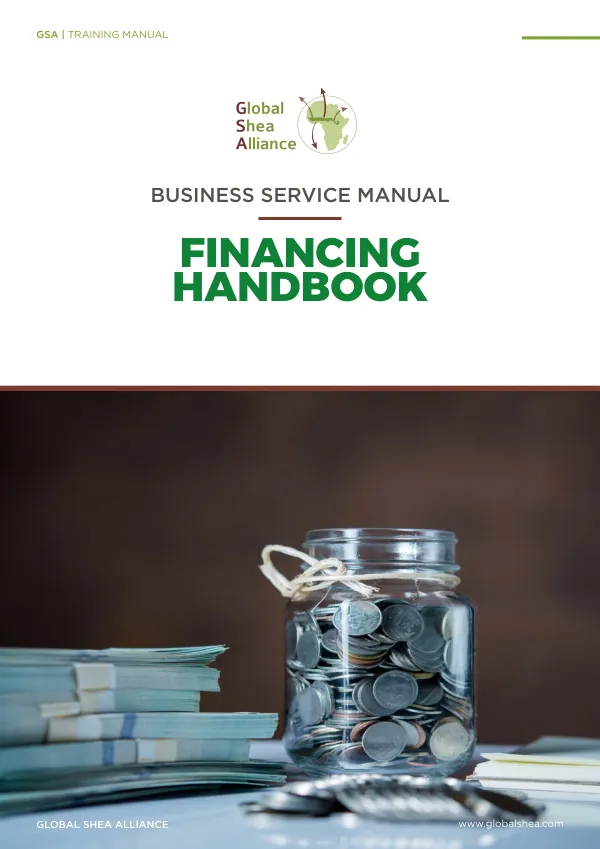
Business Service Manual: Financing Handbook for Shea Producers
The Global Shea Alliance (GSA) has developed a handbook to accelerate the adoption and scaling of agricultural financing for women shea cooperatives.
20 pages
Sign in to readA free account is required to download.
Abstract
The handbook aims to aggregate and highlight the different types of financing options available to shea producers, addressing the specific constraints that exclude female shea producers from the formal financial market. A needs assessment has been carried out to highlight the areas where different financing options can be utilized to improve the shea value chain, provide financial inclusion for the value chain actors, and create an enabling environment for commercial partners. The handbook focuses on various financing options, including buyer pre-financing, SLA financing, crowd-funding, government agricultural loans, microfinance banks, and other innovative finance delivery channels. Buyer pre-financing is an innovative model that aims to improve shea nut production, encourage structured markets arrangements, and increase shea producers' income. This model involves the buyer providing sufficient working capital to shea producing cooperatives to enable them to complete new orders. The pre-finance is usually a percentage of the value of the agreed shea nuts to be provided by the cooperative to the buyer. Buyer pre-financing loan terms are adaptable and can be customized to situational circumstances and community-specific needs. However, there are some key characteristics/loan terms that are generally present in most buyer pre-financing scenarios, including the pre-finance being a crop receipt in the form of a bond issued by shea producer cooperatives, being subject to the promissory note rules, and being secured by a security right created over the future products or a mortgage over the farming land. The advantages of buyer pre-financing include providing a collateral substitute, complementing or substituting other forms of collateral used by shea producers, and increasing shea producers' income. However, the limitations of buyer pre-financing include the need for careful contract negotiation and adherence to contractual terms to achieve success through this financing model. The handbook also explores other financing options, including SLA financing, which involves the creation of a social fund to provide financial support to shea producers. SLA financing aims to improve the shea value chain and provide financial inclusion for the value chain actors. The handbook also discusses crowd-funding, which involves raising funds from a large number of people, typically through an online platform. Crowd-funding can be used to finance shea production and provide financial inclusion for shea producers. In addition, the handbook explores government agricultural loans, which are provided by governments to support agricultural development. Government agricultural loans can be used to finance shea production and provide financial inclusion for shea producers. The handbook also discusses microfinance banks, which provide financial services to low-income individuals and small businesses. Microfinance banks can be used to finance shea production and provide financial inclusion for shea producers. Overall, the handbook provides a comprehensive overview of the different financing options available to shea producers, highlighting the advantages and limitations of each option. The handbook aims to accelerate the adoption and scaling of agricultural financing for women shea cooperatives, improving the shea value chain and providing financial inclusion for the value chain actors.
Related documents