ACDI/VOCA
C-AME COMMUNICATION TOOL: Perspectives and challenges for reconciliation
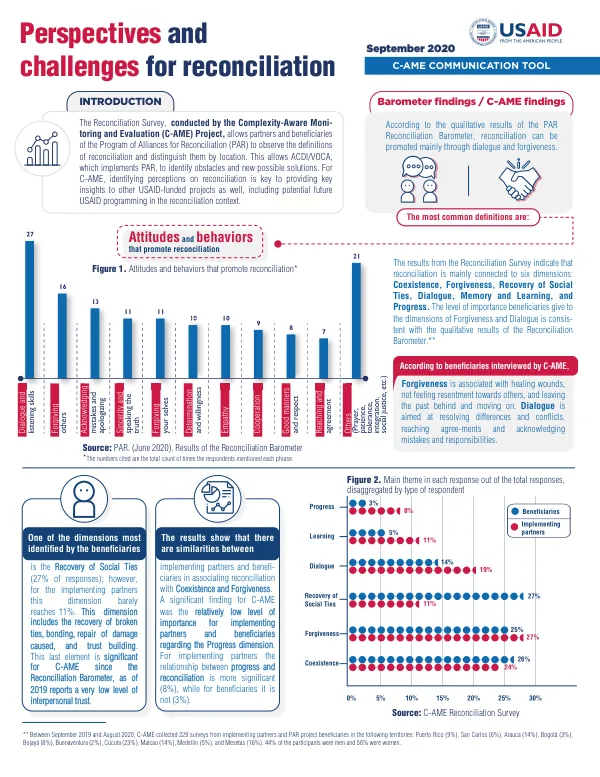
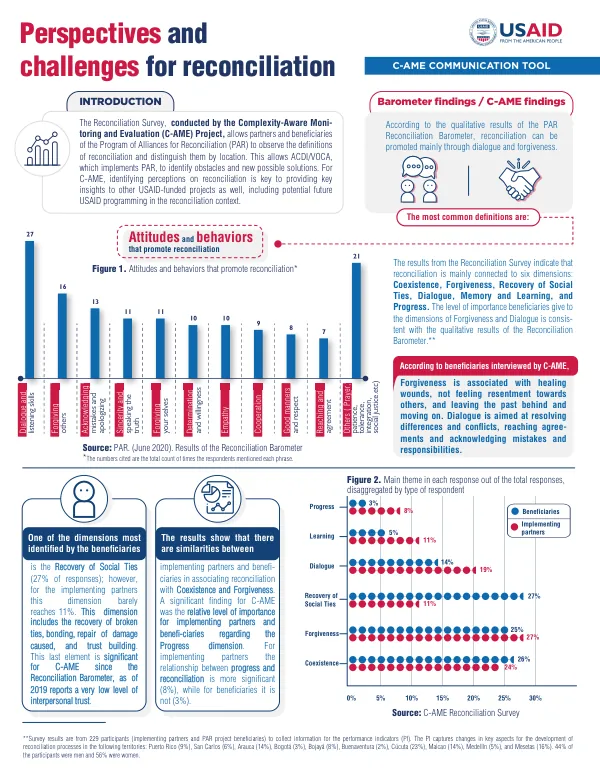
Reconciliation processes in various territories have been assessed through the C-AME Reconciliation Survey, which collected information from 229 participants, including implementing partners and PAR project beneficiaries.
2020 · 2 pages
Sign in to readA free account is required to download.
Abstract
The survey aimed to identify perceptions on reconciliation and distinguish them by location, allowing ACDI/VOCA to identify obstacles and new possible solutions for the Program of Alliances for Reconciliation (PAR). The results indicate that reconciliation is mainly connected to six dimensions: Coexistence, Forgiveness, Recovery of Social Ties, Dialogue, Memory and Learning, and Progress. The level of importance given to the dimensions of Forgiveness and Dialogue is consistent with the qualitative results of the Reconciliation Barometer. Forgiveness is associated with healing wounds, not feeling resentment towards others, and leaving the past behind and moving on. Dialogue is aimed at resolving differences and conflicts, reaching agreements and acknowledging mistakes and responsibilities. Both women and men have a positive or very positive perception of the reconciliation processes in their communities, with women having a higher level of positive or very positive perception compared to men. While one out of two participants thinks that there has been progress in reconciliation processes in their territory, one out of three participants thinks that there has been no progress or only marginal progress. The main reasons cited for the lack of progress include the continuity and intensification of violence in the territory, insecurity issues in their communities, high levels of poverty, polarization, political exclusion, and persistence of gender inequalities and discrimination against the migrant population. The survey also identified possible actions that PAR could continue to strengthen through its interventions. According to those surveyed, progress towards reconciliation has been due to promoting personal changes to facilitate the reconciliation process, strengthening coexistence in the communities, promoting integration between different ethnic and cultural groups, using contingent situations to generate greater unity between families and communities, and promoting the inclusion of migrants. The results of the survey provide key insights for other USAID-funded projects, including potential future USAID programming in the reconciliation context. The C-AME Reconciliation Survey highlights the importance of addressing the underlying factors that hinder reconciliation processes, such as poverty, polarization, and gender inequalities. By understanding the perceptions and challenges of reconciliation, PAR and other stakeholders can develop targeted interventions to promote reconciliation and improve the lives of communities affected by conflict. The survey's findings also underscore the need for continued support and resources to address the complex challenges facing these communities.