DEMOCRACY INTERNATIONAL, INC.
Challenges to Reconciliation: An Ethnic Perspective
The Complexity-Aware Monitoring and Evaluation (C-AME) project for the Program of Alliances for Reconciliation (PAR) analyzed information collected in a Reconciliation Survey (RS) and considered the results of Developmental Evaluations completed throughout the PAR implementation process.
2020 · 10 pages
Sign in to readA free account is required to download.
Abstract
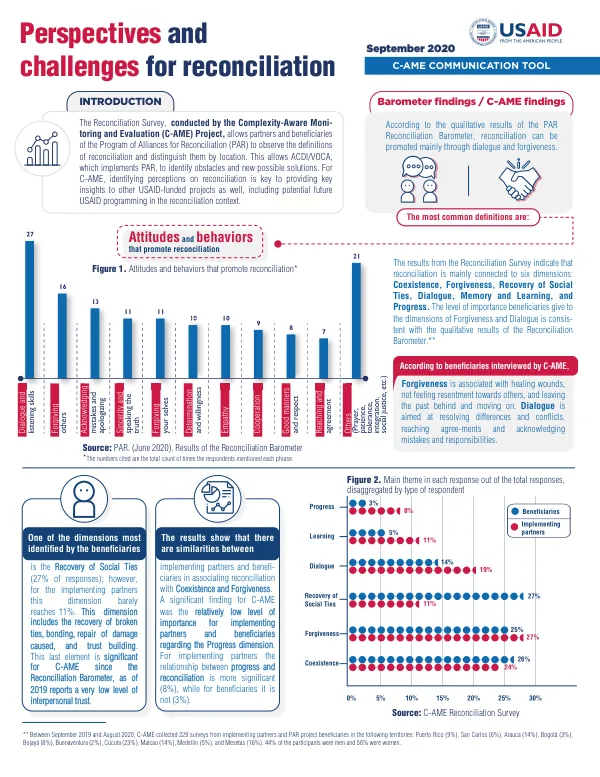
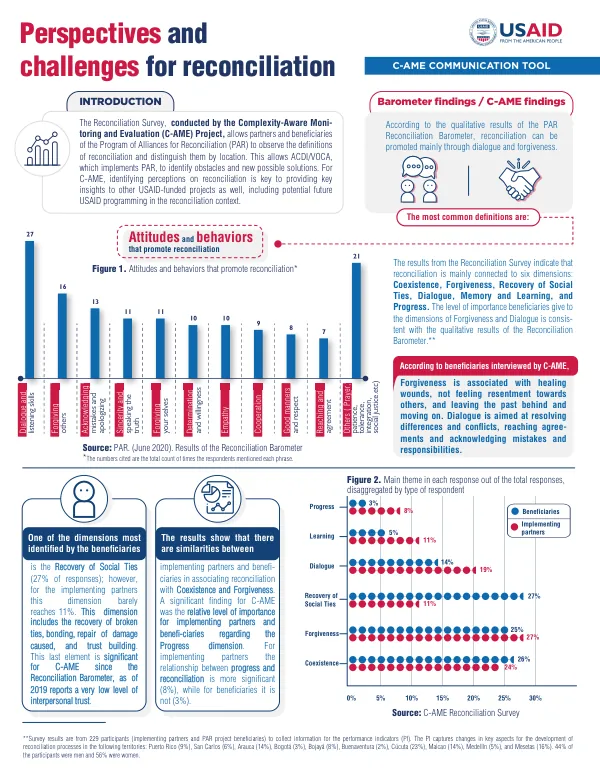
The RS collected information in 10 of PAR's target municipalities between September 2019 and October 2020, investigating perceptions and roles around reconciliation. The survey was collected from an exploratory sample of 291 people, of whom 78 percent were PAR beneficiaries, 13 percent were implementing partners, 8 percent did not define their role with respect to PAR, and only 1 percent reported indirect knowledge of PAR. The largest segment of participants reported that they were between 30 and 50 years old (48 percent), while 27 percent were between 14 and 29 years old and 25 percent were more than 50 years old. Survey respondents self-reported as mestizo (42 percent), Afro-Colombian (15 percent), indigenous (13 percent), and white (8 percent). The RS data do not claim to describe causal relationships, but provide evidence to identify challenges and potential opportunities for improvement. When respondents were asked for the meaning of reconciliation, they usually related it to matters of collective work, such as coexistence, reconstructing the social fabric, and dialogue. These collective-first definitions were more common among respondents who self-identified as indigenous or Afro-Colombian, groups in which the plurality emphasized the reconstruction of the social fabric. This category encompasses actions that respond to the harm caused by armed conflict, state abandonment, and distrust of institutions, and is therefore useful to address these ethnic communities' historical grievances. Individual-centric visions of reconciliation can be an advantage for initiatives that address beneficiaries' emotional wellbeing as a catalyst for reconciliation. Nevertheless, they can pose challenges to sustainable change in behaviors, attitudes, and relationships at community, social, and political levels. Programs with extensive expertise in reconciliation and inclusion, like PAR, illustrate some of these challenges. PAR's intervention strategy, the Reconciliatory Focus (ER), consists of workshops and methodologies with a strong psychosocial component, which take advantage of individuals' experiences and capacities in order to raise awareness and promote reconciliatory practices and narratives. The ER has been successful in work with youth, accumulated cultural legacy, and promoting building capacity for emotional (self-) management, soft skills, and the strengthening of relationships in the participants' immediate environments. However, C-AME's Developmental Evaluations have documented limitations in applying the ER when working with indigenous persons and, to a lesser extent, Afro-descendants. In initiatives conducted with indigenous populations, experiential methods that involve reflection on individual emotions and interpersonal physical contact have caused difficulties, since beneficiaries are often not used to this sort of interaction.