ACDI/VOCA
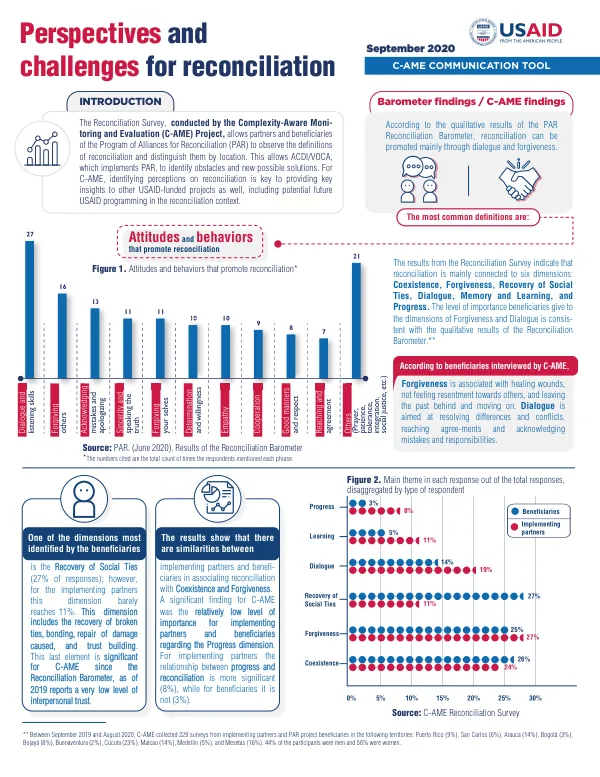
C-AME COMMUNICATION TOOL: Perspectives and challenges for reconciliation
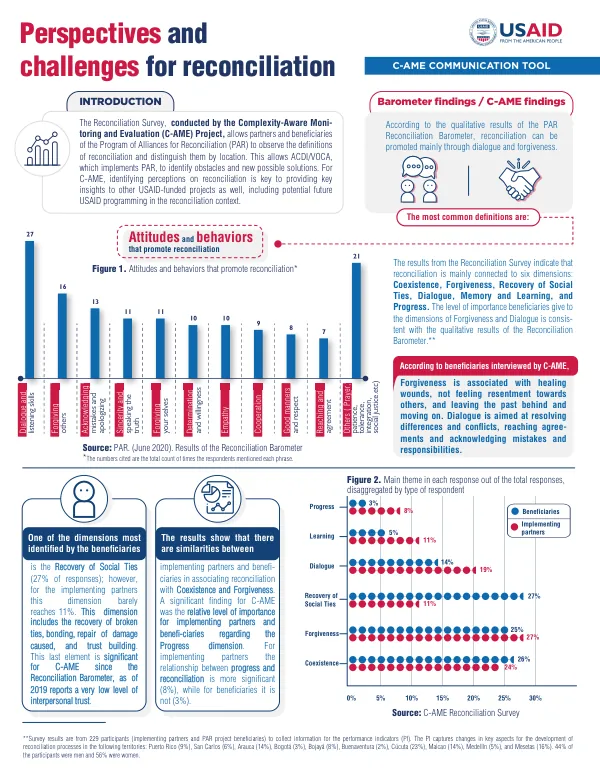
Reconciliation is a complex process that involves various dimensions, including Coexistence, Forgiveness, Recovery of Social Ties, Dialogue, Memory and Learning, and Progress.
2020 · 2 pages
Sign in to readA free account is required to download.
Abstract
The Reconciliation Barometer, conducted by the PAR Program, indicates that reconciliation is mainly associated with Forgiveness and Dialogue. The results of the Reconciliation Survey, conducted by the C-AME Project, show that the dimensions of Coexistence, Forgiveness, Recovery of Social Ties, Dialogue, Memory and Learning, and Progress are the most important for promoting reconciliation. The survey collected data from 2,000 participants, including 1,000 implementing partners and 1,000 beneficiaries, in 10 territories in Colombia. The results indicate that the most common definitions of reconciliation are Coexistence and Forgiveness, with 27% and 16% of the respondents mentioning these dimensions, respectively. The survey also found that the implementing partners and beneficiaries have similar perceptions of reconciliation, with both groups associating it with Coexistence and Forgiveness. The C-AME Reconciliation Survey also found that the dimension of Recovery of Social Ties is the least important for implementing partners, with only 11% of the respondents mentioning it. In contrast, the dimension of Progress is more significant for implementing partners, with 8% of the respondents mentioning it. The survey also found that the relationship between progress and reconciliation is more significant for implementing partners than for beneficiaries. The survey results also indicate that the most common attitudes and behaviors that promote reconciliation are Coexistence, Forgiveness, and Dialogue. The survey found that 27% of the respondents mentioned Coexistence, 16% mentioned Forgiveness, and 11% mentioned Dialogue. The survey also found that the most common themes in each response are Coexistence, Forgiveness, and Forgiveness, with 27%, 16%, and 11% of the respondents mentioning these themes, respectively. The survey results also indicate that the most common definitions of reconciliation are Coexistence, Forgiveness, and Forgiveness, with 27%, 16%, and 11% of the respondents mentioning these definitions, respectively. The survey also found that the most common themes in each response are Coexistence, Forgiveness, and Forgiveness, with 27%, 16%, and 11% of the respondents mentioning these themes, respectively. The survey results also indicate that the most common barriers to reconciliation are the continuity of conflicts within communities, the lack of forgiveness, and the lack of progress. The survey found that 32% of the respondents mentioned these barriers, with 12% mentioning the continuity of conflicts, 10% mentioning the lack of forgiveness, and 10% mentioning the lack of progress. The survey results also indicate that the most common actions that can facilitate the reconciliation process are promoting personal changes, strengthening coexistence, and promoting integration between different ethnic and cultural groups. The survey found that 21% of the respondents mentioned these actions, with 12% mentioning promoting personal changes, 8% mentioning strengthening coexistence, and 1% mentioning promoting integration. The survey results also indicate that the most common factors that hinder the reconciliation process are the persistence of poverty, the persistence of discrimination against migrant populations, and the persistence of political exclusion. The survey found that 21% of the respondents mentioned these factors, with 12% mentioning the persistence of poverty, 8% mentioning the persistence of discrimination, and 1% mentioning the persistence of political exclusion. The survey results also indicate that the most common perceptions of the progress of reconciliation processes in the territory are positive, with 49% of the respondents mentioning that there has been progress, and 32% mentioning that there has been no progress. The survey also found that the most common factors that hinder the reconciliation process are the persistence of poverty, the persistence of discrimination against migrant populations, and the persistence of political exclusion. The survey results also indicate that the most common actions that