USAID DEC
C-Bulletins: Developing and Adapting Materials for Audiences with Lower Literacy Skills
Sign inFHI 360
C-Bulletins: Developing and Adapting Materials for Audiences with Lower Literacy Skills
Social and Behavior Change Communication (SBCC) is a systematic approach to address tipping points for change at individual, community, and social levels.
2012 · 4 pages
Sign in to readA free account is required to download.
Abstract
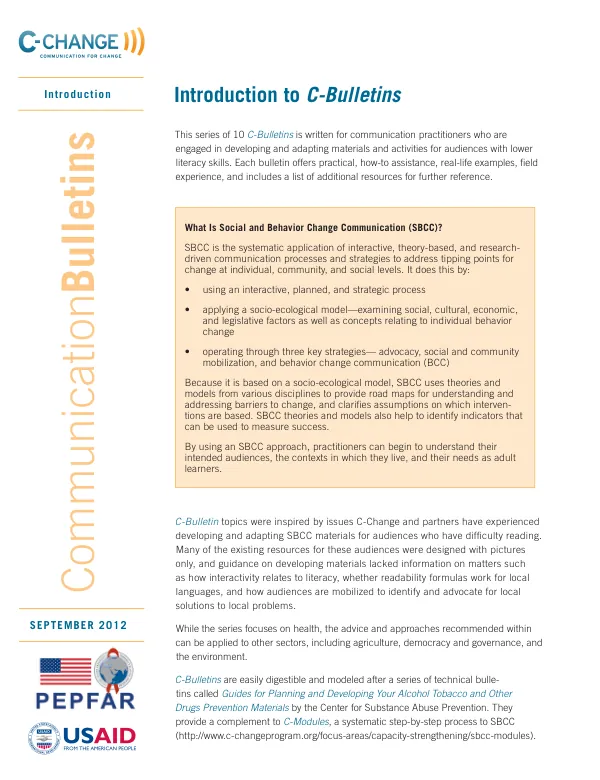
It involves the interactive, theory-based, and research-driven application of communication processes and strategies to influence behavior. SBCC operates through three key strategies: advocacy, social and community mobilization, and behavior change communication. The approach is based on a socio-ecological model, examining social, cultural, economic, and legislative factors as well as concepts relating to individual behavior change. SBCC uses theories and models from various disciplines to provide road maps for understanding and addressing barriers to change. These theories and models help identify indicators that can be used to measure success. By using an SBCC approach, practitioners can begin to understand their intended audiences, the contexts in which they live, and their needs as adult learners. The C-Bulletins series is designed to assist social and behavior change communication practitioners in developing and adapting materials and activities for audiences with lower literacy skills. The series includes 10 topics that provide practical, how-to assistance, real-life examples, and field experience. These topics cover various aspects of SBCC, including understanding literacy, developing creative briefs, using participatory processes, and testing SBCC materials. Literacy is a complex set of abilities that allow people to understand and use the dominant symbols and systems of a particular culture for personal and community development. It goes beyond the capacity to read, write, and perform basic numeric skills, and includes health literacy, technological literacy, cultural and media literacy, and other skills. Materials that are conscious of literacy issues often try to make information more palatable for different audiences. The C-Bulletins series suggests a variety of formats for SBCC materials and activities and provides advice on suitable illustrations, text fonts, and other practical issues that need to be addressed within a participatory materials development process. By following this guidance, practitioners will be able to increase the quality and usability of SBCC materials for lower literacy audiences. The C-Bulletins series is part of C-Change's Communication Bulletins, which aim to assist social and behavior change communication practitioners in developing and adapting materials and activities for audiences with lower literacy skills. The publication is made possible by the generous support of the American people through the US Agency for International Development (USAID) under Cooperative Agreement No. GPO-A-00-07-0004-00. It was produced by C-Change, a project managed by FHI 360, to improve the effectiveness and sustainability of SBCC as an integral part of development efforts in health, environment, civil society, and other sectors. The C-Bulletins series includes topics such as understanding literacy, developing creative briefs, using participatory processes, and testing SBCC materials. These topics are designed to provide practical assistance, real-life examples, and field experience to practitioners working with audiences with lower literacy skills. The series is easily digestible and modeled after a series of technical bulletins called Guides for Planning and Developing Your Alcohol, Tobacco, and Other Drugs Prevention Materials by the Center for Substance Abuse Prevention. The C-Bulletins series is a valuable resource for social and behavior change communication practitioners working with audiences with lower literacy skills. It provides practical guidance, real-life examples, and field experience to help practitioners develop and adapt materials and activities that are effective and usable for their target audiences. By following the guidance provided in the C-Bulletins series, practitioners can increase the quality and usability of SBCC materials and improve the effectiveness of their programs.