WILDLIFE CONSERVATION SOCIETY
CAFEC SEMIANNUAL REPORT: OCTOBER 1, 2014 – MARCH 31, 2015
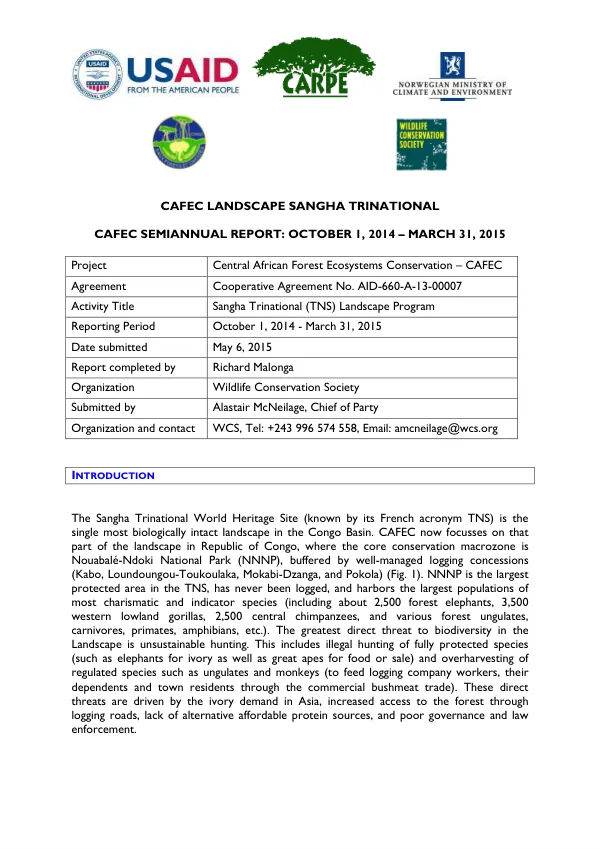
The Sangha Trinational (TNS) landscape is the single most biologically intact landscape in the Congo Basin, spanning across the Republic of Congo.
2015 · 15 pages
Sign in to readA free account is required to download.
Abstract
The core conservation macrozone is Nouabalé-Ndoki National Park (NNNP), a protected area that has never been logged and harbors large populations of charismatic and indicator species, including forest elephants, western lowland gorillas, and central chimpanzees. The primary goal of the Central African Forest Ecosystems Conservation (CAFEC) project is to ensure the long-term protection of the biodiversity of the TNS. The project focuses on building up management and protection systems through the establishment of the Nouabalé Ndoki Foundation and the renewal of protocols for the buffer zone management project (PROGEPP). This involves increasing the size and quality of the protection force through improved support infrastructure and targeted training. The project also aims to install a strong team and new systems to reflect the restructuring of management structures. Significant advancements have been made in the first semester of the second year of the CAFEC project. The Nouabalé Ndoki Foundation convened its first meeting, approving the proposed new senior staff and the first year workplan for the foundation. A second comprehensive ecoguard training was conducted in November 2014, and the research program in Mombongo was relaunched. A new protocol was signed between WCS, the Ministry of Forest Economy and Sustainable Development, and Congolaise Industrielle du Bois to manage the PROGEPP project in two logging concessions. The project has also made progress in gender integration, with staff members trained on how to integrate gender issues into conservation activities. A Gender Focal Point (GFP) has been designated for PROGEPP, and the designation of a GFP for NNNP is pending. The GFP will ensure that gender integration is effectively put into action and that gender integration actions are reported competently. The project has also strengthened protected area management capacity through the signing of a 25-year agreement for the management of NNNP. The Nouabalé Ndoki Foundation was established as the governing body, and WCS was assigned as the management authority for the park. The first meeting of the Foundation Board was held in February 2015, and the Board approved the first year budget and workplan for the park. The project has also made progress in developing a first draft of the management plan and business plan for the park. Both plans are currently being finalized for submission to the Board, to be followed by validation by the government. The next Board meeting is scheduled for June 2015. The project has also strengthened the implementation of land use management plans, which relate to the park itself and the surrounding logging concessions. The project aims to ensure that land use management plans are implemented effectively, taking into account the needs of local communities and the conservation goals of the project. The project has also made progress in developing a strong team and new systems to reflect the restructuring of management structures. The project has appointed a new Director of NNNP, who oversees a number of units core to the functioning and protection of the park. The management support team now includes the Director of Administration and Finance, Director of Logistics, and Director of Research and Monitoring. Overall, the CAFEC project has made significant progress in the first semester of the second year, focusing on building up management and protection systems, strengthening protected area management capacity, and implementing land use management plans. The project aims to ensure the long-term protection of the biodiversity of the TNS and to support the conservation goals of the project.