USAID DEC
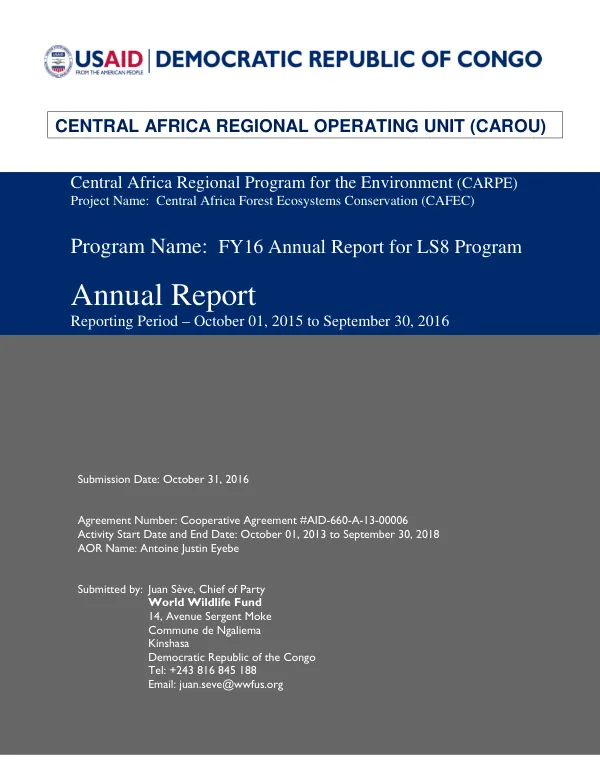
FY16 Annual Report for LS8 Program: Central Africa Forest Ecosystems Conservation (CAFEC)
Sign inPACT
FY16 Annual Report for LS8 Program: Central Africa Forest Ecosystems Conservation (CAFEC)
The Central Africa Forest Ecosystems Conservation (CAFEC) project is a collaborative effort between the World Wildlife Fund (WWF), the Institut National pour la Conservation de la Nature (ICCN), and other partners to conserve the Salonga National Park and its surrounding landscapes in the Democratic Republic of the Congo.
2016 · 37 pages
Sign in to readA free account is required to download.
Abstract
The project aims to maintain the current forest cover, prevent deforestation, and promote sustainable livelihoods for local communities. The Salonga National Park, a UNESCO World Heritage Site, is Africa's largest tropical rainforest park, covering an area of 33,000 km2. The park is home to the world's largest bonobo population, as well as a nearly intact forest ecosystem of enormous ecological importance. The project focuses on addressing the challenges of illegal hunting, ivory trafficking, and bush-meat sales, which threaten the park's biodiversity and carbon sequestration potential. The CAFEC project has implemented various activities to address these challenges, including community-based natural resource management, law enforcement, and infrastructure development. The project has also worked with local communities to develop sustainable livelihoods, such as sustainable agriculture and fishing practices, to reduce pressure on the park's resources. The project's climate change goal is to maintain forest cover, which is achieved through community activities that promote education, health, and stability. The project has made significant progress in its first year, with over 1,930 people receiving training in natural resources management and biodiversity conservation. The project has also detected a significant number of poaching incidents, with a rate of 0.351 incidents per km patrol effort. The project has also made progress in reducing the proportion of illegally killed elephants, with a rate of 100% in the Salonga National Park. The project has also made significant progress in forest conservation, with a total of 165,000 hectares of forested area proposed, 107,720 hectares planned, and 10,632 hectares officially registered as community forestry areas. The project has also made progress in reducing the rate of forest cover change, with a rate of 0.02% in the Salonga National Park. The project has also made significant progress in reducing greenhouse gas emissions, with a total of 3,010,175 metric tons of CO2 equivalent reduced, sequestered, and/or avoided. The project has also made progress in conserving elephant populations, with a stable population of 304 elephants in the Salonga National Park. The project's partners, including the WWF, ICCN, WCS, ZSM, and PACT, have worked together to implement the project's activities and achieve its goals. The project has also received funding from the KfW and the Environmental Development Fund (EDF) from the EU, which has supported the project's infrastructure, logistics, and training needs. Overall, the CAFEC project has made significant progress in its first year, with a focus on conserving the Salonga National Park and its surrounding landscapes, promoting sustainable livelihoods for local communities, and reducing greenhouse gas emissions. The project's success is a testament to the collaborative efforts of its partners and the commitment of the project's team to achieving its goals.
Related documents