FHI 360
Cambodia Nutrition Profile
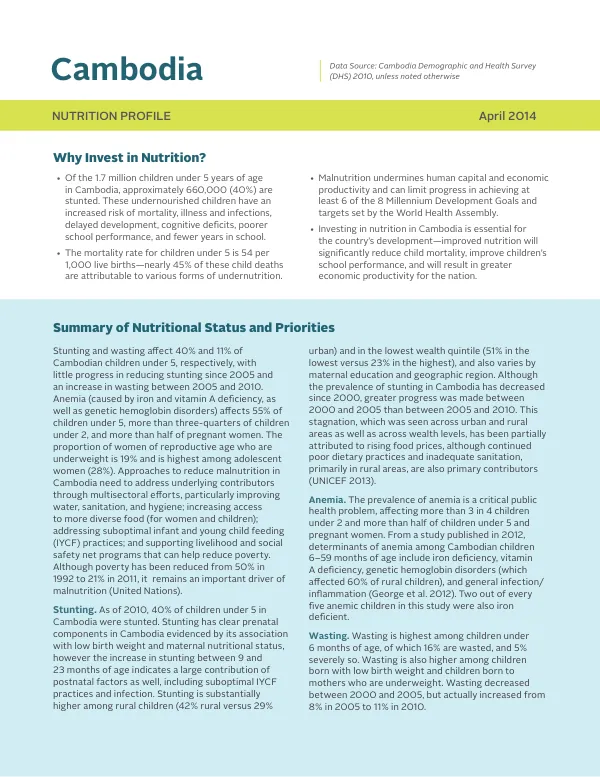
Cambodia has a significant nutrition problem, with approximately 40% of children under 5 years of age being stunted.
2014 · 8 pages
Sign in to readA free account is required to download.
Abstract
This condition increases the risk of mortality, illness, and infections, as well as delayed development, cognitive deficits, and poorer school performance. The mortality rate for children under 5 is 54 per 1,000 live births, with nearly 45% of these child deaths attributable to various forms of undernutrition. Stunting and wasting affect 40% and 11% of Cambodian children under 5, respectively. Anemia affects more than 3 in 4 children under 2 and more than half of children under 5 and pregnant women. The proportion of women of reproductive age who are underweight is 19%, with the highest prevalence among adolescent women at 28%. Approaches to reduce malnutrition in Cambodia need to address underlying contributors through multisectoral efforts, particularly improving water, sanitation, and hygiene; increasing access to more diverse food; addressing suboptimal infant and young child feeding practices; and supporting livelihood and social safety net programs that can help reduce poverty. Maternal malnutrition and low birth weight are key drivers of maternal and child malnutrition in Cambodia. Suboptimal infant feeding practices, inadequate water, sanitation, and hygiene practices, disease burden among children under 5, food insecurity, and low dietary diversity for women are also contributing factors. Basic drivers of malnutrition include low parental education levels, poverty, cultural beliefs that prohibit consumption of micronutrient-rich foods, and a long history of brutal violence and repressive living conditions. The prevalence of stunting in Cambodia has decreased since 2000, but progress was made between 2000 and 2005 than between 2005 and 2010. Stunting is substantially higher among rural children and in the lowest wealth quintile. Anemia is a critical public health problem, affecting more than 3 in 4 children under 2 and more than half of children under 5 and pregnant women. Wasting is highest among children under 6 months of age and is also higher among children born with low birth weight and children born to mothers who are underweight. Maternal malnutrition and low birth weight are significant concerns in Cambodia. Among women of reproductive age, roughly 1 in 5 is underweight, with the highest prevalence among adolescent women at 28%. Anemia affects more than half of pregnant women, and low birth weight was estimated to affect 11% of births in 2005. Vitamin A and iodine deficiencies are also concerns, with 22% of preschool-age children being vitamin A deficient in 2000 and 84% of households with young children having adequately iodized salt in 2010. The median urinary iodine concentration for school-age children is 236 ug/L, indicating that iodine deficiency is not a significant public health problem. However, the prevalence of anemia is a critical concern, with determinants including iron deficiency, vitamin A deficiency, genetic hemoglobin disorders, and general infection/inflammation. Two out of every five anemic children in a 2012 study were also iron deficient. Child nutrition indicators in Cambodia show that stunting rates are higher among children under 5, with a significant increase in stunting between 9 and 23 months of age. Wasting is highest among children under 6 months of age and is also higher among children born with low birth weight and children born to mothers who are underweight. Child mortality rates have decreased between 2000 and 2010, but remain a concern. Maternal health and nutrition indicators in Cambodia show that underweight prevalence among women has remained essentially the same since 2000, with the highest prevalence among adolescent women at 28%. Anemia affects more than half of pregnant women, and low birth weight was estimated to affect 11% of births in 2005. Maternal mortality ratio, total fertility rate, and median age at first marriage and first birth are also concerns.