ROBERT NATHAN ASSOCIATES
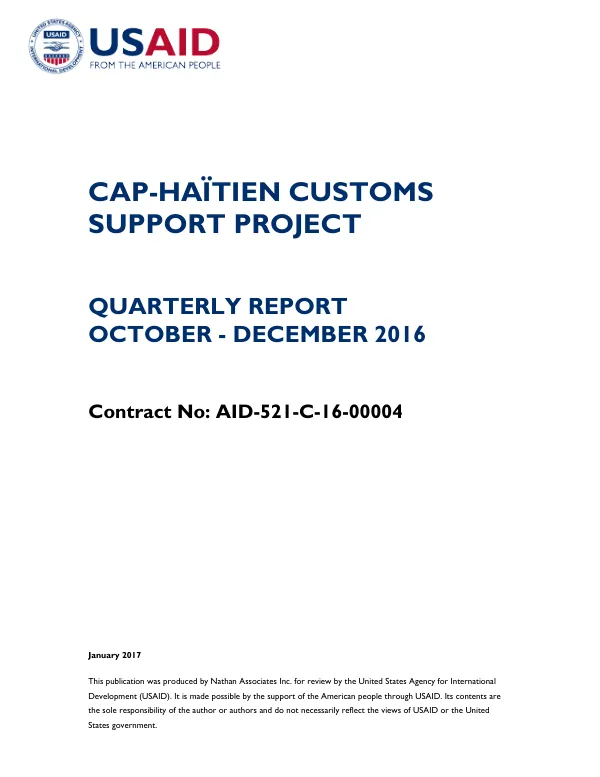
Cap-Haïten Customs Support Project Quarterly Report October - December 2016
The Cap-Haïten Customs Support Project aims to modernize customs procedures and clearances, reducing financial waste, and increasing security and revenue.
2016 · 15 pages
Sign in to readA free account is required to download.
Abstract
The project is supported by the United States Agency for International Development (USAID) and is implemented in collaboration with the Administration Générale des Douanes (AGD) of Haiti. The project's main objectives are to streamline processes for exported and imported goods, reduce financial waste, and increase security and revenue. The project is divided into four components: Mobilization, Assessment, and TFA Training; Initial Analysis of Procedures; On-Going Capacity Building; and ICT Procurement, Installation, and Training. Component I, Mobilization, Assessment, and TFA Training, has made significant progress in the past quarter. The project staff has strengthened relationships with senior AGD officials, and discussions have been held with the AGD to present the project's proposed reforms in four main areas: Organizational structure, Human Resources, Capacity building and training, and Technology and infrastructure. The project has also made progress in Component II, Initial Analysis of Procedures. The AGD Senior Executive team has been involved in the development of assessment reports for Cap-Haïten and Port-au-Prince. The team has discussed areas such as identifying capacity building and training needs, developing a pilot project in Cap-Haïten, strengthening AGD strategic partnership and collaboration with the private industry, and capturing of Strate indicators during the importation and exportation of goods. Component IV, On-Going Capacity Building, has also made progress. The AGD Senior Executive team has been involved in the development of a list of training during in-depth meetings with the Nathan project team. The team has discussed areas such as identifying capacity building and training needs, developing a matrix to identify training, and developing and implementing a training schedule for the AGD. The project has also made progress in the area of ICT Procurement, Installation, and Training. The project staff has raised port layout issues with USAID, UNOPS, AGD, and APN officials, which may pose a challenge for the timely implementation of Component III. The project has also initiated discussions with AGD and USAID to develop a sustainable mitigation strategy to install equipment in Port-Au-Prince to sustain the entire AGD-ICT infrastructure. The project has made significant progress in the past quarter, with the majority of mobilization activities completed. The project staff has strengthened relationships with senior AGD officials, and discussions have been held with the AGD to present the project's proposed reforms. The project has also made progress in the areas of Initial Analysis of Procedures and On-Going Capacity Building. The project's main results for the past quarter include: * The project staff has strengthened relationships with senior AGD officials. * Discussions have been held with the AGD to present the project's proposed reforms in four main areas. * The AGD Senior Executive team has been involved in the development of assessment reports for Cap-Haïten and Port-au-Prince. * The team has discussed areas such as identifying capacity building and training needs, developing a pilot project in Cap-Haïten, strengthening AGD strategic partnership and collaboration with the private industry, and capturing of Strate indicators during the importation and exportation of goods. * The AGD Senior Executive team has been involved in the development of a list of training during in-depth meetings with the Nathan project team. * The team has discussed areas such as identifying capacity building and training needs, developing a matrix to identify training, and developing and implementing a training schedule for the AGD. The project's main challenges for the next quarter include: * The project staff needs to address the port layout issues raised with USAID, UNOPS, AGD, and APN officials. * The project needs to develop a sustainable mitigation strategy to install equipment in Port-Au-Prince to sustain the entire AGD-ICT infrastructure. * The project needs to ensure that the AGD Senior Executive team is involved in the development of assessment reports for Cap-Haïten and Port-au-Prince. The project's main recommendations for the next quarter include:
Related documents