USAID DEC
Capacitación Participativa con Enfoque de Equidad de Género en Iniciativas de Conservación
Sign inUSAID DEC
Capacitación Participativa con Enfoque de Equidad de Género en Iniciativas de Conservación
The concept of gender and its relationship to conservation is a critical aspect of environmental initiatives.
2015 · 20 pages
Sign in to readA free account is required to download.
Abstract
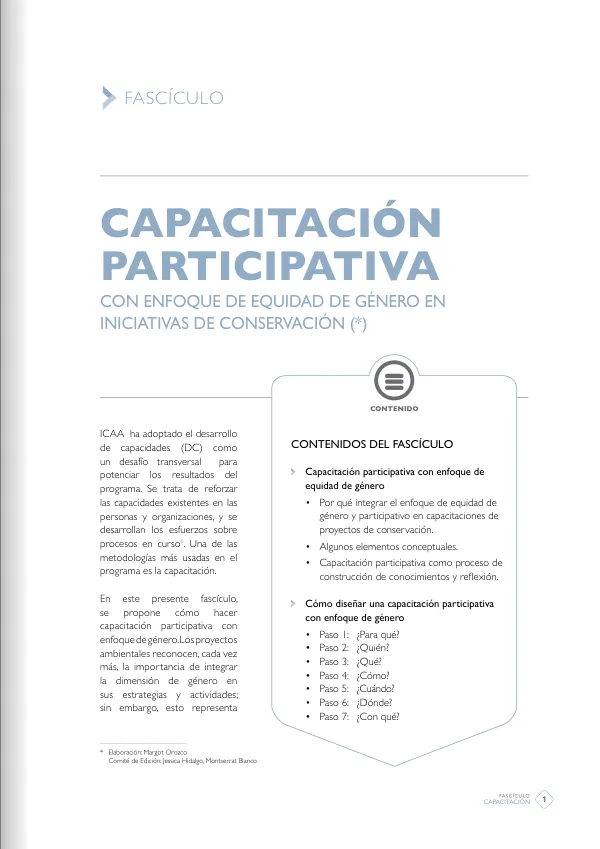
Integrating an equity of gender approach in conservation projects, particularly in training and capacity-building activities, is essential for achieving effective and sustainable outcomes. This approach recognizes the different ways in which men and women interact with natural resources and ecosystems, and seeks to address the social and cultural factors that influence their relationships with the environment. The importance of considering gender in conservation efforts is rooted in the understanding that people, not just ecosystems, are the primary managers of natural resources. However, many conservation organizations tend to focus on the technical aspects of conservation, neglecting the social dimension of environmental management. This oversight can lead to the perpetuation of gender inequalities in conservation practices. Capacitación participativa con enfoque de equidad de género is a methodology that seeks to address these issues by empowering women and men to take an active role in conservation efforts. This approach recognizes that women and men have different relationships with natural resources and ecosystems, and seeks to address the social and cultural factors that influence their interactions with the environment. The development of capacities is a key challenge for conservation programs, and capacitación participativa con enfoque de equidad de género is a methodology that can help address this challenge. By empowering women and men to take an active role in conservation efforts, this approach can help build the capacities of individuals and communities, and promote more effective and sustainable conservation outcomes. In order to integrate an equity of gender approach in conservation projects, it is essential to identify the situation of disadvantage in which women live. This involves recognizing the relationships of gender present in a given context, and the differences in access to resources, benefits, and services that result from these relationships. It also involves analyzing the position of technical staff with regard to their willingness to change towards equity of gender, and reflecting on and analyzing preconceptions and stereotypes related to gender. Ultimately, the integration of an equity of gender approach in conservation projects requires a commitment to addressing the social and cultural factors that influence the relationships between men and women and the environment. By empowering women and men to take an active role in conservation efforts, and by addressing the social and cultural factors that influence their interactions with the environment, conservation organizations can promote more effective and sustainable conservation outcomes. In order to achieve these outcomes, it is essential to consider the following premises when designing a training event: * Identify the situation of disadvantage in which women live, and recognize the relationships of gender present in a given context. * Analyze the position of technical staff with regard to their willingness to change towards equity of gender. * Reflect on and analyze preconceptions and stereotypes related to gender. * Develop a training program that addresses the social and cultural factors that influence the relationships between men and women and the environment. * Empower women and men to take an active role in conservation efforts, and promote their participation in decision-making processes. By following these premises, conservation organizations can promote more effective and sustainable conservation outcomes, and contribute to the achievement of the United Nations' Sustainable Development Goals.