CATHOLIC RELIEF SERVICES ORGANIZATION
Capacity Building Strategy for Zambia Family Activity
Strengthening capacity and ownership of community structures to care for vulnerable children and associated PLHIV is a critical objective of the Zambia Family Activity (ZAMFAM) project.
2017 · 4 pages
Sign in to readA free account is required to download.
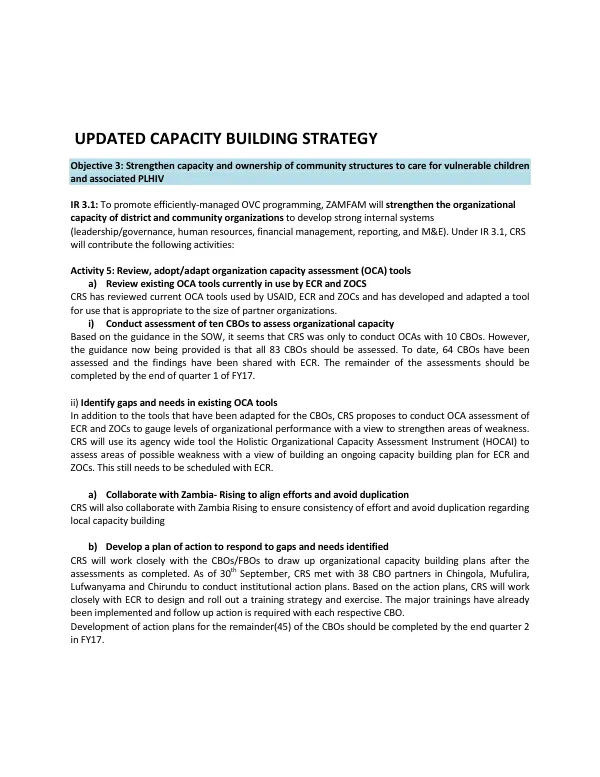
Abstract
To achieve this objective, ZAMFAM will strengthen the organizational capacity of district and community organizations to develop strong internal systems, including leadership, governance, human resources, financial management, reporting, and monitoring and evaluation. The organizational capacity assessment (OCA) is a key component of this effort. CRS has reviewed existing OCA tools used by USAID, ECR, and ZOCS and has developed and adapted a tool for use that is appropriate to the size of partner organizations. The adapted tool has been used to conduct assessments of ten CBOs, with 64 CBOs assessed to date. The findings of these assessments have been shared with ECR, and the remainder of the assessments are expected to be completed by the end of quarter 1 of FY17. In addition to the adapted tool, CRS proposes to conduct OCA assessments of ECR and ZOCs to gauge levels of organizational performance and identify areas of weakness. The Holistic Organizational Capacity Assessment Instrument (HOCAI) will be used to assess areas of possible weakness and develop an ongoing capacity building plan for ECR and ZOCs. This effort will be coordinated with Zambia Rising to ensure consistency of effort and avoid duplication. The capacity building strategy for ZAMFAM partners involves several key components. First, CRS will work closely with CBOs/FBOs to draw up organizational capacity building plans after the assessments are completed. These plans will be developed through clustering of partners at the district level. Organizational capacity building will take place through structured trainings for individual CBOs/FBOs and through combined trainings on common weaknesses. CRS has already provided trainings in governance, finance, project planning, monitoring and evaluation, and has trained a total of 72 CBOs in these areas. However, the remaining CBOs from Luangwa, Chongwe, and Rufunsa will require separate trainings to address the areas identified as weaknesses. Mentorship will also be conducted on a one-to-one basis, with ECR finance, M&E, and HR staff weighing in on the assessment gaps and training needs. CRS proposes several capacity strengthening interventions to support the ZAMFAM project. First, technical assistance will be provided to CBOs to address the gaps and areas identified during the OCA assessment. CRS will provide onsite technical assistance on a quarterly basis, while ECR will provide support supervision on a monthly basis. Second, capacity building trainings will be held for CBOs on the Copperbelt and Lusaka provinces, addressing key weaknesses identified in the OCA assessments. The trainings will be developed in collaboration with ECR and will be user-friendly for CBOs to assimilate. Finally, CRS proposes that an annual review of progress be conducted to ensure consistency and follow-up on capacity building efforts. This review will be conducted jointly by CRS and ECR through the Capacity Building Officer, and will result in the production of capacity building reports.