CATHOLIC RELIEF SERVICES ORGANIZATION
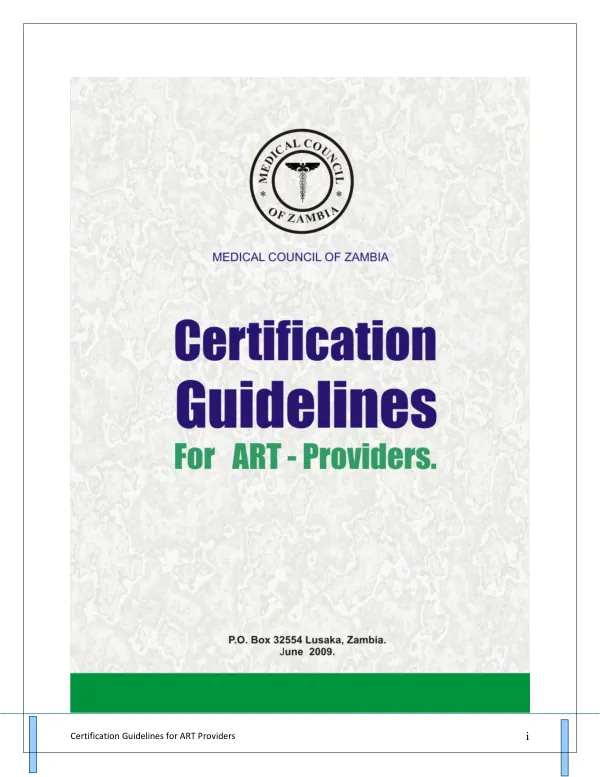
Certification Guidelines for ART Providers
The Medical Council of Zambia is a statutory body established under the Medical Practitioners Act of 1977.
2010 · 27 pages
Sign in to readA free account is required to download.
Abstract
Its mission is to regulate and maintain optimal standards of competence, care, and professional conduct among healthcare professionals. The Council has developed certification guidelines for all healthcare providers working in the public or private sector who are providing Antiretroviral Therapy (ART) services. The HIV/AIDS pandemic has had a significant impact on Zambia's life expectancy, labor productivity, and economic growth potential. To address this situation, the Government introduced ART services in public health facilities. ART services have proven to be an essential intervention in mitigating against HIV and AIDS. The Medical Council of Zambia has developed certification guidelines to provide guidance for recognizing ART trainers, training institutions, and ensuring the usage of Ministry of Health-approved training packages. The certification guidelines have been developed to regulate and unite all ART providers to ensure uniformity in basic knowledge, skills, and attitudes and to standardize the quality of care. The guidelines provide a framework for recognizing training programs for ART providers, including management of HIV with antiretroviral therapy and management of opportunistic infections, management of pediatric HIV care, prevention of mother-to-child transmission of HIV, smart care, management of national ARV logistics system training course, HIV test logistics system, pharmacovigilance, and psychosocial counseling. The guidelines outline the requirements for training programs, including the target cadres, training package, duration of the training, and certificates. The certification process involves recognizing training programs that meet the specified requirements. The guidelines also provide a framework for continuing professional development for ART providers. The certification guidelines are intended to enhance quality in the provision of ART and healthcare in general. The Medical Council of Zambia hopes that these guidelines will be useful in promoting uniformity and standardization in the provision of ART services. The guidelines recognize training programs for continuing professional development, including training for medical practitioners, medical licentiates, clinical officers, and other healthcare professionals. The training programs must meet the specified requirements, including the target cadres, training package, duration of the training, and certificates. The certification process involves evaluating the training programs against the specified requirements. The guidelines provide a framework for evaluating the training programs and issuing certificates to qualified ART providers. The certification process is intended to ensure that ART providers have the necessary knowledge, skills, and attitudes to provide high-quality care to patients. The guidelines also provide a framework for monitoring and evaluating the performance of ART providers. The Medical Council of Zambia will monitor and evaluate the performance of ART providers to ensure that they meet the specified standards. The guidelines provide a framework for addressing any deficiencies or gaps in the provision of ART services. The certification guidelines are an essential tool for promoting quality in the provision of ART services. The Medical Council of Zambia hopes that these guidelines will be useful in promoting uniformity and standardization in the provision of ART services and improving the quality of care provided to patients.