USAID DEC
Capacity Strengthening in HIV Operations Research: Report on Second Project SOAR Workshop, 15–18 May 2018, Johannesburg, South Africa
Sign inAVENIR HEALTH
Capacity Strengthening in HIV Operations Research: Report on Second Project SOAR Workshop, 15–18 May 2018, Johannesburg, South Africa
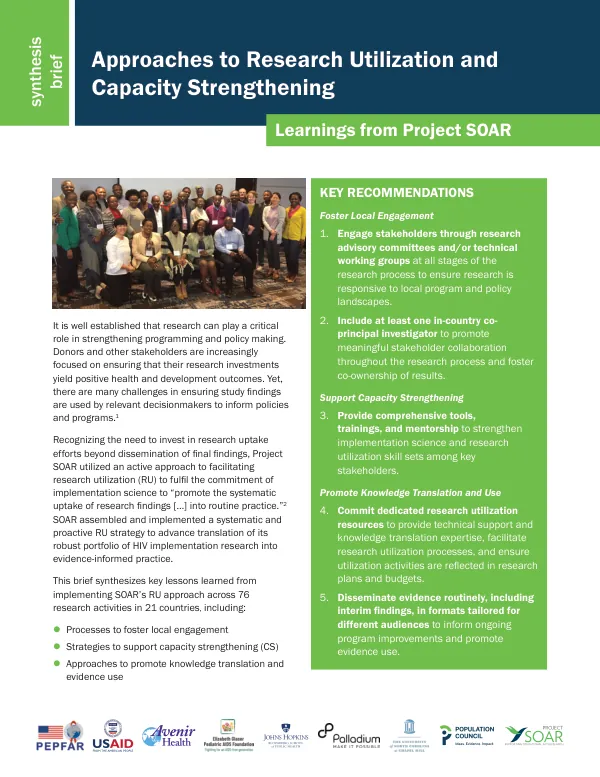
Capacity strengthening in HIV operations research was a key objective of Project SOAR, a cooperative agreement between the Population Council and the United States Agency for International Development (USAID).
2019 · 34 pages
Sign in to readA free account is required to download.
Abstract
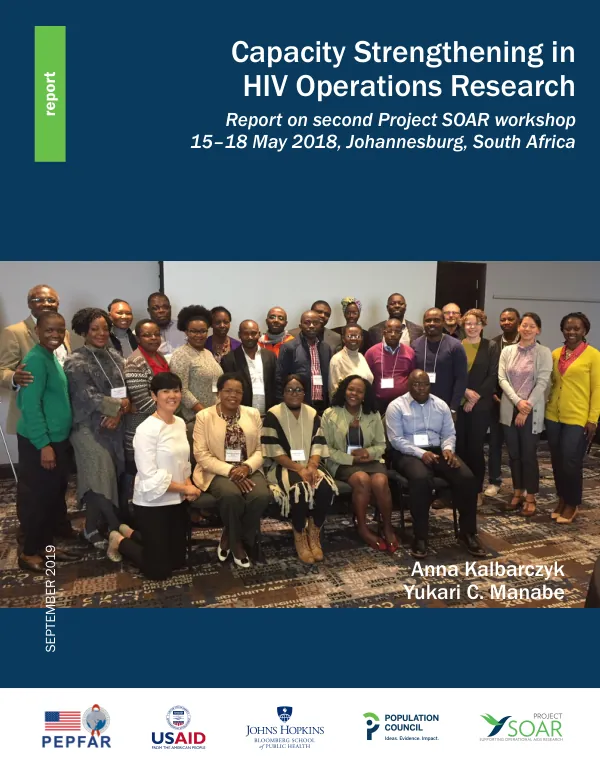
The project aimed to determine how best to address challenges and gaps in the delivery of HIV and AIDS care and support, treatment, and prevention services. Through operations research, Project SOAR produced a large, multifaceted body of high-quality evidence to guide the planning and implementation of HIV and AIDS programs and policies. The Population Council, a nongovernmental, nonprofit organization, played a crucial role in Project SOAR. Established in 1952, the Council works with partners to deliver solutions that lead to more effective policies, programs, and technologies to improve lives worldwide. The Johns Hopkins Bloomberg School of Public Health, another key partner, has a mission to protect health, save lives, and promote health equity through research, education, and service. A four-day capacity strengthening workshop was conducted in February 2017, followed by a second workshop in May 2018. The second workshop, held in Johannesburg, South Africa, brought together 20 participants from eight African countries. The workshop was designed to build on the momentum of the small grants initiative, which aimed to enhance knowledge translation, research utilization, and secondary analysis efforts. The workshop content was based on strengths and weaknesses identified in the small grant applications, as well as mentorship and leadership needs. The workshop included discussions of mentorship, small group sessions with mentors, identification of individual goals, and the development of a mentorship plan. Each participant rotated through a series of working groups, tackling implementation challenges, project management, and research idea generation. On the final day, participants presented their plans for incorporating lessons learned from the workshop into their research and practice activities. The workshop was evaluated through an online survey, which showed that 85 percent of participants responded. The survey revealed that 47 percent of participants strongly agreed that the workshop objectives were met, while 53 percent somewhat agreed. All respondents agreed that the workshop content was relevant to their job, and almost all respondents said they networked with someone new. Six months after the workshop, a follow-up survey was distributed to assess the evolution of mentorship relationships and the development of mentorship and personal/professional development plans. The survey showed that 10 respondents completed the entire survey, and 7 respondents reported that they had developed and pursued mentorship plans. The results of the survey indicated that the workshop had a positive impact on the participants' professional development and networking opportunities. The capacity strengthening activities conducted during the workshop and the insights gained from the follow-up evaluation suggest that Project SOAR's efforts to build capacity in HIV operations research are yielding positive results. The project's focus on mentorship, leadership development, and knowledge translation is critical to addressing the challenges and gaps in HIV and AIDS care and support, treatment, and prevention services.
Related documents