USAID DEC
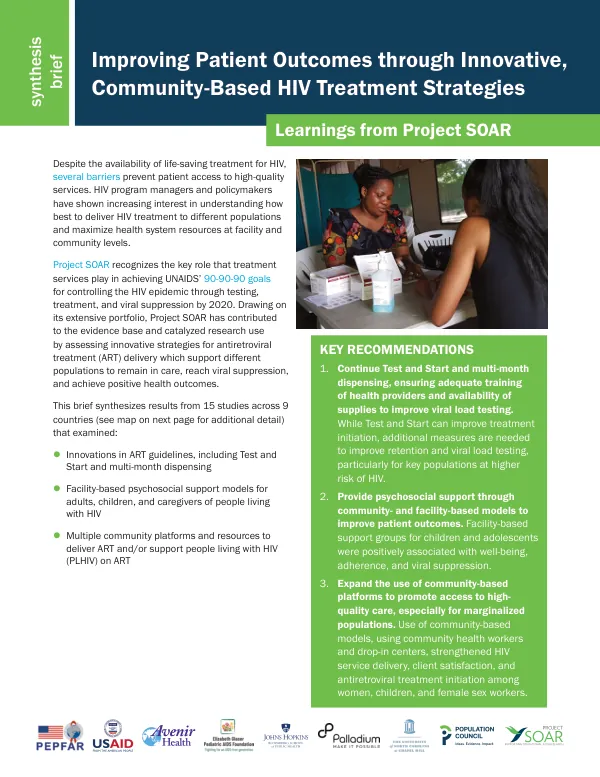
Improving patient outcomes through innovative, community-based HIV treatment strategies
Sign inAVENIR HEALTH
Improving patient outcomes through innovative, community-based HIV treatment strategies
The Test and Start model, recommended by the World Health Organization, involves initiating antiretroviral treatment (ART) immediately after an HIV-positive diagnosis.
2021 · 8 pages
Sign in to readA free account is required to download.
Abstract
This approach has been shown to lead to better health outcomes. In addition to Test and Start, multi-month dispensing (MMD) of ART has emerged as a community-oriented and time-saving approach for stable patients and clinicians. The SOAR project examined the impact of these ART distribution models on treatment outcomes, including initiation and retention in care, in Namibia, Nigeria, Senegal, and Tanzania. In Namibia, the national rollout of Test and Start in rural district hospitals and community-based health facilities did not compromise key treatment outcomes among clients. Time to ART initiation decreased significantly, and more than 90 percent of patients were retained in care after 12 months. However, while viral load testing improved over time, the proportion of clients being tested remained low. Additionally, most patients lacked basic knowledge of viral load testing. In Nigeria, SOAR researchers assessed the performance of two community-based Test and Start service delivery models for key populations, including men who have sex with men (MSM) and female sex workers (FSWs). The models comprised HIV prevention drop-in centers (DICs) supported by a separate implementing partner that provided ART services, and one-stop-shop (OSS) clinics operated by a full-time clinical team offering comprehensive care and treatment services. Participants were recruited via DIC-organized community outreach and from OSS walk-in clients, and those who tested positive were offered same-day ART. Of the 605 recruited clients, 71 percent were successfully linked to treatment, well below the 90 percent UNAIDS goal, and this did not differ by model. ART initiation was significantly higher among MSM compared to FSWs. Retention at one year was poor, with just 56 percent of clients who initiated ART remaining in treatment; however, retention was higher in the OSS model than in the DIC model and higher among MSM compared to FSWs. In Senegal, SOAR researchers conducted a randomized controlled trial to compare individual case management to the standard of care (SOC) as part of the country's rollout of Test and Start. The case management intervention was a multi-step process to coordinate care and provide a family-like support system for people living with HIV (PLHIV). Between one-third and one-half of the 573 participants assigned to either the intervention or SOC were members of key populations (FSWs and MSM). The proportion of all participants who were virally suppressed at 12 months ranged from 70 percent to 77 percent, below the target of 90 percent. The study found no difference in viral suppression between clients in the intervention group versus the control group, and loss to follow-up was high. About half of participants were retained by the end of the study. In Tanzania, MMD appeared to be a safe alternative to single month dosing. Those receiving MMD had improved treatment outcomes, including higher rates of viral suppression and retention in care. The results of these studies suggest that while Test and Start may improve treatment initiation, additional measures are needed to improve retention and viral load testing, particularly for key populations. MMD appears to be a safe alternative to single month dosing and led to improved treatment outcomes. The SOAR project has contributed to the evidence base and catalyzed research use by assessing innovative strategies for ART delivery that support different populations to remain in care, reach viral suppression, and achieve positive health outcomes. The project's research utilization approach has supported the inclusion of end-users in the research process from inception to dissemination and fostered data-driven policy and program change. The results of the SOAR project have informed the development of evidence-informed programs and policies to improve patient outcomes through innovative, community-based HIV treatment strategies.