AVENIR HEALTH
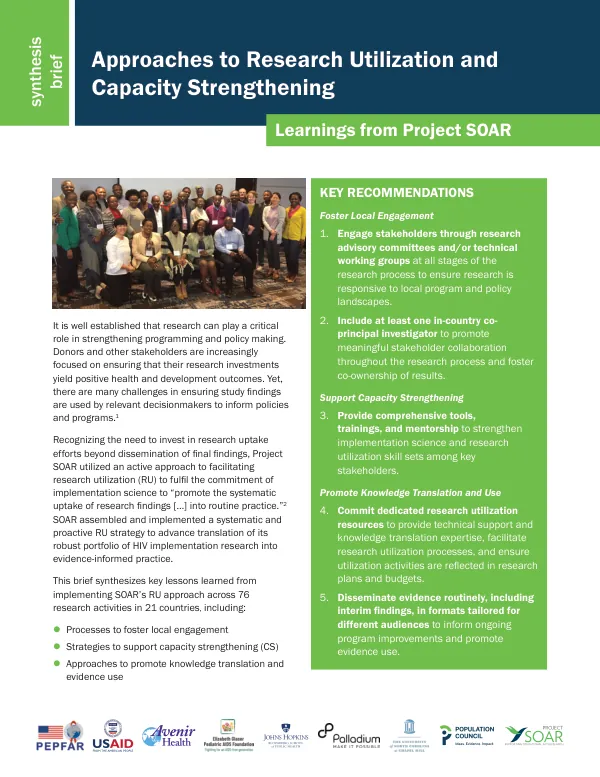
Approaches to Research Utilization and Capacity Strengthening
Research plays a critical role in strengthening programming and policy making.
2021 · 8 pages
Sign in to readA free account is required to download.
Abstract
Donors and other stakeholders are increasingly focused on ensuring that their research investments yield positive health and development outcomes. However, there are many challenges in ensuring study findings are used by relevant decisionmakers to inform policies and programs. Project SOAR utilized an active approach to facilitating research utilization (RU) to fulfill the commitment of implementation science to promote the systematic uptake of research findings into routine practice. SOAR assembled and implemented a systematic and proactive RU strategy to advance translation of its robust portfolio of HIV implementation research into evidence-informed practice. The RU process begins with the identification and engagement of key stakeholders during study design to ensure research questions respond to local program and policy needs. Engagement of stakeholders through a research advisory committee (RAC) continues throughout study implementation, including data collection, analysis, and interpretation. Finally, this RAC works together to disseminate results, formulate relevant recommendations, and champion evidence-informed policy and/or program change. A cornerstone of the RU process is identifying stakeholders who can provide input throughout the study and promote the translation of research results into policy and practice. SOAR promoted the engagement of stakeholders at many points in the research process, including through RACs and/or technical working groups (TWGs) as well as the involvement of co-principal investigators in study countries. Research advisory committees and technical working groups were formed to provide a structured approach with key questions to optimize the identification of stakeholders and define their respective roles. Membership in RACs and TWGs varied, but the most common stakeholders engaged were from national AIDS coordinating bodies, ministry of health HIV programs at national and sub-national levels, President's Emergency Plan for AIDS Relief (PEPFAR) country teams, intervention implementation partners, and community advocates. Other RAC members were specific to the focus of the study. Core activities of RACs included developing in-country data use plans and facilitating the translation of research results into policy and practice. SOAR consistently included principal and co-investigators from study countries to ensure research agendas were responsive to country needs and promote co-ownership of results. Before initiating a study, SOAR researchers assessed opportunities to use existing national forums as platforms for engaging stakeholders throughout the research process. Pre-existing technical working groups, as well as newly formed RACs, provided critical venues for formulating study plans, sharing interim and final results, and creating dissemination plans. In Tanzania, a study on the family planning needs of people living with HIV engaged the reproductive health division of the Ministry of Health, donors, and service providers. In Zambia, the RAC for the Project YES! study included young people living with HIV as members. Globally, SOAR established a working group featuring representatives from the Global Network of People Living with HIV and the International Community of Women Living with HIV to guide the process. SOAR researchers took advantage of existing forums, such as TWGs or newly established RACs, to hold periodic meetings throughout the course of the study to discuss the data and its implications. In countries with multiple SOAR studies, SOAR held joint RAC meetings at the national level, which helped to conserve time and resources, and facilitated participation of USAID and government representatives. Additionally, SOAR encouraged RACs to develop written plans that described how the data would be communicated and used. Co-investigators from study countries were involved in the research team from the outset of the project. In total, 135 in-country researchers and other stakeholders collaborated as co-investigators across SOAR's implementation science portfolio. These co-investigators were often members of local research institutions, collaborators from implementing organizations, and officials from ministries of health, national HIV/AIDS authorities, or other government agencies.
Related documents