USAID DEC
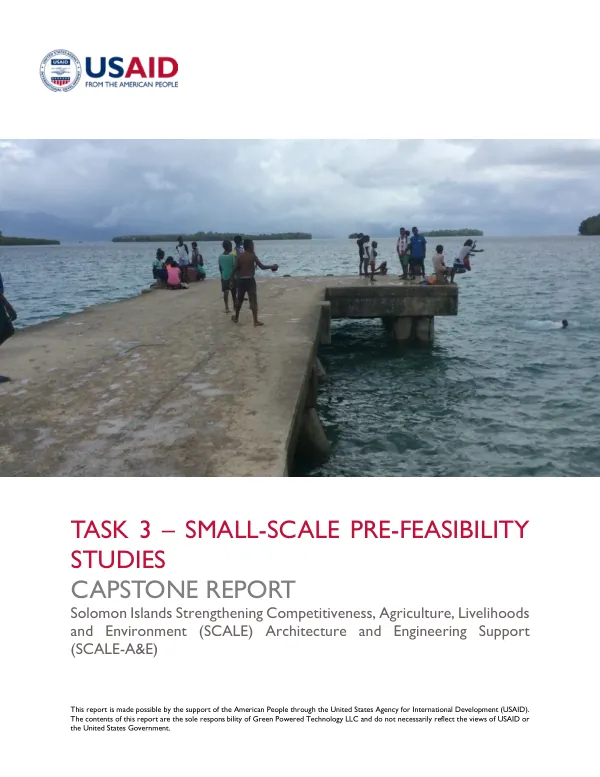
Capstone Report – Task 3 Pre-Feasibility Studies for Solomon Islands Strengthening Competitiveness, Agriculture, Livelihoods and Environment (SCALE) Architecture and Engineering Support (A&E) Project
Sign inGREEN POWERED TECHNOLOGY
Capstone Report – Task 3 Pre-Feasibility Studies for Solomon Islands Strengthening Competitiveness, Agriculture, Livelihoods and Environment (SCALE) Architecture and Engineering Support (A&E) Project
The Solomon Islands Strengthening Competitiveness, Agriculture, Livelihoods, and Environment (SCALE) Architecture and Engineering Support (A&E) Project is a USAID-funded initiative aimed at enhancing the competitiveness of small-scale pilot projects in Malaita.
23 pages
Sign in to readA free account is required to download.
Abstract
The project focuses on seven key areas: a Fisheries Center in Malu'u, an Agricultural Warehouse in Gwaigeo, Cocoa Bean Solar Drying Facilities in a To Be Determined location, a Coconut Processing Mill in Gwaigeo, a Kava Processing Facility in Gwaigeo, a Mini-Feed Mill in Gwaigeo, and a Taro Processing Facility in Gwaigeo. The project scope excludes supporting infrastructure projects, detailed design activities, and procurement activities for the selected projects. The work was carried out by a small team of national and international personnel from Green Powered Technology and Planet Partnerships over a condensed period of four months. The team adopted a customized version of the 'Better Business Case' (BBC) model, a globally recognized best practice methodology for infrastructure project appraisal. The pre-feasibility work involved gathering information through a combination of documentation reviews, structured interviews, and facilitated workshops with key stakeholders, including the private sector. However, the team faced several challenges, including a lack of baseline data, civil unrest, and COVID-19-related restrictions that inhibited fieldwork and market engagement. Key assumptions made during the pre-feasibility work include focusing on the feasibility of individual proposed facilities at Gwaigeo due to the availability of land owned by the Malaita Provincial Government. The project team also considered other locations for certain projects. The project's objective is to inform decision-making for detailed design and future stages of the project. The pre-feasibility studies aim to provide a high-level overview of the scope and approach taken, summarize key findings and recommendations, and provide a snapshot overview of each project. The project summaries for each of the seven small-scale pilot projects are as follows: The Fisheries Center in Malu'u is a proposed facility that aims to enhance the fishing industry in the area. The center will provide a platform for fishermen to sell their catch, and it will also serve as a hub for fishing-related activities. The Agricultural Warehouse in Gwaigeo is a proposed facility that aims to improve the storage and handling of agricultural products. The warehouse will provide a secure and dry environment for farmers to store their produce, reducing post-harvest losses and improving the quality of their products. The Cocoa Bean Solar Drying Facilities in a To Be Determined location are proposed facilities that aim to enhance the processing and drying of cocoa beans. The facilities will use solar energy to dry the beans, reducing the need for fossil fuels and improving the quality of the final product. The Coconut Processing Mill in Gwaigeo is a proposed facility that aims to enhance the processing and production of coconut products. The mill will provide a platform for coconut farmers to process their products, improving their income and livelihoods. The Kava Processing Facility in Gwaigeo is a proposed facility that aims to enhance the processing and production of kava products. The facility will provide a platform for kava farmers to process their products, improving their income and livelihoods. The Mini-Feed Mill in Gwaigeo is a proposed facility that aims to enhance the production of animal feed. The mill will provide a platform for farmers to produce high-quality animal feed, improving the health and productivity of their livestock. The Taro Processing Facility in Gwaigeo is a proposed facility that aims to enhance the processing and production of taro products. The facility will provide a platform for taro farmers to process their products, improving their income and livelihoods. The indicative implementation plan for the project includes a number of key activities, including detailed design, procurement, and construction. The plan also includes a number of timelines and milestones, which will be used to track the progress of the project. Overall, the SCALE A&E Project aims to enhance the competitiveness of small-scale pilot projects in Malaita, improving the livelihoods and income of farmers and communities in the area. The project's pre-feasibility studies provide a high-level overview of the scope and approach taken, summarize key findings and recommendations, and provide a snapshot overview of each project.
Related documents