CARE
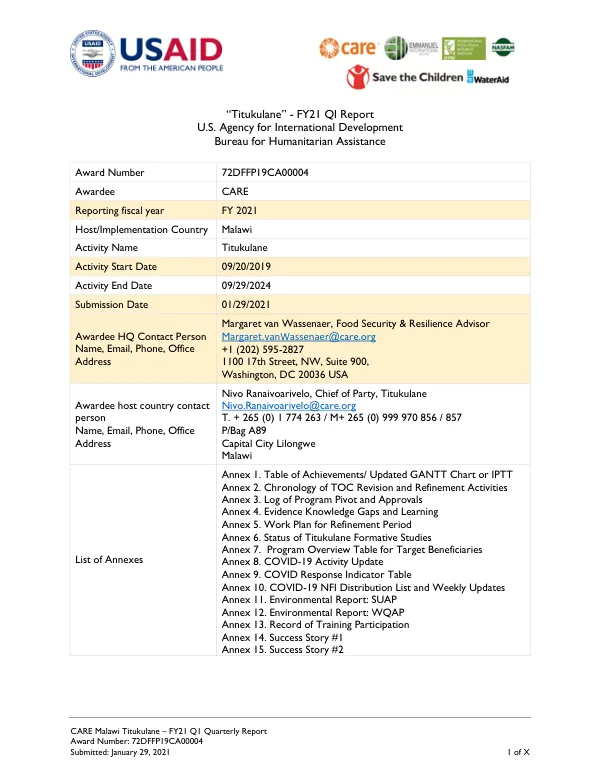
CARE Malawi Titukulane – FY21 Annual Results Report
The goal of Titukulane is "sustainable, equitable, and resilient food and nutrition security for ultra-poor and chronically vulnerable households in Mangochi and Zomba Districts".
2021 · 26 pages
Sign in to readA free account is required to download.
Abstract
To achieve this, the program has three purposes: Increased diversified, sustainable and equitable incomes for ultra-poor, chronically vulnerable households, women and youth; Nutritional status among children under five, adolescent girls and women of reproductive age improved; Increased institutional and local capacities to reduce risk and increase resilience among ultra-poor and chronically vulnerable households in alignment with the National Resilience Strategy (NRS). In addition to the three purposes, Titukulane addresses several crosscutting issues including: Gender Equality, Governance and Accountability, Youth Engagement, Strategic Learning, Monitoring, Evaluation, Accountability, and Learning, and Environmental Safeguarding. The COVID-19 pandemic presented extraordinary challenges and program pivots in FY21, with activities slowing down during movement lock-down periods. The country imposed an international travel ban, and both the government and project followed safety and security measures to protect staff and beneficiaries. These measures delayed or constrained the rollout of some field activities, access to technical support, and preparatory assessments. FY21 was also marked by intense research and learning to inform program strategy and direction, also known as "refine and implement" (R&I). In coordination with BHA and the IDEAL award, Titukulane conducted a culmination workshop that discussed and investigated cumulative results of five priority studies. The culmination workshop gave an opportunity for Titukulane to discuss proposed changes with BHA, ultimately leading to a revised Theory of Change (ToC), Detailed Implementation Plan (DIP), Indicator Performance Tracking Table (IPTT), Performance Indicator Reference Sheet (PIRS) and associated budget. Regarding baseline data collection, Titukulane and Innovations for Poverty Actions (IPA) met regularly in FY21 to ensure adequate preparation. COVID-19 safety protocols and technical design issues delayed the start of the baseline survey. The cumulative effect of not being able to implement activities at the field level without information on target villages led to cascading delays in the rollout of field activities, including those tied to the agricultural calendar. In order to compensate for these delays, Titukulane focused on district-level activities and Training of Trainers (ToT) for all activities, across all Purposes and crosscutting themes. After these ToTs, field staff cascaded some of these trainings to community structures like civil protection committees, natural resource management committees, VSLA/YSLA Agents, and lead farmers. Titukulane reached a total of 39,699 participants (12,573 M; 27,126 F) in FY21, including civil servants, community committees that managed the interventions, and community agents. These participants include 3,479 (1,755 M; 1,724 F) direct beneficiaries. Programmatic Adjustments and Acceleration Plan: Titukulane Activity initially planned to be implemented in 20 Traditional Authorities (TAs): nine in Mangochi and 11 in Zomba Districts. However, in FY21, one TA in Zomba (Nkumbira) was set aside pending determination as an ecologically sensitive Ramsar site for Lake Chirwa. Further to this, Titukulane will no longer implement P2 activities (Health & Nutrition and Water, Sanitation, and Hygiene (WASH)) in Nkapita and Mbiza TAs in Zomba, because the World Bank-funded projects investing in Early Years for Growth and Productivity (IEYGP) and Resilience Economic Development (RED) will be implemented by the government of Malawi and Save the Children.