CARE
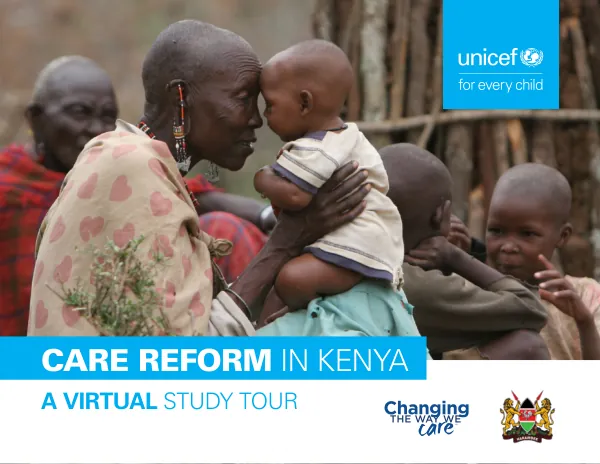
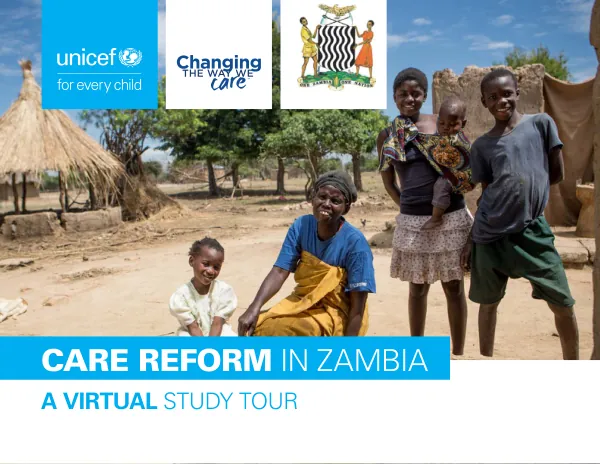
CARE Reform in Zambia: A Virtual Study Tour
The National Child Policy in Zambia was developed in 2001, which included stipulations on supervision and training of social workers, and the coordination of services for the placement of children in care and their reintegration in families.
2021 · 41 pages
Sign in to readA free account is required to download.
Abstract
The Ministry of Community Development and Social Services (MCDSS) with support from UNICEF initiated child care reforms through the Child Care Upgrading Programme (CCUP) in 2006. This work focused on strengthening government oversight of residential care. The MCDSS received dedicated multi-year funding from the GHR Foundation through UNICEF in 2013. The support aimed to build on the success of the CCUP to strengthen Zambia's alternative care system with a focus on promoting family-based care. In 2014, multi-year funding was provided by the GHR Foundation to a consortium of NGOs to complement Government's alternative care systems strengthening programmes through family preservation and response interventions implemented under the Children in Families Initiative. The Children in Families Technical Working Group was established under the leadership of MCDSS in 2014 to strengthen coordination and pilot the delivery of collaborative efforts to promote family preservation and family-based alternative care interventions. The Minimum Standards of Care for Child Care Facilities: Regulations and Procedures were launched in 2014, which comprehensively addressed alternative care among other child protection issues. The National Child Policy was amended and implemented in 2015 to promote adherence to minimum standards for residential care providers. Research conducted in 2016 found that most children in residential care have living relatives and that placement is driven by poverty, death of a parent, disability or chronic illness of the child in care or caregivers, and abuse, maltreatment, or neglect. Technical support was provided through the Hague Conference on Private International Law for strengthening national standards on intercountry adoption. The Accelerating Children's Care Reform – A Call to Action was released by the Ministry of Community Development and Social Welfare (currently MCDSS) in 2016 to urge line ministries and others working with children to support the implementation of a set of strategic actions to accelerate child care reform in Zambia. A nationwide assessment of residential care facilities was undertaken in 2017, which showed a rise in the number of children in residential care from 4,500 in 2005 to 6,413 in 2017. Many facilities did not meet the minimum standards of care, particularly in relation to management capacity, record keeping, care planning, and quality of care provision. Gatekeeping mechanisms were found to be weak or non-existent, with two-thirds of children who were admitted into residential care doing so with signed consent by parents or guardians. Poverty was cited as the main reason for admission into residential care. The Alternative Care and Reintegration Guidelines were developed in 2017, which provided a step-by-step guide on the provision of emergency care, reintegration, kinship, foster care, and domestic and intercountry adoption. Alternative Care Case Management tools and Standard Operating Procedures (SOPs) were also developed in 2017, which informed the development of child and family welfare statutory and non-statutory case management system. The National Alternative Care Technical Working Group was established by MCDSS in 2017 to support more harmonised and coordinated implementation of alternative care programmes within the broader child and family welfare system.
Related documents