CARE
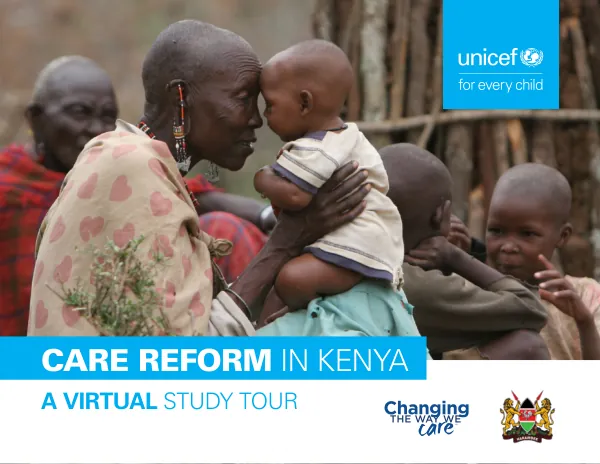
CARE REFORM IN KENYA
Care reform in Kenya has been a significant focus area for the government and various stakeholders.
2021 · 51 pages
Sign in to readA free account is required to download.
Abstract
The country's population is approximately 49.6 million, with 49% of the population being children, totaling around 24.3 million. Kinship care is a common arrangement, with around 13% of children, or 3.2 million, living with relatives. Residential care has been a significant concern, with prior to the COVID-19 pandemic, 40-45,000 children living in registered facilities, and up to 200,000 in unregistered facilities. However, a 42% reduction in the number of children in registered facilities was achieved during the pandemic, with 21% of these children returning to their biological families and the rest placed in alternative family-based care, mostly kinship care. Foster care is another area of focus, with government estimates suggesting around 4,000 children in foster care. Domestic adoption is also practiced, with around 800 adoptions per year. However, inter-country adoption has been suspended due to concerns about child trafficking and exploitation. The government has taken several steps to reform the care system, including the development of the Children's Act, which sets out children's rights to parental care and regulations regarding residential care, foster care, and adoption. The Charitable Children's Institutions Regulations outline how residential care should be registered and run, and regulations on adoption have also been developed. The National Child Policy acknowledges the importance of family-based care, and the government has initiated several programs to support this, including the Children's Community Safety Nets Project, which led to the reintegration of 674 children from government-run institutions. The government has also established a section to work on family strengthening and alternative care. The National Standards for Best Practices in Charitable Children's Institutions were developed in 2013, which describe institutional care as a last resort, promote reintegration, and provide guidance on residential care. Training of staff in residential care facilities has been implemented to ensure the implementation of these new national standards. The Guidelines for the Alternative Family Care of Children, introduced in 2014, call for a reduction in institutional care, outline strategies for preventing family separation, and highlight the need to support kinship and foster care. The guidelines also introduce the concepts of supervised independent living and kafalah as care options. The National Plan of Action for Children in Kenya (2015-2022) commits to deinstitutionalisation, reductions in the use of inter-country adoption, improvements in parenting supports, and an aftercare policy for care leavers. The government has also issued a suspension on the registration of new residential care facilities, stating that many children are unnecessarily separated from families and are exposed to unscrupulous practices such as trafficking. The government has initiated the piloting of care reform in Kisumu County, demonstrating the implementation of the alternative care guidelines, and has formed the Association for Alternative Family Care to coordinate over 25 organisations working on care reform. Further piloting of care reform at the county level has begun, with support from Changing the Way We Care (CTWWC) and other stakeholders. Research has shown that children with disabilities are poorly cared for in overcrowded and dirty residential care, with some evidence of sexual abuse and torture. Parents receive little support to care for children at home. In response, the government has initiated further piloting of care reform at the county level, with support from CTWWC and other stakeholders. The National Council for Children Services has established the multi-agency Care Reform Core Team to help with the coordination of the care reform agenda in Kenya. The Governor of Murang'a County has signed a declaration promoting family-based care and social workforce strengthening, and devolution has given governors substantial power in child care reform. The COVID-19 pandemic has had a significant impact on the care system, with a 42% reduction in the number of children in registered residential care facilities. The government has issued key messages to support those working with vulnerable children during COVID-19, including residential care providers, and has published a case management package for reintegration. UNICEF and CTWWC have provided an emergency cash transfer for some of the families of children reintegrated from residential care following the government directive linked to COVID-19.