USAID DEC
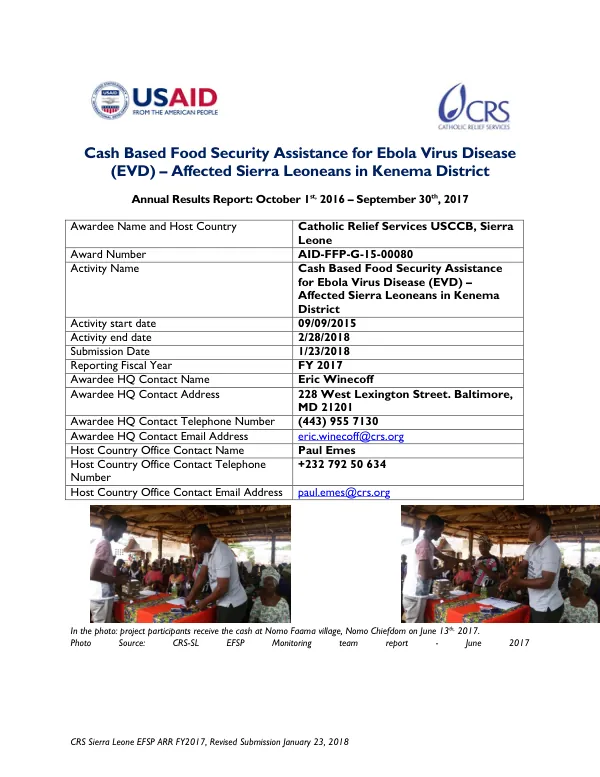
Cash Based Food Security Assistance for Ebola Virus Disease (EVD) – Affected Sierra Leoneans in Kenema District
Sign inCATHOLIC RELIEF SERVICES ORGANIZATION
Cash Based Food Security Assistance for Ebola Virus Disease (EVD) – Affected Sierra Leoneans in Kenema District
The Cash Based Food Security Assistance for Ebola Virus Disease (EVD) – Affected Sierra Leoneans in Kenema District project, implemented by Catholic Relief Services (CRS) Sierra Leone, aimed to enable target households to recover from the shock of the epidemic.
2018 · 32 pages
Sign in to readA free account is required to download.
Abstract
The project provided unconditional cash transfers and complementary knowledge and capacity building support to 9,689 Ebola Virus Disease (EVD) affected households in nine chiefdoms of Kenema district. The objective of the program was to enable target households to increase access to food during the lean season as well as meet other essential basic needs such as health care, agricultural inputs, and education. The project reached 46,771 participants, with 31,023 female and 15,748 male, during the reporting period of October 2016 through September 2017. The project activities focused on distribution of cash grants to the target households and training of the target households on improved agronomic, nutrition, and hygiene practices. The cash enabled the affected households to increase access to food, with 82 percent of participants reporting that they regularly consume 3 meals a day, up from 79% in the baseline. The meals consist of diversified foods such as proteins, carbohydrates, fruits, vegetables, and fats. Crop cultivation has been revived, with the number of households that cultivated above two acres of land increasing from 3 percent to 42 percent. The self-formed farmer and saving groups encouraged by the cash transfers have increased community cohesion as a safety net. The project also conducted a market assessment to understand the functionality of markets and the impact of the cash transfers on local markets within project locations. The assessment results showed that the market system was functioning normally as compared to the period of the Ebola crisis, but with some limitations such as limited market integration, limited market competition, impact of seasonality, and limited capacity of traders. The project conducted price monitoring surveys from one central market in Freetown, one supply market in Kenema, and four intervention markets. Price monitoring focused on rice, salt, maggi, onions, and fish because these are the commodities on which project participants spend a more significant portion of their cash. The objective was to inform the program on the effects of the cash transfers on the markets and the effects of price changes on the purchasing power of the participants. The security situation in all project locations was stable during the reporting period, enabling markets to function normally and providing essential food commodities needed by communities. The rains and the cash grants provided by the project enabled target communities to cultivate their own food, decreasing dependence on markets for food between August and September 2017. However, rising inflation will make it hard for many poor households to achieve all their dietary requirements, and the continuous depreciation of the Leone, high fuel prices, and poor road infrastructure are increasing economic difficulties for many poor households in Sierra Leone. The project has made significant improvements in food security, with 82 percent of participants reporting that they regularly consume 3 meals a day. Crop cultivation has been revived, with the number of households that cultivated above two acres of land increasing from 3 percent to 42 percent. The self-formed farmer and saving groups encouraged by the cash transfers have increased community cohesion as a safety net. The project has also conducted market assessments and price monitoring surveys to understand the functionality of markets and the impact of the cash transfers on local markets within project locations. The project has also conducted a market assessment to understand the functionality of markets and the impact of the cash transfers on local markets within project locations. The assessment results showed that the market system was functioning normally as compared to the period of the Ebola crisis, but with some limitations such as limited market integration, limited market competition, impact of seasonality, and limited capacity of traders. The project has also conducted price monitoring surveys from one central market in Freetown, one supply market in Kenema, and four intervention markets. Price monitoring focused on rice, salt, maggi, onions, and fish because these are the commodities on which project participants spend a more significant portion of their cash.
Related documents