USAID DEC
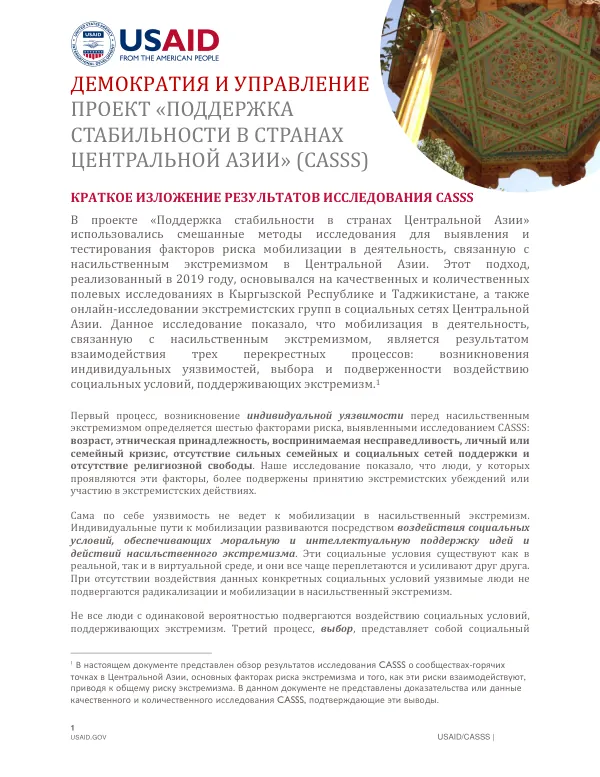
Краткое изложение результатов исследования CASSS: Поддержка стабильности в странах Центральной Азии
Sign inUSAID DEC
Краткое изложение результатов исследования CASSS: Поддержка стабильности в странах Центральной Азии
The research project "Supporting Stability in Central Asia" (CASSS) was conducted to identify and test factors that contribute to mobilization in violent extremism in Central Asia.
2021 · 16 pages
Sign in to readA free account is required to download.
Abstract
The project used a mixed-methods approach, combining qualitative and quantitative field research in Kyrgyzstan and Tajikistan, as well as online research on extremist groups in social media in Central Asia. The study found that mobilization in violent extremism is the result of the interaction of three cross-processes: the emergence of individual vulnerabilities, the choice, and the susceptibility to the influence of social conditions that support extremism. The first process, the emergence of individual vulnerabilities, is defined by six risk factors identified by the CASSS research: age, ethnic affiliation, perceived injustice, personal or family crisis, lack of strong family and social support networks, and lack of religious freedom. The study found that individuals who exhibit these factors are more likely to adopt extremist beliefs or participate in extremist activities. However, vulnerability alone does not lead to mobilization in violent extremism. Individual pathways to mobilization develop through the influence of social conditions that provide moral and intellectual support for extremist ideas and actions. These social conditions exist in both real and virtual environments and are increasingly intertwined and reinforcing each other. The third process, choice, represents the social process by which individuals with varying degrees of vulnerability are exposed to real and network (virtual) social conditions that support extremism. The CASSS research found that three factors increase the risk of an individual's choice and susceptibility to social conditions that support extremism: migration, social and family networks, and interests and preferences. The overall risk of extremism is the result of the interaction between vulnerability, choice, and susceptibility. Individual pathways in these processes are diverse and highly individualized, making them difficult to classify. However, a group of processes, including the destruction of family and social support, personal and family crises, community and family conflicts over religion, migration, contribute to individual life trajectories that increase the risk and push people towards radicalization and mobilization in violent extremism. The CASSS research identified six specific risk factors that increase individual susceptibility to involvement in violent extremism: personal or family crisis, lack of strong family and social support networks, lack of religious freedom, perceived injustice, ethnic affiliation, and age. The study found that individuals who exhibit these factors are more likely to adopt extremist beliefs or participate in extremist activities. The CASSS research also identified a group of processes that contribute to individual life trajectories that increase the risk of radicalization and mobilization in violent extremism. These processes include the destruction of family and social support, personal and family crises, community and family conflicts over religion, migration, and the influence of social conditions that provide moral and intellectual support for extremist ideas and actions. The CASSS project used a mixed-methods approach to identify and test factors that contribute to mobilization in violent extremism in Central Asia. The project included a qualitative component, the Individual Risk and Resilience Study (IRRS), which involved interviews with extremists in Kyrgyzstan and a control group with similar demographic and geographic characteristics from communities-at-risk in Kyrgyzstan. The quantitative component, the Community Potential Study on Risks and Resilience (CPSRR), was conducted in high-risk communities-at-risk in Kyrgyzstan and Tajikistan, as well as in a comparison group of similar communities with low levels of mobilization. The CASSS project also conducted three cycles of digital research and monitoring to determine the scope of the extremist ecosystem in the online environment in Central Asia. The project identified a group of communities-at-risk in Central Asia, including Kyrgyzstan, Kazakhstan, Tajikistan, and Uzbekistan, where there is a disproportionately high level of mobilization in violent extremism. The CASSS research found that the emergence of individual vulnerabilities is a key factor in the mobilization of individuals in violent extremism. The study identified six specific risk factors that increase individual susceptibility to involvement in violent extremism, including personal or family crisis, lack of strong family and social support networks, lack of religious freedom, perceived injustice, ethnic affiliation, and age. The CASSS research has important implications for the development of programs to reduce and prevent the risk of violent extremism. Understanding how these risks and processes emerge, interact, and affect individuals and communities is essential for the development of effective prevention and reduction strategies.
Related documents