USAID DEC
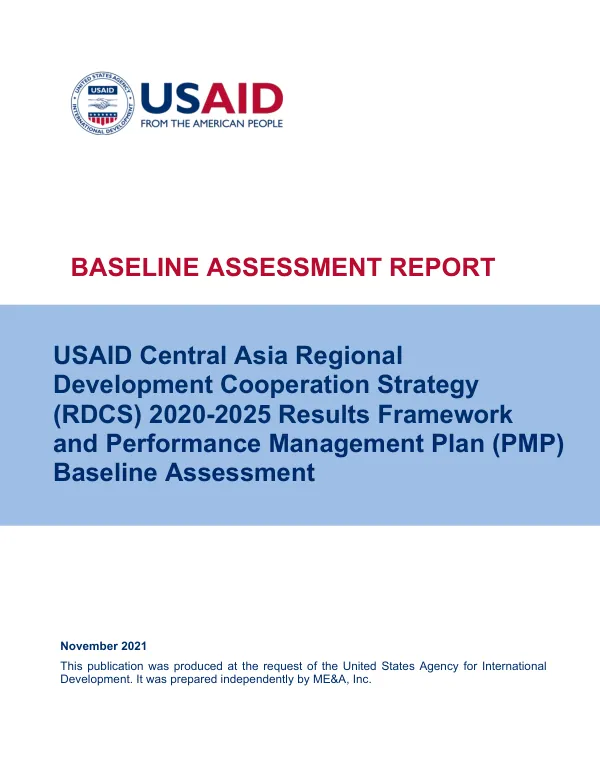
USAID Central Asia Regional Development Cooperation Strategy (RDCS) 2020-2025 Results Framework and Performance Management Plan (PMP) Baseline Assessment
Sign inME&A, INC.
USAID Central Asia Regional Development Cooperation Strategy (RDCS) 2020-2025 Results Framework and Performance Management Plan (PMP) Baseline Assessment
The Regional Development Cooperation Strategy (RDCS) 2020-2025 Results Framework and Performance Management Plan (PMP) Baseline Assessment was conducted to identify and develop measurements with baseline data for a limited number of context indicators applicable to the Intermediate Results (IRs) of the RDCS.
2021 · 172 pages
Sign in to readA free account is required to download.
Abstract
The assessment aimed to provide baseline data for the IRs and sub-IRs of the RDCS that the Regional Mission (RM) chose to measure performance in the PMP. The RDCS is a new approved strategy for the United States Agency for International Development Central Asia (USAID/CA) Regional Mission for the period 2020-2025. The strategy focuses on five IRs, which are: IR 1.1: Barriers to Trade Reduced, IR 1.2: Regional Energy Modernization Increased, IR 1.3: Transboundary Cooperation on Water and Environment Improved, IR 2.1: Central Asian Cooperation on Addressing Trafficking in Persons Strengthened, and IR 2.2: Ability of Central Asian Actors to Reduce Violent Extremism Risks Strengthened. The Baseline Assessment Team (BAT) consulted remotely with USAID's IR teams in June and July 2021 and then met remotely with USAID Implementing Partners (IPs) in each of the five IRs between July and October 2021. The team also reviewed written sources of data on Central Asia and countries of the region and held other remote meetings with key stakeholders in these technical areas focused on the changing context of the region, data quality and availability, and learning and recommendations for learning for the RM going forward. The assessment identified several context indicators and performance indicators for each of the five IRs. For example, under IR 1.1: Barriers to Trade Reduced, the context indicators include the cost incurred at a Border Crossing Point and the time taken to clear a Border Crossing Point. The performance indicators include sub-IR 1.1.1: Customs and border procedures harmonized, sub-IR 1.1.2: Public/private dialogue (PPD) on regional trade and investment increased, and sub-IR 1.1.3: Cross-border firm-to-firm connectivity increased. The assessment also identified several learning questions for future evaluations and assessments to support the RM's learning agenda. These questions include: What are the key factors that influence the adoption of customs and border procedures harmonization in Central Asia? How can the RM support the development of a regional electricity market in Central Asia? What are the main challenges to transboundary cooperation on water and environment in Central Asia, and how can the RM address these challenges? The Baseline Assessment Report provides a comprehensive overview of the RDCS 2020-2025 Results Framework and Performance Management Plan, including the context indicators, performance indicators, and learning questions for each of the five IRs. The report also provides recommendations to the RM for results framework and learning agenda validation in the future. The RDCS aims to reduce barriers to trade, increase regional energy modernization, improve transboundary cooperation on water and environment, strengthen Central Asian cooperation on addressing trafficking in persons, and strengthen the ability of Central Asian actors to reduce violent extremism risks. The assessment provides a baseline for measuring progress towards these goals and identifying areas for improvement. The RM can use the findings of the Baseline Assessment to inform its programming and policy decisions, and to track progress towards the goals of the RDCS. The assessment can also be used to identify areas where additional support is needed to achieve the goals of the RDCS.
Related documents